
Cell Phones and Cancer Risk
Cell phones first came into wide use in the United States in the 1990s. Since then, the number of cell phone users, both adults and children, has continued to grow. The amount of time people spend on their phones has also greatly increased.
Cell phone use has raised some health concerns, including questions about its impact on cancer risk. Knowing what the research says can help you understand more about the possible link between cell phones and cancer.
- Do cell phones cause cancer?
- What do expert agencies say?
- What do studies show?
- What kind of radiation do cell phones use?
- How are people exposed to radiation from cell phones?
- Are phones on 5G networks any different?
- What about cordless phones?
- What about Bluetooth devices, including earbuds?
- Where to find more information
Do cell phones cause cancer?
Cell phones give off a form of energy known as radiofrequency (RF) radiation. The amount can vary depending on the type of phone. Some energy from cell phones can be absorbed by the body. However, the frequency and energy levels of radiation from cell phones are low.
So far, there is no clear evidence that cell phone use increases brain tumor risk. Ongoing international studies continue to follow long-term cell phone users to monitor potential health effects.
Studying cell phones and cancer risk is difficult because cell phone technology is continually changing. Usage has also changed. For example, people don’t hold phones close to their ear as often as they did in the past. Children are also using phones at younger ages.
More research is needed to fully study the possible risks of cell phone exposure for people today.
What do expert agencies say?
In general, the American Cancer Society (ACS) does not determine whether something should be considered a carcinogen. Instead, ACS looks to other respected organizations for help with this. Based on animal and human evidence, several expert agencies have evaluated the cancer-causing potential of cell phones:
- The International Agency for Research on Cancer (IARC) classifies RF radiation as “possibly carcinogenic to humans,” based on limited evidence of a possible increase in risk for brain tumors among cell phone users, and inadequate evidence for other types of cancer. An IARC advisory group has suggested this topic as a high priority for reevaluation by 2029.
- The US National Toxicology Program (NTP) has not included RF radiation in its Report on Carcinogens, which lists exposures that are known to be or reasonably anticipated to be human carcinogens. Some NTP lab studies in rats suggested a link between cancer and high levels of RF radiation, but other animal studies did not show associations with tumors.
- The US Food and Drug Administration (FDA) states that current research doesn’t provide enough evidence to show that exposure to RF radiation directly causes tumor formation.
- The US Federal Communications Commission (FCC) states that current evidence does not show that using wireless devices causes cancer or other illnesses. Experts looking at potential risks agree that more and longer-term studies are needed to explore whether current safety standards for RF radiation exposure with wireless devices are adequate.
- The US Centers for Disease Control and Prevention (CDC) states they do not know for sure if RF radiation from cell phones can cause health problems later and they do not have the science to link health problems to cell phone use. Scientists continue to study the possible health effects of cell phone use.
To learn more about how cancer causes are studied and classified, see How Do We Know What Causes Cancer? and Known and Probable Human Carcinogens.
What do studies show?
Researchers use 2 main types of studies to try to determine if something might cause cancer:
- Lab studies are done using lab animals or cells in lab dishes.
- Studies in people compare groups to see if people with higher exposures are more likely to develop cancer.
Often, neither type of study provides enough evidence on its own to show if something causes cancer in people. Researchers usually look at both lab-based studies and studies in people.
Lab studies
RF waves from cell phones are a type of non-ionizing radiation. They don’t have enough energy to damage DNA directly or cause high heat to body tissues. Because of this, it’s not clear how cell phone use might cause cancer. Some studies have reported higher rates of certain types of cancers in lab animals exposed to RF radiation. However, the results of these studies have not been consistent.
Large studies that exposed lab animals’ whole bodies to high levels of RF radiation, like that from cell phones, for most of their lives found more rare heart tumors and possible increases in some brain and adrenal gland cancers in male rats, but not in female rats or in mice. Expert reviews of these studies note important limitations and say the results are not directly relevant to cancer risk from RF energy in humans.
Still, the results of these studies do not rule out the possibility that RF radiation from cell phones might somehow impact human health.
Studies in people
Several major studies have looked at whether cell phone use is linked to cancer, such as brain tumors, but results have been mixed. Some research suggests a possible link, while other studies find no increase in risk.
The INTERPHONE study
The 13-country INTERPHONE study was a large case-control study that compared cell phone use among more than 5,000 people who developed brain tumors (gliomas or meningiomas) and a similar group of people without tumors. Overall, the study found no link between brain tumor risk and the frequency of calls, longer call time, or cell phone use for 10 or more years.
There was a suggestion of a possible increased risk of glioma, and a smaller suggestion of an increased risk of meningioma, in the 10% of people who used their cell phones the most. But this finding was hard to interpret because some people in the study reported unrealistically high cell phone use. The researchers noted that the shortcomings of the study prevented them from drawing any firm conclusions, and that more research was needed.
Another part of the INTERPHONE study compared more than 1,000 people with acoustic neuromas to more than 2,000 people without tumors, who served as matched controls. As with gliomas and meningiomas, there was no overall link between cell phone use and acoustic neuromas.
The Million Women Study
This large prospective (forward-looking) study of nearly 800,000 women in the United Kingdom examined the risk of developing brain tumors over an average of about 14 years based on self-reported cell phone use. The study found no link between cell phone use and the risk of brain tumors overall or of several common brain tumor subtypes. But again, there are limits as to how well this study might apply to people using cell phones today. Most of the data was collected in the early 2000s, when people used cell phones differently than they do today. Daily screen time, streaming, and regular cell phone use were less common then.
The Danish cohort study
This large, long-term study compared people in Denmark who had cell phones (about 400,000 people) to those who did not over a 10-year period. Cell phone use, even for more than 13 years, was not linked with an increased risk of brain tumors, salivary gland tumors, or cancer overall, nor was there a link with any brain tumor subtypes or with tumors in any location within the brain.
However, this study also had some limits. First, it was based only on whether or not people had a cell phone plan at the time. It didn’t measure how often these people used their phones (if at all), or if people who didn’t have their own cell phone service used someone else’s phone. There are also limits to how well this study might apply to people using cell phones today. For example, while the cell phones used at the time of the study tended to give off higher levels of RF waves than modern cell phones do, people also may have used their phones quite a bit less than people use their phones today.
The Cohort Study on Mobile Phones and Health (COSMOS)
This was a large multi-national study of mobile phone use and health. In the study, more than 250,000 people reported how they remembered using their phones. Data from mobile carriers was also included. Researchers followed the users for a median of 7 years and examined rates of brain tumors, including gliomas, meningiomas, and acoustic neuromas.
The study found no increased risk of developing brain tumors in people who used their phones most often.
What kind of radiation do cell phones use?
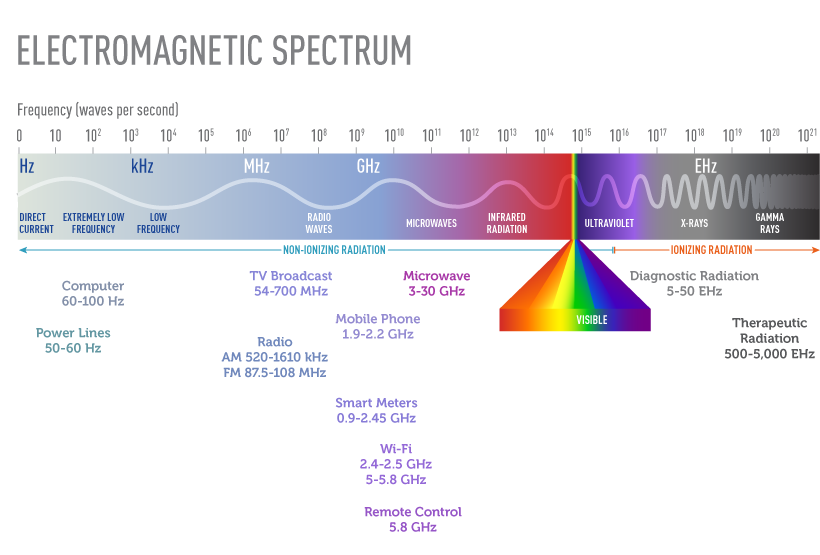
Cell phones use RF radiation to send signals to and from nearby cell towers (base stations). RF radiation is part of the electromagnetic spectrum. It falls between FM radio waves and microwaves.
Like FM radio waves, microwaves, visible light, and heat, RF waves are a form of non-ionizing radiation. They don’t have enough energy to damage the DNA inside cells directly. RF waves are different from stronger (ionizing) types of radiation such as x-rays, gamma rays, and ultraviolet (UV) rays. Ionizing radiation can break the chemical bonds in DNA, which might lead to cancer.
At very high levels, RF waves can heat body tissues. However, the energy levels from cell phones are much lower and are not strong enough to raise body temperatures.
How are people exposed to radiation from cell phones?
The RF waves come from the cell phone’s built-in antenna. The waves are strongest near the phone, and they lose energy quickly as they move away from the phone. When someone holds their phone against their head during a call, nearby tissue is exposed to RF waves. Less tissue is exposed when the phone is farther away from the body.
Many factors can affect the amount of energy from RF waves that a person is exposed to, including:
- The amount of time the person is on the phone.
- Whether the person is holding the phone close to their head or using the speaker mode or a hands-free device. The farther away from a person’s body the phone is, the less they are exposed.
- Distance and path to the nearest cell phone tower. Cell phones adjust their power to use the lowest level for a good signal. When the phone is farther away from a tower or being blocked inside a building, it requires more energy to get a good signal.
- The amount of cell phone traffic in the area at the time. A phone may require more energy to get a good signal if many people are using phones nearby.
- The model of phone used. Different phones give off different amounts of energy.
Cell phone specific absorption rate (SAR)
The specific absorption rate (SAR) is the amount of RF energy from the phone absorbed by a person’s body. Different cell phones have different SAR levels. Cell phone makers are required to report the maximum SAR level of their product to the FCC.
This information is often found on the manufacturer’s website or in the phone’s user manual. The upper limit of SAR allowed in the US according to FCC safety guidelines is 1.6 watts per kilogram (W/kg) of body weight.
However, comparing SAR values between phones can be misleading. The listed SAR value is based only on the phone operating at its highest power, not the levels people are exposed to with normal phone use.
The actual SAR during use varies, based on a number of factors such as signal strength and the way the phone is used. A phone with a lower listed SAR value might expose a person to more energy from RF radiation than one with a higher listed SAR value.
Are phones on 5G networks any different?
Fifth-generation (5G) cellular networks are now widely used in many parts of the US and in other countries. They can transmit larger amounts of data quicker than previous networks such as 3G and 4G.
For more on 5G networks, see Cell Phone Towers.
What about cordless phones?
Cordless phones used in homes connect to base units that are plugged into telephone lines and wired to a local telephone service. They are different from cell phones. Cordless phones operate at a lower RF power than cell phones, so RF exposure is lower.
What about Bluetooth devices, including earbuds?
Many wireless devices such as earbuds, tablets, laptops, car systems, and phones can connect via Bluetooth.
Bluetooth devices use RF radiation in a similar wavelength range as those used for cell phones. Because the signals only need to travel a short distance, such as from the phone to a person’s earbuds, they operate at much lower power levels than cell phones and have lower RF exposure.
Where to find more information
Centers for Disease Control and Prevention (CDC)
Frequently Asked Questions about Cell Phones and Your Health
Federal Communications Commission (FCC)
Wireless Devices and Health Concerns
Food and Drug Administration (FDA)
Cell Phones
National Cancer Institute (NCI)
Cell Phones and Cancer Risk
National Institute of Environmental Health Sciences (NIEHS)
Cell Phone Radio Frequency Radiation
- Written by
- References

The American Cancer Society medical and editorial content team
Our team is made up of doctors and oncology certified nurses with deep knowledge of cancer care as well as editors and translators with extensive experience in medical writing.
Centers for Disease Control and Prevention. Facts about cell phones and your health. 2024. Accessed at https://www.cdc.gov/radiation-health/data-research/facts-stats/cell-phones.html on March 11, 2026.
Centers for Disease Control and Prevention. Facts about wearable technology. Accessed at https://www.cdc.gov/radiation-health/data-research/facts-stats/wearable-technology.html on March 11, 2026.
Centers for Disease Control and Prevention. NHIS early release: Wireless phone use. 2025. Accessed at https://www.cdc.gov/nchs/nhis/early-release/wireless-substitution.html on March 11, 2026.
Cohort Study of Mobile Phone Use and Health (COSMOS). About the study. Accessed at https://thecosmosproject.org/about-the-study/ on March 11, 2026.
Deltour I, Guida F, Ribet C, Zins M, Goldberg M, Schüz J. Use of Mobile Phones and Radiofrequency-Emitting Devices in the COSMOS-France Cohort. Int J Environ Res Public Health. 2024;21(11):1514. Published 2024 Nov 14.
Food and Drug Administration. Cell Phones. Accessed at https://www.fda.gov/radiation-emitting-products/home-business-and-entertainment-products/cell-phones on March 11, 2026.
Food and Drug Administration. Review of Published Literature between 2008 and 2018 of Relevance to Radiofrequency Radiation and Cancer. 2020. Accessed at https://www.fda.gov/media/135043/download on March 11, 2026.
National Cancer Institute. Electromagnetic fields and cancer. Accessed at https://www.cancer.gov/about-cancer/causes-prevention/risk/radiation/electromagnetic-fields-fact-sheet on March 9, 2026.
National Institute of Environmental Health Sciences. Cell phone radio frequency radiation. 2025. Accessed at https://www.niehs.nih.gov/health/topics/agents/cellphones on March 11, 2026.
National Toxicology Program. Cell phone radiation: GSM (CELLPRADGSM). Chemical Effects in Biological Systems (CEBS). Research Triangle Park, NC (USA): National Toxicology Program (NTP). Accessed at https://cebs.niehs.nih.gov/cebs/test_article/CELLPRADGSM on March 5, 2026
Schuz J, Pirie K, Reeves GK, Floud S, Beral V; Million Women Study Collaborators. Cellular telephone use and the risk of brain tumors: Update of the UK Million Women Study. J Natl Cancer Inst. 2022 Mar 29: djac042.
Zhang L, Muscat JE. Trends in malignant and benign brain tumor incidence and mobile phone use in the U.S. (2000-2021): A SEER-based study. Int J Environ Res Public Health. 2025;22(6):933. Published 2025 Jun 13.
Last Revised: June 26, 2026
American Cancer Society medical information is copyrighted material. For reprint requests, please see our Content Usage Policy.
American Cancer Society Emails
Sign up to stay up-to-date with news, valuable information, and ways to get involved with the American Cancer Society.