Your gift is 100% tax deductible.
Lymph Node Surgery for Breast Cancer
If you’ve been diagnosed with breast cancer, it’s important to find out if the cancer has spread outside your breast. To do this, one or more lymph nodes under your arm will most likely be removed and checked in the lab. If cancer is found in one or more lymph nodes, additional nodes will need to be removed.
Lymph nodes can be removed in a few different ways, depending on whether any lymph nodes are enlarged, how big the breast tumor is, and other factors.
Why is lymph node surgery important?
If breast cancer spreads, it usually goes first to nearby lymph nodes under the arm (axillary lymph nodes). It can also sometimes spread to lymph nodes near the collarbone or near the breastbone (the front center of the chest).
Knowing if your cancer has spread to your lymph nodes helps doctors find the best way to treat it. This is an important part of staging.
If your lymph nodes have cancer cells, there is a higher chance the cancer cells have also spread to other parts of your body. You might need more imaging tests to find out if and where the cancer has spread.
Biopsy of an enlarged lymph node
If any lymph nodes under your arm or around your collarbone are swollen, they may first be checked for cancer with a needle biopsy. Less often, the enlarged node is removed with surgery.
Lymph node biopsy is done using either a fine needle aspiration (FNA) or a core needle biopsy. If cancer is found in any of these lymph nodes, more nodes will need to be removed with surgery.
Types of lymph node surgery
Even if nearby lymph nodes are not enlarged, they will still need to be checked for cancer. This is done during surgery.
There are 2 types of lymph node surgery:
- Sentinel lymph node biopsy is used most often. Only a few lymph nodes are removed.
- Axillary lymph node dissection is used in some cases, if needed. More lymph nodes are removed during this procedure.
Lymph node surgery is often done as part of the main surgery to remove the breast cancer, but sometimes it is done as a separate operation.
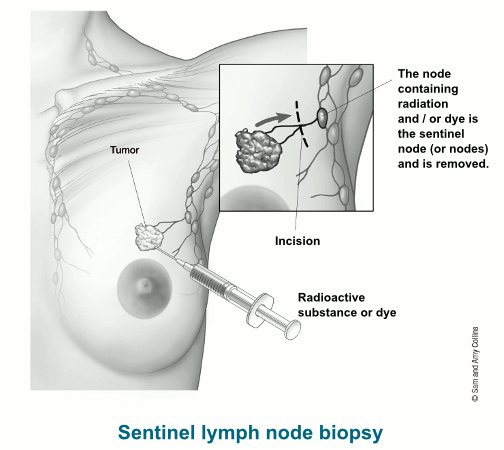
In this procedure, the surgeon finds and removes the sentinel nodes. These are the lymph node(s) where cancer is likely to spread first.
To find the sentinel nodes, the surgeon injects a substance into the tumor, the area around it, or the area around the nipple. The substance is either:
- A radioactive substance
- A blue dye
- A liquid containing iron oxide particles
These substances are not harmful and will not hurt your body. Your lymph vessels carry them along the same path the cancer cells would likely travel. The first lymph node(s) they reach are called the sentinel node(s).
The surgeon finds the sentinel node(s) with a special machine that detects radioactivity or iron oxide particles in the nodes. The surgeon might also look for nodes that have turned blue or brown. Sometimes, both methods are used.
The surgeon cuts the skin over the lymph node area and removes the affected nodes. These nodes are checked closely in the lab for cancer cells.
The lymph nodes are sometimes checked for cancer while you are in surgery. But most of the time, they are examined later and the results are available 1-2 weeks after surgery.
What happens after the biopsy?
If cancer is found during surgery: If cancer is found in the sentinel lymph node(s), there is a chance other lymph nodes in the same area will also have cancer. The surgeon may go ahead with an axillary lymph node dissection (ALND) to remove more lymph nodes while you are still on the operating table.
If cancer is not found during surgery: If no cancer cells are seen in the node(s) at the time of the surgery, or if they are not checked by a pathologist at the time of the surgery, they will be examined more closely over the next several days.
If there is no cancer in the sentinel node(s): It is very unlikely that the cancer has spread to other lymph nodes, so no further lymph node surgery is needed.
If cancer is found in the sentinel node(s) later: The surgeon may recommend an axillary dissection (ALND) later to check more nodes for cancer. However, studies have shown that in some cases it may be safe to leave the rest of the lymph nodes behind. This is based on the size of the breast tumor, what type of surgery is used to remove the tumor, what treatment is planned after surgery, and other factors.
Based on the studies that have looked at this, skipping ALND may be an option for:
- Women with breast tumors 5 cm (about 2 inches) across or smaller who have no more than 2 positive sentinel lymph nodes, are having breast-conserving surgery followed by radiation, and did not get any chemotherapy before surgery.
- Women who have lymph nodes with a very small amount of cancer (no more than 2 mm).
When is sentinel lymph node biopsy used?
SLNB is often considered for women with early-stage breast cancer. It is typically not used for women with inflammatory breast cancer. It might be used for women with locally advanced breast cancer in certain instances, such as after neoadjuvant treatment (treatment given before surgery).
SLNB has become a common procedure, but it requires a great deal of skill. It should only be done by a surgeon with experience in this technique. If you are offered this type of biopsy, ask your surgeon if they do them regularly.
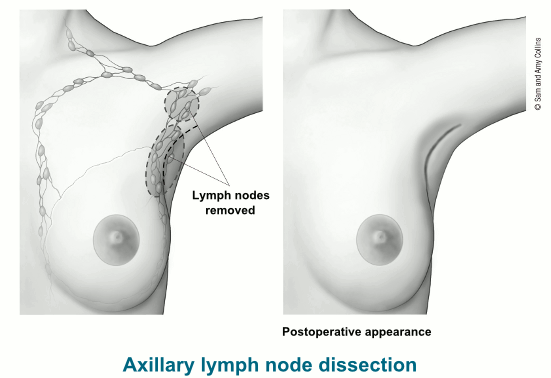
In this procedure, lymph nodes are removed from the area under the arm (axilla) and checked for cancer spread. Anywhere from about 10 to 40 lymph nodes can be removed, though it’s usually less than 20.
ALND is usually done at the same time as a mastectomy or breast-conserving surgery (BCS), but it can be done in a second operation.
When is axillary lymph node dissection used?
ALND may be needed if:
- A previous sentinel lymph node biopsy (SLNB) shows 3 or more of the underarm lymph nodes have cancer cells.
- Swollen underarm or collarbone lymph nodes can be felt before surgery or seen on imaging tests, and a needle biopsy shows cancer.
- The cancer has grown large enough to extend outside the lymph node(s).
- Chemotherapy was given to shrink the tumor before surgery, and an SLNB is positive for cancer cells after the chemo is finished.
Does everyone with breast cancer need lymph node surgery?
Some people with early-stage breast cancer may not need lymph node surgery.
This was studied in 2 large clinical trials, called SOUND and INSEMA. These trials showed that lymph node surgery could be avoided in certain situations.
Not having lymph node surgery may be an option if all of these are true:
- The tumor is small (about 2 cm or less).
- Ultrasound or other imaging tests show no signs of cancer in your lymph nodes.
- The cancer is hormone receptor-positive and HER2-negative.
- You plan to have breast-conserving surgery (lumpectomy) and radiation to the whole breast.
- You plan to take hormone therapy after surgery.
However, many people who are diagnosed with early-stage breast cancer will need to have lymph node surgery. You and your cancer care team will decide together on the best plan for you.
Side effects of lymph node surgery
Some side effects are common after lymph node surgery, especially in the early recovery period. These can include:
- Pain or soreness
- Increased sensitivity (paresthesia)
- Swelling
- Bleeding
- Blood clots
- Infection
- Lymphedema
- Arm and shoulder movement problems
- Numbness of the skin
Lymphedema (long-term swelling)
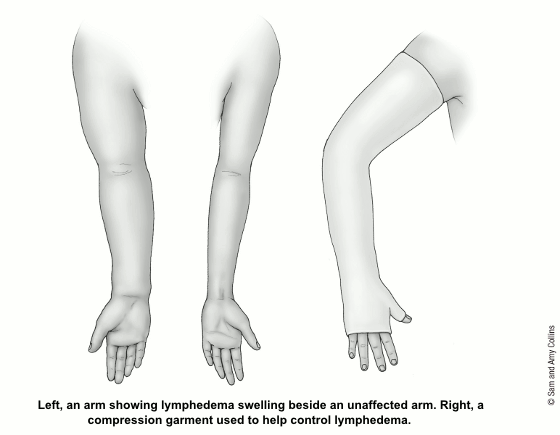
Swelling in the arm or chest (lymphedema) is one possible long-term side effect of lymph node surgery. It happens when lymph nodes are removed and fluid cannot drain normally, causing it to build up. This swelling may be temporary, but in some cases it can last a long time.
- Lymphedema is less common after sentinel lymph node biopsy. The risk is about 5% to 17%.
- It is more common after axillary lymph node dissection. The risk is about 20% to 30%.
- Your risk may be higher if you’ve had radiation or if you have a higher body mass index (BMI).
If you notice swelling, tightness, or pain in your arm, tell your healthcare team right away.
Arm and shoulder movement problems
You might also have limited movement in your arm and shoulder after lymph node surgery. This is more common after axillary lymph node dissection.
Frozen shoulder
Your healthcare team might give you exercises to help keep you from having a long-lasting movement problem called frozen shoulder.
Lymphatic cording
Some people notice a rope-like structure that begins under the arm and can extend down toward the elbow. It can cause pain and limit movement of the arm and shoulder.
This is sometimes called axillary web syndrome or lymphatic cording. It is more common after axillary lymph node dissection.
Symptoms might not appear for weeks or even months after surgery. It often goes away without treatment, although some people find physical therapy helpful.
Numbness
Numbness of the skin on the upper part of the inner arm is a common side effect of lymph node surgery. This is because the nerve that controls sensation (feeling) in this part of the body passes through the lymph node area.
- Written by
- References

Developed by the American Cancer Society medical and editorial content team with medical review and contribution by the American Society of Clinical Oncology (ASCO).
Henry NL, Shah PD, Haider I, Freer PE, Jagsi R, Sabel MS. Chapter 88: Cancer of the Breast. In: Niederhuber JE, Armitage JO, Doroshow JH, Kastan MB, Tepper JE, eds. Abeloff’s Clinical Oncology. 7th ed. Philadelphia, PA: Elsevier; 2024.
Jagsi R, King TA, Lehman C, Morrow M, Harris JR, Burstein HJ. Chapter 79: Malignant Tumors of the Breast. In: DeVita VT Jr, Lawrence TS, Rosenberg SA, eds. DeVita, Hellman, and Rosenberg’s Cancer: Principles and Practice of Oncology. 12th ed. Philadelphia, PA: Wolters Kluwer; 2023
National Comprehensive Cancer Network (NCCN). Practice Guidelines in Oncology: Breast Cancer. Version 2.2026. Accessed at https://www.nccn.org/professionals/physician_gls/pdf/breast.pdf March 9, 2026.
Wu T, Long Q, Zeng L, Zhu J, Gao H, Deng Y, Han Y, Qu L, Yi W. Axillary lymph node metastasis in breast cancer: from historical axillary surgery to updated advances in the preoperative diagnosis and axillary management. BMC Surg. 2025 Feb 27;25(1):81.
Last Revised: July 1, 2026
American Cancer Society medical information is copyrighted material. For reprint requests, please see our Content Usage Policy.
American Cancer Society Emails
Sign up to stay up-to-date with news, valuable information, and ways to get involved with the American Cancer Society.