Your gift is 100% tax deductible.
Melanoma Skin Cancer
Melanoma is less common than some other types of skin cancer, but it is more likely to grow and spread. If you have melanoma or are close to someone who does, knowing what to expect can help you cope. Here you can find out all about melanoma, including risk factors, symptoms, how it is found, and how it is treated.
About melanoma skin cancer
Melanoma skin cancer develops when melanocytes, the cells that give skin its tan or brown color, start to grow out of control in the skin. Most melanomas start in the skin. Another name for these cancers is cutaneous melanoma. Melanocytes are also in the eyes and other areas of the body.
Melanoma is much less common than some other types of skin cancer. But melanoma is more dangerous because it’s much more likely to spread to other parts of the body if not found and treated early.
Melanomas can start anywhere on the skin, but in people with lighter skin tones, they are more likely to start on:
- The trunk (chest and back), especially in men
- The arms or legs, especially in women
- The neck and face
People with darker skin tones have a lower risk of melanoma at these sites.
Where do skin cancers start?
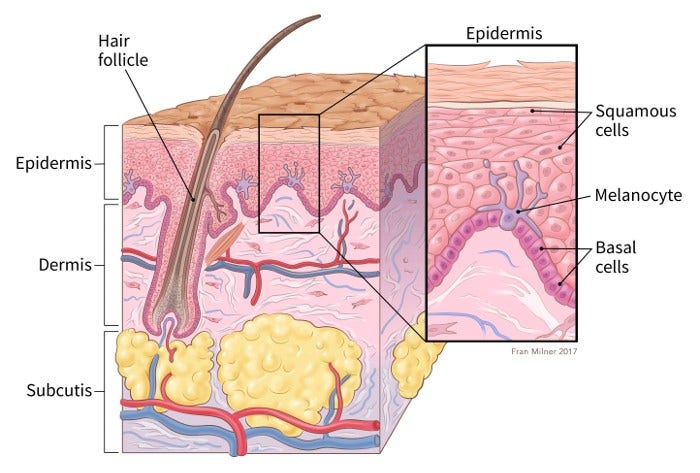
Most skin cancers start in the top layer of skin, called the epidermis. There are 3 main types of cells in this layer.
Squamous cells: These are flat cells in the upper (outer) part of the epidermis, which are constantly shed as new ones form.
Basal cells: These cells are in the lower part of the epidermis, called the basal cell layer. These cells constantly divide to form new cells to replace the squamous cells that wear off the skin’s surface. As these cells move up in the epidermis, they get flatter and eventually become squamous cells.
Melanocytes: These are the cells that can become melanoma cells. They normally make a brown pigment called melanin, which gives the skin its tan or brown color. Melanin protects the deeper layers of the skin from some of the harmful effects of the sun.
The epidermis is separated from the deeper layers of skin by the basement membrane. When a skin cancer becomes more advanced, it grows through this barrier and into the deeper layers.
Types of melanoma skin cancers
There are different types of skin melanoma.
This is the most common type, making up about 7 in 10 skin melanomas. These tumors tend to grow outward along the surface of the skin, at least at first, so they might be noticed as a dark spot on the skin that is changing shape or getting bigger. Some of these melanomas start in existing moles, but others do not.
This type accounts for about 2 in 10 skin melanomas. These tumors often appear as a distinct, raised bump (nodule) on the skin that is often dark brown or black, but it can also be pink or red. This can make them hard to find early. Nodular melanomas tend to grow down into deeper layers of the skin fairly early, so they’re often at a more advanced stage than superficial spreading melanomas by the time they are found.
This type of melanoma tends to occur in older people in areas of skin that get a lot of sun, such as the face or arms. It often first appears as a tan or brown spot. It tends to grow slowly over time, and parts of it might become darker or raised.
This type of melanoma starts in areas that don’t get a lot of sun exposure, such as the palms of the hands, soles of the feet, or under the nails. Acral melanomas make up a large portion of melanomas in people with darker skin tones.
Melanomas in other parts of the body
Melanomas can also form in other parts of the body:
- Ocular melanomas occur inside the eye. Most of these start in the uvea (the middle layer of the eyeball) and are known as uveal melanomas.
- Mucosal melanomas start inside the nose, mouth, throat, or the genital or anal area.
These are much less common than melanoma of the skin.
Other types of skin cancer
There are many other types of skin cancer. Skin cancers that are not melanomas are sometimes grouped as non-melanoma skin cancers because they develop from skin cells other than melanocytes. They tend to behave differently from melanomas and are often treated differently.
Basal cell and squamous cell skin cancers
Basal cell cancer (BCC) and squamous cell cancer (SCC) are by far the most common types of skin cancer. In fact, they are more common than any other form of cancer in the United States. These cancers, especially BCCs, are much less likely to spread (metastasize) to other parts of the body than melanomas.
Less common skin cancers
Other types of non-melanoma skin cancer are much less common than basal and squamous cell cancers and are treated differently. They include:
- Merkel cell carcinoma
- Kaposi sarcoma
- Cutaneous (skin) lymphoma
- Skin adnexal tumors (tumors that start in hair follicles or skin glands)
- Various types of sarcomas
Together, these types account for less than 1% of all skin cancers.
Benign skin tumors
Many types of benign (noncancerous) tumors can develop from different types of skin cells.
Benign tumors that start in melanocytes
A mole (nevus) is a benign skin tumor that develops from melanocytes. Almost everyone has some moles. Nearly all moles (nevi) are harmless, but having some types can raise your risk of melanoma. Learn more in Melanoma Skin Cancer Causes, Risk Factors, and Prevention.
A Spitz nevus is a kind of mole that sometimes looks like melanoma. It’s more common in children and teens, but it can also be seen in adults. These tumors are typically benign and don’t spread. But sometimes doctors have trouble telling Spitz nevi from true melanomas, even when looking at them under a microscope. They are often removed if there’s any question, just to be safe.
Benign tumors that develop from other types of skin cells
Most skin tumors are benign and rarely turn into cancers. There are many kinds of benign skin tumors, including:
- Seborrheic keratoses: Tan, brown, or black raised spots with a waxy texture or sometimes a slightly rough and crumbly surface when they are on the legs (also known as stucco keratosis)
- Hemangiomas: Benign blood vessel growths, often called strawberry spots
- Lipomas: Soft tumors made up of fat cells
- Warts: Rough-surfaced growths caused by some types of human papillomavirus (HPV)
Quick guides
Tools and resources
News and Stories
- Written by
- References

Developed by the American Cancer Society medical and editorial content team with medical review and contribution by the American Society of Clinical Oncology (ASCO).
Barnhill RL, Kim J. Spitz nevus, atypical Spitz tumor (Spitz melanocytoma), and Spitz melanoma. UpToDate. 2026. Accessed at https://www.uptodate.com/contents/spitz-nevus-atypical-spitz-tumor-spitz-melanocytoma-and-spitz-melanoma on April 29, 2026.
Curiel-Lewandrowski C. Melanoma: Epidemiology and risk factors. UpToDate. 2026. Accessed at https://www.uptodate.com/contents/melanoma-epidemiology-and-risk-factors on April 29, 2026.
Mitchell TC, Karakousis G, Schuchter L. Chapter 66: Melanoma. In: Niederhuber JE, Armitage JO, Doroshow JH, Kastan MB, Tepper JE, eds. Abeloff’s Clinical Oncology. 6th ed. Philadelphia, Pa: Elsevier; 2020.
National Cancer Institute. Melanoma Treatment (PDQ®)–Patient Version. 2025. Accessed at https://www.cancer.gov/types/skin/patient/melanoma-treatment-pdq on April 29, 2026.
Swetter S, Geller AC. Melanoma: Clinical features and diagnosis. UpToDate. 2026. Accessed at https://www.uptodate.com/contents/melanoma-clinical-features-and-diagnosis on April 29, 2026.
Last Revised: August 12, 2026
American Cancer Society medical information is copyrighted material. For reprint requests, please see our Content Usage Policy.