How a Clinical Trial and Hope Lodge Helped Duane During His Cancer Journey
Lung cancer is the second most common cancer in both men and women in the United States. While many people associate a lung cancer diagnosis with smoking, about 20% of lung cancers are diagnosed in people who don’t smoke.
Duane Steiner of Tampa, Florida, is one of those people who never smoked. In 2019, at the age of 50, Duane was diagnosed with ALK-positive lung cancer, a type of non-small cell lung cancer (NSCLC) caused by a gene change or mutation. NSCLCs caused by the ALK gene mutation are more likely to occur in people who have no history of smoking. About 5% of NSCLCs are ALK-positive.
Duane’s diagnosis came shortly after he experienced two fainting spells in the middle of the night. He went to an emergency room, and after several hours and many tests, he received “the scary diagnosis of a very bad cancer,” he said.
“It was very scary to think about having only weeks or months to live,” he said.
Molecular or genomic testing was done on the tumor to identify any known gene mutations that might be driving the cancer’s growth. Because certain treatments can target specific proteins from gene mutations, knowing a mutation is present helps doctors better match patients with the most effective treatment. This type of testing is what determined Duane’s cancer was ALK-positive. At the time, molecular testing was fairly new, and the results took six weeks to come back. In the meantime, because of the severity of his symptoms, Duane began treatment with an oral targeted therapy at the Moffitt Cancer Center near his home.
Finding hope
Armed with the knowledge that his cancer tested positive for the ALK gene mutation, Duane learned that a new treatment that targets this specific mutation was available through a clinical trial that might be an effective option for him. He began looking for a cancer center that offered the trial, which led him to Johns Hopkins Medicine in Baltimore, Maryland.
A home away from home
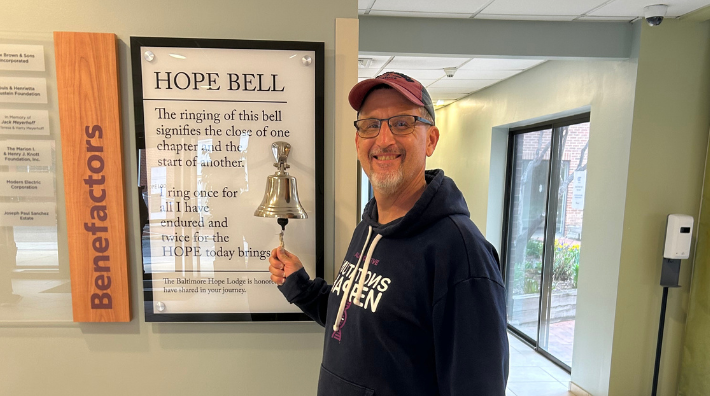
Duane was accepted into the clinical trial at Johns Hopkins Medicine. Since the treatment being studied in the trial is designed to be given along with standard treatment, Duane continued his initial treatment while on the clinical trial. Over the course of his care and treatment, Duane stayed at the American Cancer Society Hope Lodge in Baltimore eight times. At the beginning of the trial, frequent visits required him to stay at the Hope Lodge for four straight weeks.
The free lodging, meals, and support Duane received as a guest at Hope Lodge Baltimore made it possible for him to take part in the clinical trial. Duane was also able to work remotely at the Hope Lodge during his stays. He also used the free shuttle to travel to and from his appointments.
“Without Hope Lodge, participating in this clinical trial would have been financially toxic. I would have been sinking money for accommodations that would have strained the budget,” he said.
Duane also appreciated the camaraderie of the fellow Hope Lodge guests.
“I would have gone stir-crazy by myself in a hotel,” he said. “Knowing that I can talk to people at Hope Lodge who are going through their own cancer journey is reassuring.”
A strong advocate
Duane has now been living with ALK-positive lung cancer for over six years, a rare feat for someone with stage IV metastatic lung cancer. While he knows his cancer is not curable, Duane credits cancer research and innovative treatments for his survival and improved quality of life.
Though Duane is uncertain what the future will bring, he remains hopeful.
“It is hard for me to remember what life was like before my diagnosis,” said Duane, who returns to Baltimore periodically to be monitored for the trial. “I devote quite a bit of time connecting with my peers and delving into research from scientists and doctors.”
In addition to keeping up with the latest advances, Duane is also an advocate for cancer research. His cancer journey has helped him understand how critical research funding is to the discovery of new and better treatments. During one of his Hope Lodge stays, he traveled to Capitol Hill in Washington, D.C., just an hour away from Baltimore, to rally in support of cancer research.
“I am helping my peers and all cancer patients by advancing research through this trial,” he said. “Without patients volunteering for clinical trials, novel and potentially lifesaving treatments simply wouldn’t exist.”
- Reviewed by

Reviewed by the American Cancer Society communications team.