American Cancer Society Awards $38.5 Million in New Cancer Research Grants
ACS is funding 92 new research grants across the cancer research continuum.
- Infographic
- Text Alternative
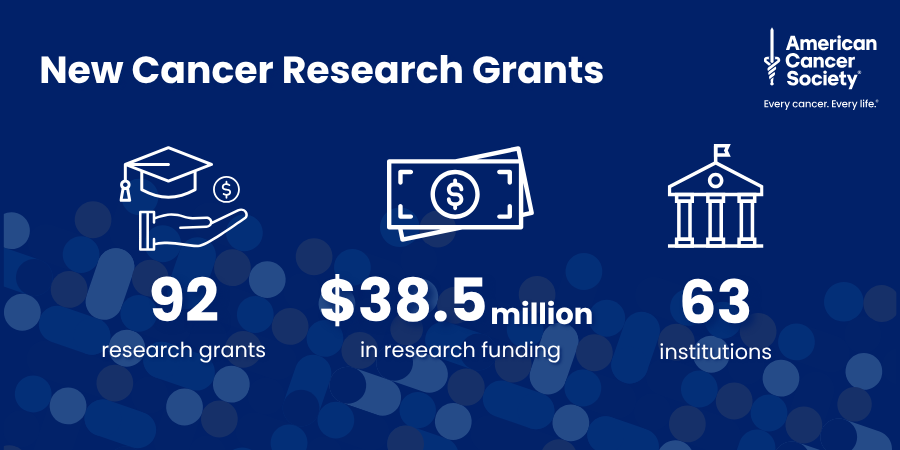
New Cancer Research Grants
- 92 research grants
- $38.5 million in research funding
- 63 Institutions
American Cancer Society
The American Cancer Society (ACS) is pleased to announce a new investment of $38.5 million in cancer research through 92 new grant awards that will begin funding later this year. Selected through the Winter 2025 grant cycle, these grants support researchers tackling some of the most pressing challenges in cancer prevention, detection, treatment, survivorship, and access to care.
A full list of the newly funded grants can be found here.
"At a time of unprecented demand for research funding, the American Cancer Society remains committed to investing in the bold ideas and exceptional scientists that move the field forward," said William Dahut, PhD, Chief Scientific Officer of the American Cancer Society. "These awards reflect our belief that meaningful progress against cancer requires advances across the entire continuum of research, from understanding the biology of cancer to improving prevention, treatment, survivorship, and equitable access to care. We are grateful to our volunteer expert reviewers and supporters who make this work possible, and we are optimistic about the impact these investments will have in the years ahead."
Meeting a Growing Need
The research community's demand for funding continued to rise during the Winter grant cycle, following a substantial increase in applications earlier in the year. Across the two grant cycles in 2025, ACS received 85% more applications than it did during the year prior, reflecting growing uncertainty around the availability of traditional research funding sources.
As always, ACS funding decisions were guided by expert scientific peer review. During the Winter 2025 cycle, 817 volunteer reviewers serving on 22 peer review committees evaluated applications and helped identify the most innovative and impactful projects for support.
We are deeply grateful to these reviewers, as well as our donors and partners, whose commitment makes it possible for ACS to continue investing in lifesaving cancer research.
Supporting Progress Across the Cancer Continuum
The grants awarded through this cycle reflect the breadth of today's cancer research landscape. From fundamental studies that deepen our understanding of cancer biology to projects designed to improve survivorship outcomes and reduce disparities in care, the newly funded research spans the full cancer continuum.
ACS also remains committed to supporting scientists throughout their careers. More than one-third of the funding announced today supports early-career investigators through Postdoctoral Fellowships and Clinician Scientist Development Grants, helping promising researchers gain the experience, mentorship, and resources needed to become future leaders in cancer research.
In addition to these career development awards, this funding slate also includes awards made through a diverse portfolio of grant mechanisms, including ACS Professorships, Research Scholar Grants, Discovery Boost Grants, Mission Boost Grants, and Cancer Health Research Centers.
- Infographic
- Text Alternative
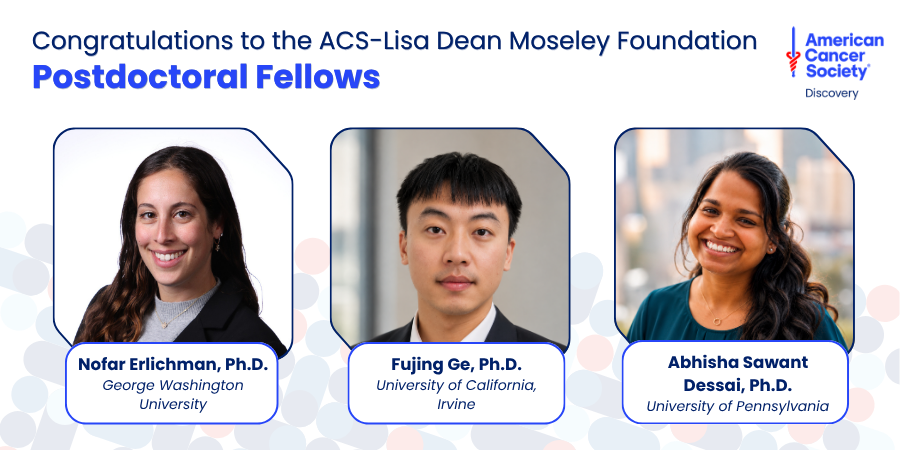
Congratulations to the ACS-Lisa Dean Moseley Foundation
Postdoctoral Fellows
- Nofar Erlichman, Ph.D.
George Washington University
- Fujin Ge, Ph.D.
University of California, Irvine
- Abhisha Sawant Dessai, Ph.D.
University of Pennsylvania
American Cancer Society
Accelerating Impact Throught Partnership
Progress against cancer is a shared effort, and partnerships help us amplify our impact by investing in outstanding researchers and innovative ideas that move the field forward.
Among the awards announced today are the first three fellows supported through the newly established ACS-Lisa Dean Moseley Foundation Postdoctoral Fellows Fund, and innovative collaboration designed to support the next generation of cancer researchers through funding, mentorship, professional development, and access to a national network of scientific leaders.
Nofar Erlichman, Ph.D.
George Washington University
ACS-Lisa Dean Moseley Foundation Postdoctoral Fellowship
“Adipocyte PD-L1 mediates the promotion of mammary tumor growth by the sympathetic nervous system”
This project will investigate how fat cells in the breast contribute to the growth of triple-negative breast cancer (TNBC), an aggressive form of breast cancer with limited treatment options. Building on Dr. Erlichman’s previous work showing that a protein called PD-L1 produced by fat cells can promote tumor growth, she will examine how fat cells, nerve signals, and cancer cells communicate to drive cancer progression. This work could uncover new treatment targets and improve the effectiveness of immunotherapy for patients with TNBC.
Fujing Ge, Ph.D.
University of California, Irvine
ACS-Lisa Dean Moseley Foundation Postdoctoral Fellowship
“YTHDF2 Controls T9 Cell Identity and Its Targeting Enhances EGFR-CAR Activity in Glioblastoma”
This project will investigate a new immunotherapy approach for glioblastoma (GBM), an aggressive brain cancer with few effective treatment options. Building on Dr. Ge’s preliminary work showing that disabling a protein called YTHDF2 enhances the cancer-fighting activity of specialized immune cells, he will develop and optimize a therapy that combines engineered T cells and natural killer cells to attack GBM. Early studies suggest this approach can strengthen anti-tumor immune responses and extend survival in preclinical models. This work could lead to a more effective immunotherapy strategy for patients with glioblastoma.
Abhisha Sawant Dessai, Ph.D.
University of Pennsylvania
ACS-Lisa Dean Moseley Foundation Postdoctoral Fellowship
“Epigenetic Reprogramming During Mitotic Exit Drives Tumor Heterogeneity in Liver Cancer”
This project will investigate how liver cancer cells develop the diverse traits that help tumors grow, spread, and resist treatment. Dr. Sawant Dessai’s preliminary work suggested that a metabolic enzyme called ACLY may help cancer cells rapidly restart cancer-promoting gene programs after cell division. In this project, she will examine how this process contributes to tumor growth and cellular diversity in liver cancer. She will also test whether blocking ACLY can limit these harmful cell states and improve treatment responses. This work could reveal a new strategy for slowing liver cancer progression and preventing metastasis.
- Infographic
- Text Alternative
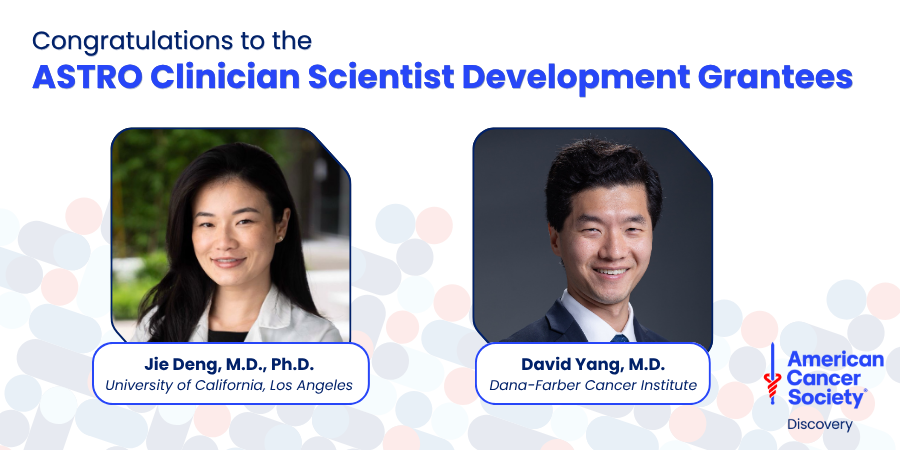
Congratulations to the
ASTRO Clinician Scientist Development Grantees
- Jie Deng, M.D., Ph.D.
University of California, Los Angeles
- David Yang, M.D.
Dana-Farber Cancer Institute
American Cancer Society Discovery
This grant slate also includes two ASTRO Clinician Scientist Development Grants, supported through ACS's longstanding partnership with the American Society for Radiation Oncology (ASTRO) and Speed of Light-The ASTRO Foundation. These awards help clinician-scientists in radiation oncology build successful research careers while advancing new approaches to cancer treatment.
Jie Deng, M.D., Ph.D.
University of California, Los Angeles
Felix Feng ASTRO-Clinician Scientist Development Grant
“Activating Lymph Node Immunity to Enhance Radiation Therapy”
This project will investigate how radiation therapy and immunotherapy can work together more effectively to treat non-small cell lung cancer. Building on Dr. Deng’s previous work showing that activating specific immune pathways can enhance communication between tumors and nearby lymph nodes, she will study how this process helps generate cancer-fighting T cells after radiation treatment. They will examine how immune cells carry information from the tumor to the lymph node and identify ways to strengthen this response. This work could lead to new combination therapies that improve the effectiveness of radiation treatment and help more patients achieve lasting responses.
David Yang, M.D.
Dana-Farber Cancer Institute
ASTRO Clinician Scientist Development Grant
“ASTRO: Advancing Biomarker Discovery in Prostate Cancer Through Computer Vision-Driven Profiling of Tumor and Microenvironmental Heterogeneity”
This project will investigate how artificial intelligence (AI) can improve the ability to distinguish aggressive prostate cancers from those that are unlikely to cause harm. Building on advances in AI and medical imaging, Dr. Yang will analyze thousands of pathology slides, MRI scans, and PSMA-PET images to identify patterns linked to patient outcomes that may not be visible to the human eye. He will also develop models that combine information from multiple imaging technologies to better predict disease progression. This work could lead to more personalized treatment decisions, reducing unnecessary side effects while improving outcomes for patients with prostate cancer.
Together, these partnerships reflect a shared commitment to supporting outstanding researchers and accelerating discoveries that will improve the lives of people affected by cancer.
Looking Ahead
The American Cancer Society is the largest non-governmental, nonprofit funder of cancer research in the United States. The researchers receiving funding through this grant cycle join a legacy of ACS-supported scientists whose work has transformed cancer prevention, detection, treatment, and surivorship for decades.
Over the coming days, we will share additional stories highlighting the researchers and projects funded through this award slate.
View the complete list of Winter 2025 grant recipients here.
Learn more about our current grant funding opportunities at any time on cancer.org. Please note that our next grant application window opens on September 1, 2026, and will remain open until December 1, 2026.
American Cancer Society news stories are copyrighted material and are not intended to be used as press releases. For reprint requests, please see our Content Usage Policy.