Your gift is 100% tax deductible.
Lymphoma in Children
If your child has lymphoma, knowing what to expect can help you cope. Here you can learn all about lymphoma in children, including the different types of lymphoma, the risk factors and symptoms, and how it is found and treated.
About lymphoma in children
Lymphoma is a type of cancer that starts in cells called lymphocytes, which are part of the body’s immune system. Unlike leukemias, lymphomas occur when cancer cells grow and multiply mostly outside of the bone marrow in the lymphatic system.
There are many different types of lymphoma. These can be grouped broadly into 2 main categories:
- Hodgkin lymphoma (HL): Also known as Hodgkin disease, this is named after Dr. Thomas Hodgkin, who first described it. Hodgkin lymphoma is made up of B cells and a unique type of cell, called Reed-Sternberg cells. Reed-Sternberg cells are only present in Hodgkin lymphoma.
- Non-Hodgkin lymphoma (NHL): This is a group of other lymphomas, each made up of either B-cell or T-cell lymphocytes, that can be caused by immature or mature forms of the cells.
Both of these types are more common in adults, but they can also develop in children and teens. Younger children are more likely to have non-Hodgkin lymphoma, while Hodgkin lymphoma is more likely to affect older children and teens.
Together, Hodgkin and non-Hodgkin lymphomas are the third most common type of cancer in children and young adults.
These lymphomas differ in how they behave, spread, and respond to treatment, so it’s important to know which type your child has. See below for more on each.
How does lymphoma develop?
Lymphoma starts in white blood cells called lymphocytes. Lymphocytes can be found throughout the body’s lymph system, also known as the lymphatic system.
The lymph system is part of the body’s immune system, which helps fight infections and some other diseases. It also helps fluids move around in the body.
There are 2 main types of lymphocytes:
- B lymphocytes (B cells): B cells make proteins called antibodies to help protect the body from germs (bacteria or viruses).
- T lymphocytes (T cells): There are several types of T cells. Some T cells destroy germs or abnormal cells in the body. Other T cells help boost or slow the activity of other immune system cells.
Lymphomas can develop from either B cells or T cells.
Where in the body does lymphoma start?
The lymph system is in many parts of the body, so lymphomas can start almost anywhere.
Lymph tissue is found in the lymph nodes, spleen, bone marrow, thymus, adenoids and tonsils, as well as the stomach, intestines, and other organs of the digestive tract. The location of the lymphoma in a child’s body can affect what symptoms they have.
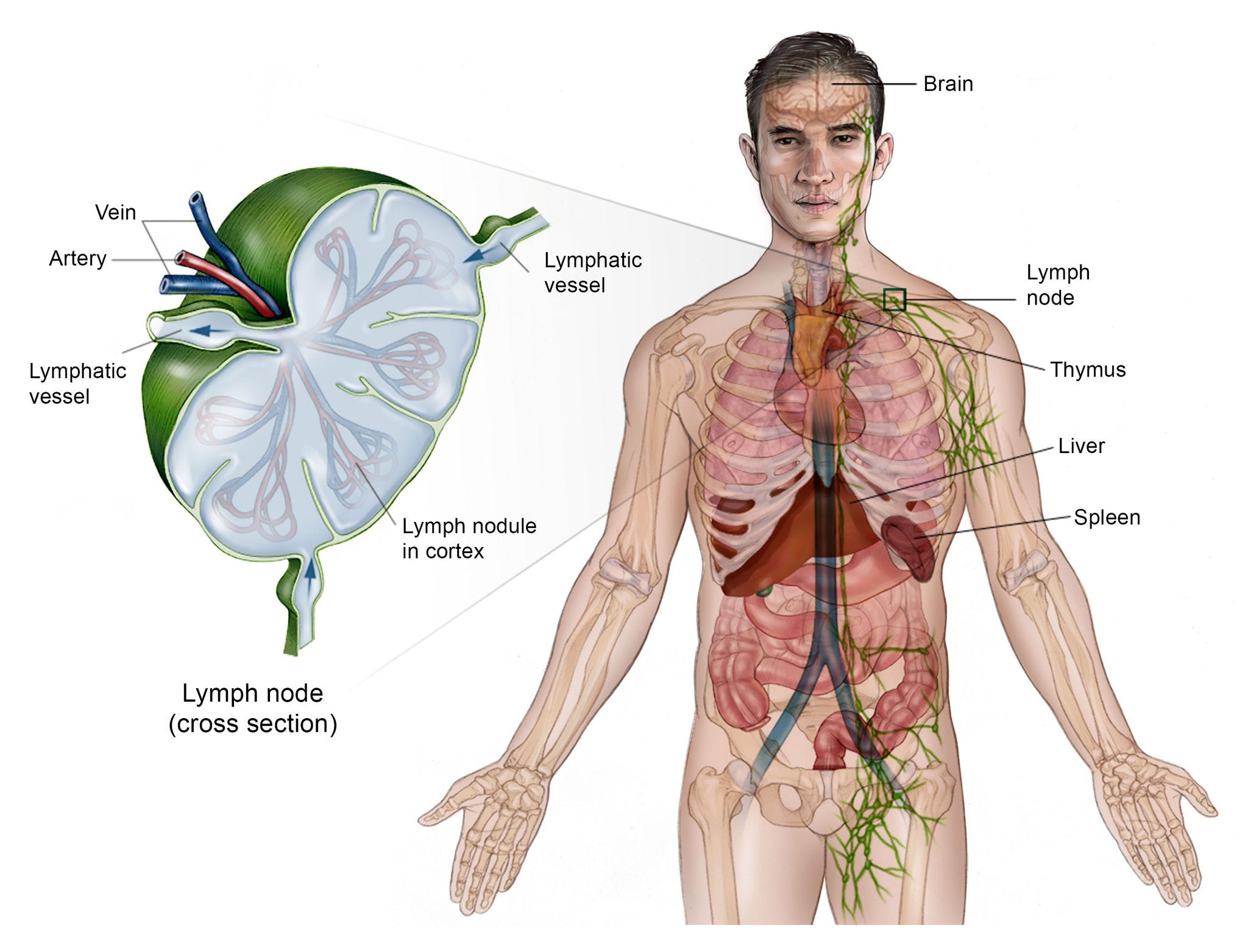
© American Society for Clinical Oncology. Used with permission.
Hodgkin lymphoma (HL)
Hodgkin lymphomas usually start in B lymphocytes. These B-cell lymphomas have large, abnormal cells in them called Reed-Sternberg cells, which can be seen under the microscope. They also often have specific proteins on the cell surface that help doctors make a diagnosis of Hodgkin lymphoma.
Types of Hodgkin lymphoma in children
There are 2 main types of Hodgkin lymphoma. Both of these types, and their subtypes, can be seen in children. Classical Hodgkin lymphoma is most common in children and young adults.
Classical Hodgkin lymphoma has 4 subtypes, named for how they look under the microscope:
- Nodular sclerosing Hodgkin lymphoma
- Mixed-cellularity Hodgkin lymphoma
- Lymphocyte-rich Hodgkin lymphoma
- Lymphocyte-depleted Hodgkin lymphoma
The most common type of classical Hodgkin lymphoma in children and young adults is the nodular sclerosing type.
This type of Hodgkin lymphoma is less common in children. Only 5 to 10% of children with Hodgkin lymphoma have this type, and it is more common in children less than 10 years of age. NLPHL is treated differently than other types of Hodgkin lymphoma.
Non-Hodgkin lymphoma (NHL)
There are many types of non-Hodgkin lymphoma.
Some types of lymphoma are treated differently, so it's important to find out which type of NHL your child has. To do this, doctors will look at many characteristics of the lymphoma, including:
- The type of lymphocyte the cancer starts in. The cancer cells could be either B cells or T cells.
- How the lymphoma cells look under a microscope. Doctors look at markers on the cell surface to see if they are B or T cells and if they are mature or immature.
- Where the cancer is located. Some types of lymphoma grow in specific parts of the lymph node or body.
- Chromosome or gene changes. Certain types of lymphomas are caused by specific chromosome or gene changes.
Types of non-Hodgkin lymphoma in children
The types of non-Hodgkin lymphoma (NHL) that happen most often in children and teens are different than the types that happen most often in adults.
Most childhood NHLs are one of these types:
- B-cell or T-cell lymphoblastic lymphoma (LBL)
- Burkitt lymphoma (small non-cleaved cell lymphoma)
- Diffuse large B-cell lymphoma (DLBCL)
- Anaplastic large cell lymphoma (ALCL)
All of these types of NHL are considered high-grade or aggressive lymphomas, meaning they tend to grow quickly. There are other types of NHL as well.
Lymphoblastic lymphoma (LBL) accounts for close to 20% of all non-Hodgkin lymphomas in children and teens in the United States. Boys are about twice as likely to develop LBL as girls.
The cancer cells of LBL are very immature lymphocytes called lymphoblasts. They are the same cells as those seen in acute lymphoblastic leukemia (ALL) in children. In fact, if more than 25% of the bone marrow is made up of lymphoblasts, the disease is classified and treated as ALL instead of lymphoma.
LBL often grows quickly with large lymph nodes in the neck and chest area.
Nodes in the chest may not be obvious by feeling or looking at a person and may need imaging tests to find. These nodes can get big enough to cause symptoms like shortness of breath, trouble lying flat, or swelling in the face and chest.
LBL can also develop in the tonsils, lymph nodes of the neck, or other lymph nodes. It can spread very quickly to the bone marrow, other lymph nodes, the surface of the brain, and/or the membranes that surround the lungs and heart.
- 3 out of 4 cases of LBL develop from T cells and are called precursor T-lymphoblastic lymphomas.
- 1 out of 4 LBLs develop from B cells and are called precursor B-lymphoblastic lymphomas. These lymphomas more often begin in lymph nodes outside the chest, particularly in the neck. They can also involve the skin and bones.
These are cancers of mature B cells. Burkitt is the most common pediatric non-Hodgkin lymphoma.
Burkitt lymphoma
Burkitt lymphoma accounts for about 40% of all childhood non-Hodgkin lymphomas in the United States. It is most often seen in boys, usually between the ages of 5 and 14 years old.
Some cases of Burkitt lymphoma are associated with infections like Epstein-Barr virus (EBV), malaria, and HIV. These infections are thought to trigger the gene changes that result in some Burkitt lymphomas.
In certain parts of Africa, Burkitt lymphoma accounts for nearly all childhood non-Hodgkin lymphomas and over half of all childhood cancers. Among children in Africa, this lymphoma usually develops in the jaw or other facial bones.
In the United States and other parts of the world, Burkitt lymphomas most often start in the abdomen (belly). Typically, a child develops a large tumor in their abdomen. This can sometimes block their bowels (intestines), causing belly pain, nausea, and vomiting.
Burkitt lymphoma can also sometimes start in the neck or tonsils, or rarely in other parts of the body.
High-grade B-cell lymphoma with 11q aberrations
This lymphoma looks like Burkitt lymphoma under the microscope but has a specific gene change that makes it different. It also shares some features with diffuse large B-cell lymphoma, described below.
These are cancers of mature B cells. Diffuse large B-cell lymphoma (DLBCL) is the most common large B-cell lymphoma in children and is more common in older children.
Diffuse large B-cell lymphoma (DLBCL)
DLBCL accounts for 15% to 20% of childhood non-Hodgkin lymphomas.
It starts in mature forms of B cells called lymphocytes, and it can grow almost anywhere in the body. It tends to happen more often in older children and teens than younger children.
Primary mediastinal B-cell lymphoma (PMBCL)
This is a related but less common type of NHL that grows as a large mass in the mediastinum (the space between the lungs). It tends to be seen most often in older teens.
Large B-cell lymphoma with IRF4 or ALK gene changes
Two additional types of large B-cell lymphoma are defined by specific gene changes. These are:
- Large B-cell lymphoma with IRF4 gene change
- Large B-cell lymphoma with ALK gene change
IRF4 gene changes have been associated with a better outlook.
Follicular lymphoma is a cancer of the B cells. It is very rare in children and adolescents, but it makes up about 30% of non-Hodgkin lymphoma in adults. Pediatric-type follicular lymphoma is more common in boys than girls.
When it happens in younger people, it is often distinctly different from follicular lymphomas in adults. Adult follicular lymphomas have a characteristic chromosome change that produces more of a specific protein called BCL-2. In children and adolescents this is rare, suggesting these cancers are different.
Children are also more likely to have cancer only in one area, where adults are more likely to have disease that has spread to other parts of the body.
Pediatric nodal marginal zone lymphoma is a rare B-cell lymphoma in children. It is much more common in boys than girls. This type of lymphoma is likely to present as swollen lymph nodes in one area (localized).
MALT lymphoma
When the marginal zone lymphoma occurs in the stomach lining, it is called MALT lymphoma. This type of marginal zone lymphoma can be related to an infection called H. pylori. When this happens, antibiotics may also be given.
This type of lymphoma makes up about 10% of all non-Hodgkin lymphomas in children and teens. It usually develops from mature T cells. It may start in lymph nodes in the neck or other areas, and it may also be found in the skin, lungs, bone, digestive tract, or other organs.
ALCL is more common in older children and teens than in younger children. 1 out of 3 cases of ALCL are localized and about 2 out of 3 have spread (disseminated) when they are diagnosed. It is uncommon for ALCL to be found in the bone marrow or central nervous system (CNS).
This is a rare mature T-cell lymphoma. Certain types of peripheral T-cell lymphomas have been seen in children with autoimmune conditions like celiac and Crohn’s disease.
Cutaneous T-cell lymphoma is a lymphoma of the skin. It is very rare in children and slightly more common in adolescents and young adults, though still rare.
The 2 most common types of cutaneous T-cell lymphomas are mycosis fungoides and lymphomatoid papulosis.
Some cases of cutaneous T-cell lymphoma can trigger hemophagocytic syndrome. This is an overactivation of the immune system that can be life-threatening if not treated quickly.
This type of lymphoma occurs in the central nervous system (brain and spinal cord) and the spinal fluid. It is rare in children and adults. Because it is rare, doctors aren’t sure if these cancers are the same in people of different ages.
Some research suggests children with CNS lymphoma may respond better to treatment than adults.
Gray zone lymphomas are a rare mix of an unclassifiable B-cell lymphoma and classical Hodgkin lymphoma. They can both be present at the time of diagnosis or found later if the lymphoma comes back (relapses) after treatment.
Quick Guides
- Written by
- References

Developed by the American Cancer Society medical and editorial content team with medical review and contribution by the American Society of Clinical Oncology (ASCO).
Cole PD, Parikh RR, Kelly KM. Chapter 18: Hodgkin Lymphoma. In: Blaney SM, Adamson PC, Helman LJ, eds. Pizzo and Poplack’s Pediatric Oncology. 8th ed. Philadelphia, Pa: Lippincott Williams & Wilkins; 2021.
Gross TG, Kamdar KY, Bollard CM. Chapter 19: Malignant Non-Hodgkin Lymphomas in Children. In: Blaney SM, Adamson PC, Helman LJ, eds. Pizzo and Poplack’s Pediatric Oncology. 8th ed. Philadelphia, Pa: Lippincott Williams & Wilkins; 2021.
McClain KL, Kamdar KY. Overview of Hodgkin lymphoma in children and adolescents. UpToDate. 2025. Accessed at https://www.uptodate.com/contents/overview-of-hodgkin-lymphoma-in-children-and-adolescents on November 13, 2025.
National Cancer Institute. Childhood Hodgkin Lymphoma Treatment (PDQ). 2025. Accessed at https://www.cancer.gov/types/lymphoma/hp/child-hodgkin-treatment-pdq on November 11, 2025.
National Cancer Institute. Childhood Non-Hodgkin Lymphoma Treatment (PDQ). 2025. Accessed at https://www.cancer.gov/types/lymphoma/hp/child-nhl-treatment-pdq on November 11, 2025.
Termuhlen AM, Gross TG. Overview of non-Hodgkin lymphoma in children and adolescents. UpToDate. 2025. Accessed at https://www.uptodate.com/contents/overview-of-non-hodgkin-lymphoma-in-children-and-adolescents on November 13, 2025.
Last Revised: February 27, 2026
American Cancer Society medical information is copyrighted material. For reprint requests, please see our Content Usage Policy.
This information is possible thanks to people like you.
We depend on donations to keep our cancer information available for the people who need it most.