A Scientific Partnership Built in the Lab and at Home
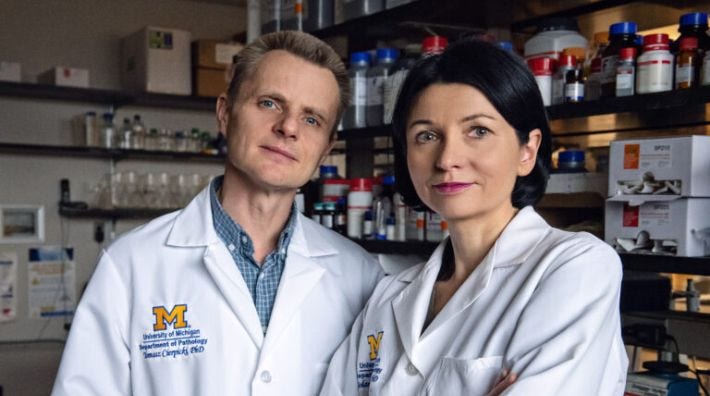
Researchers rarely make groundbreaking discoveries alone. Scientific breakthroughs happen when teams work together to pursue a common goal. Scientists Jolanta Grembecka, PhD, and Tomasz Cierpicki, PhD, wouldn't have it any other way.
These two American Cancer Society (ACS)-funded scientists are married to their research – and to each other. Whether in the lab or at home, they support each other personally and professionally through the ups and downs of searching for new discoveries. And they don't subscribe to the well-known phrase, "Never bring your work home with you."
"One of the unique aspects of working together is that discussions about research often extend beyond the laboratory and into our home life," Grembecka said. "While this can sometimes make it difficult to step away from scientific challenges, these continued conversations have frequently helped generate new ideas and ultimately moved the project forward."
Their collaboration has helped lead to a significant breakthrough in the treatment of leukemia. Their collaborative Grembecka–Cierpicki Labs at the University of Michigan Department of Pathology has developed targeted treatment using menin inhibitors. One of those menin inhibitors is ziftomenib (Komzifti™), approved by the FDA in late 2025 for the treatment of leukemia, including acute myeloid leukemia (AML). AML is among the more aggressive and difficult-to-treat blood cancers.
"By working together, we make a strong and highly complementary team," Cierpicki said. "This allows us to diversify and expand our expertise, share ideas, and amplify our efforts. Working together strengthened our resilience in overcoming challenges and was ultimately essential to the success of the project."
A research power couple
Grembecka earned her PhD in chemistry from the University of Technology in Poland and completed postdoctoral training in structural biology and leukemia drug discovery at the University of Virginia. Her work includes major contributions to understanding mixed lineage leukemia (MLL), an aggressive blood cancer in infants and children.
Cierpicki also completed his PhD at the University of Wroclaw, then conducted postdoctoral training at the University of Pennsylvania. His work focuses on understanding how certain proteins interact to drive leukemia growth. And his research laid the foundation for the development of menin inhibitors.
Both were drawn to cancer research early in their careers and recognized the desperate need to develop new therapies for leukemia.
"I have been attracted to cancer research after seeing how profoundly patients suffer and lack hope to get cured," Cierpicki said. "Leukemia is a devastating disease that affects not only patients but entire families."
For Grembecka, the motivation was even more personal.
"Several family members and close friends have been affected by cancer, including leukemia, which continues to inspire me to focus my research on the discovery of new therapeutic strategies for cancer patients," she said.
How do menin inhibitors work?
Menin is a protein and critical part of a process that keeps certain types of leukemia cells growing. It binds with MLL1 (also known as KMT2A), a gene that promotes growth signals in blood cells. Menin inhibitors block the process and shut off those growth signals that fuel leukemia.
“Witnessing ziftomenib progress from early discovery to FDA approval and now being available to leukemia patients has been extremely rewarding,” Grembecka said.
ACS: fueling discovery at critical stages
Grembecka and Cierpicki credit ACS with providing essential support at pivotal early stages. Both researchers received ACS Research Scholar Grants to build their research programs. Their work on menin inhibitors also received an ACS Mission Boost Grant, helping to move promising research closer to testing in humans through clinical trials.
“This support provided critical momentum and gave me a lot of confidence at an early stage of my career and significantly impacted my research," Cierpicki said. "Supporting junior investigators is an important priority for ACS."
Reviewed by the American Cancer Society communications team.