Relay For Life Creates Career Path for Cancer Scientist
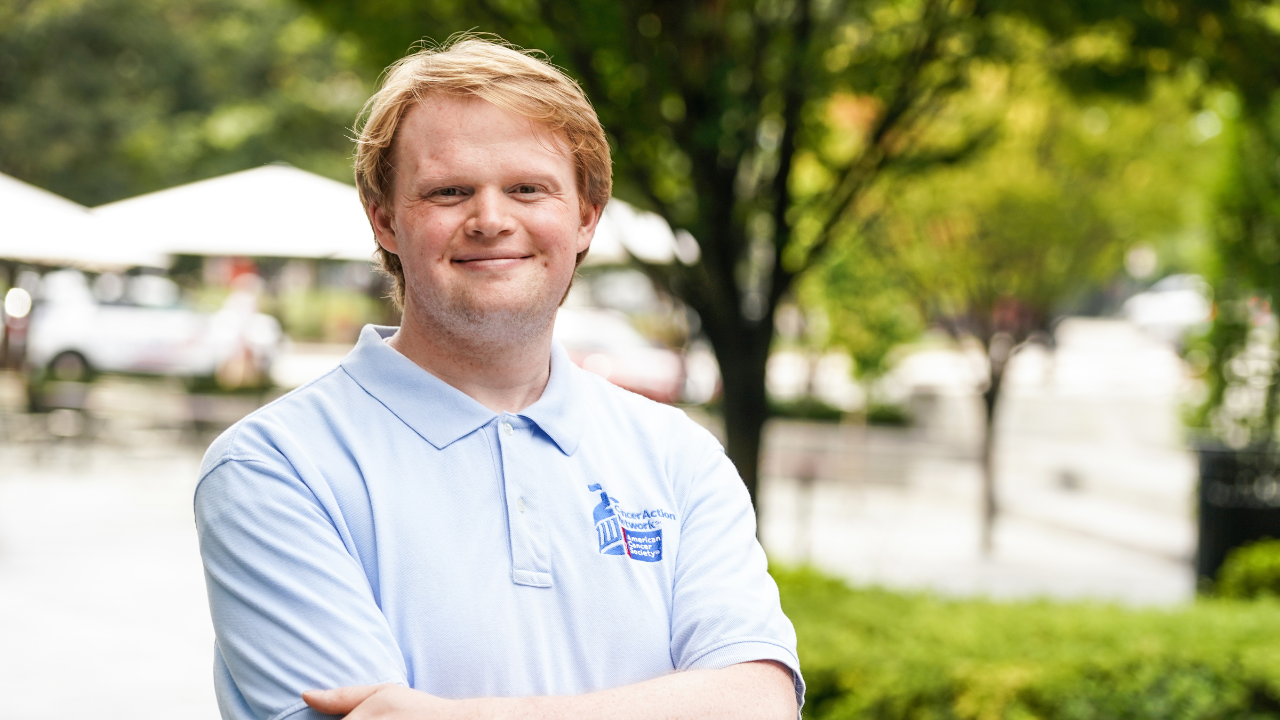
Once a reluctant Relay participant as a teen, Cody Wolf, PhD, is now an honored advocate and an American Cancer Society-funded researcher
Most people don't know when or where they may find a clear path to their future. And if and when they do, the way forward doesn't always present itself with clarity or certainty.
But it did for Cody Wolf, PhD.
Once a reluctant participant in an American Cancer Society Relay For Life® event, the experience carried Wolf from honored advocate to grant-backed cancer researcher. In April, the American Cancer Society awarded Wolf a three-year postdoctoral fellowship to help pursue his research on identifying new therapeutic targets for pancreatic tumors.
"Getting support for three years is incredible," Wolf said. "And having the support of the American Cancer Society means so much and allows me to keep doing this work."
The award reflects both the promise of his research and the American Cancer Society’s long-term investment in supporting early-career scientists working to improve outcomes for patients.
An unexpected impact
When he was 18 years old and just starting college, Wolf had an idea he wanted to pursue a degree in science. But the trail ahead was still a bit foggy.
Then, Wolf's girlfriend, Alicia, "dragged" him onto her team at a Relay For Life near their hometown of Caldwell, Idaho. It was one of thousands of Relay For Life events held across the country to celebrate cancer survivors and caregivers, remember loved ones, and raise money for cancer research and patient support.
At the event, Wolf met cancer patients, survivors, caregivers, fundraisers, and advocates. He felt their passion and sensed the urgency of the mission. And after listening to a young cancer survivor speak to the crowd, he’d realize for the first time that cancer felt real to him.
"From that event I kept the idea of learning more about cancer in the back of my mind," he said. "That was really impactful for me. The experience gave me a more tangible idea of what I wanted to do."
Wolf soon became a Relay For Life regular, participating in multiple events in the years that followed. When he learned about the American Cancer Society Cancer Action NetworkSM (ACS CAN), volunteering became an obvious next step. In 2023, while still in graduate school, Wolf won a Young Leaders Award from ACS CAN for his volunteer work advocating for legislation and government policies that support cancer research and improve access to care.
"Advocating for cancer research felt like something I should do," Wolf said. "Obviously cancer research is very important to me, but just scientific research as a whole, I think, is fundamental to our country.”
And his girlfriend Alicia, who dragged him to Relay for Life, is now his wife.
Learning through academics and advocacy
Already intrigued by science from his high school classes, Wolf attended Boise State University as a biology major. Halfway through his undergraduate studies, he took a course in the molecular biology of cancer under Cheryl Jorcyk, PhD, director of clinical and translational research at Boise State. Once again, Wolf's career path was confirmed and now he had Jorcyk as a guide and mentor. He went on to join Jorcyk’s lab and pursue a PhD, focusing his research on breast cancer metastasis.
“To say that he’s a hard worker and he’s bright describes everybody I have ever had,” Jorcyk said in a 2023 Idaho Press article profiling Wolf. “What makes him special beyond that would be his caring and his ability to help others.”
When not peering through a microscope or studying cell behavior, Wolf could be found in the halls of the Idaho state capitol advocating for cancer research funding or improving access to care as a volunteer for ACS CAN.
“I love interacting with ACS and ACS CAN volunteers," he said. "They've been amazing. And I love that I get to meet people who may actually receive the therapies that I'm trying to develop."
While still in his early 20s, Wolf became an Ambassador Constituent Team (ACT) Lead, the primary volunteer coordinator for advocacy efforts within his congressional district. When possible, Wolf brings lawmakers into the lab to give them an up-close look at research in action.
Inspired by the important role the National Institutes of Health plays in funding research, Wolf travels to Washington at least once a year to meet with members of Congress and their staff to advocate for cancer research funding.
"I really enjoy talking with lawmakers and showing them the importance of scientific research," Wolf said. "I always loved having lawmakers come to the lab and see what we're doing and show them and give them tangible proof that funding is a good investment, even outside of the fact that we should do science to better humanity."
Staying the course while shifting focus
After securing his doctorate in biomolecular sciences at Boise State, Wolf moved east to work as a postdoctoral fellow at the University of Virginia. While learning more about the mechanisms that drive cancer metastasis, Wolf shifted his focus from breast cancer to pancreatic cancer.
"I wanted to shift to pancreatic cancer because working on a disease that needs more work is very meaningful to me," he said.
Pancreatic cancer is the third leading cause of cancer deaths in the United States and has an overall five-year survival rate of 13%.
"The number one thing, especially with pancreatic cancer being so devastating, is to get a drug that works for patients that can increase their lifespan," Wolf said. "That is what all cancer researchers are trying to do."
Wolf's research is focused on targeting a protein called plectin. Normally, plectin is found inside cells of mammals and helps keep cells strong and stable. But in some cancer cells, plectin migrates from the inside to the surface of cells. When plectin migrates to the outside of the cancer cell, researchers believe it may help tumors grow and spread.
"It shouldn’t be on the outside of cells, but in cancer it is," Wolf said. "And we’ve shown it makes cancer more aggressive. It makes a great target because it’s primarily on cancer cells and not healthy ones. We’re trying to understand how it works, but also develop a drug that can specifically target those cancer cells."
Cancer gets personal
With more than 18 million cancer survivors in the United States, more than 2 million new cases, and 600,000 cancer deaths every year, it's safe to say that almost everyone knows someone touched by cancer in their lifetime.
Growing up in Caldwell, cancer was never on Wolf's radar – until that Relay For Life event. Since then, Wolf has met dozens of cancer patients, survivors, thrivers, and volunteers through his research and advocacy work. And, eventually, cancer hit closer to home.
"Relay For Life was the first time I'd ever really interacted with somebody who have had cancer," Wolf said. "I was very fortunate at the time, having not known very many people who had had cancer. That's changed now."
While in college, a friend passed away from osteosarcoma, a type of bone cancer. Wolf's grandfather was diagnosed with stage 2 prostate cancer and is currently doing well. And in 2024, Wolf's uncle passed away from acute myeloid leukemia, a fast-growing form of the disease most often found in older adults.
Wolf said his uncle was able to live longer than expected, in part due to a drug developed by researchers that included National Cancer Institute Director Tony Latai, whom Wolf met in 2026.
"I thanked him for the drug he developed," Wolf said. "That was a really cool moment."
For Wolf, it was yet another affirmation that he chose the correct career path, one he hopes will lead to drug treatment discoveries to help people with cancer live longer lives. And now, with the help of his American Cancer Society grant, his research will be funded through 2029.
“When I got the news, I was so happy," he said. "And I just feel so excited to be working with the American Cancer Society in a way I never really thought I would be able to. Now I’m part of the team.”

Reviewed by the American Cancer Society communications team.