Highlights from the New ACS Institutional Grant Recipients
American Cancer Society awards funding for three new IRGs and two new Cancer Health Research Centers.

- Infographic
- Text Alternative
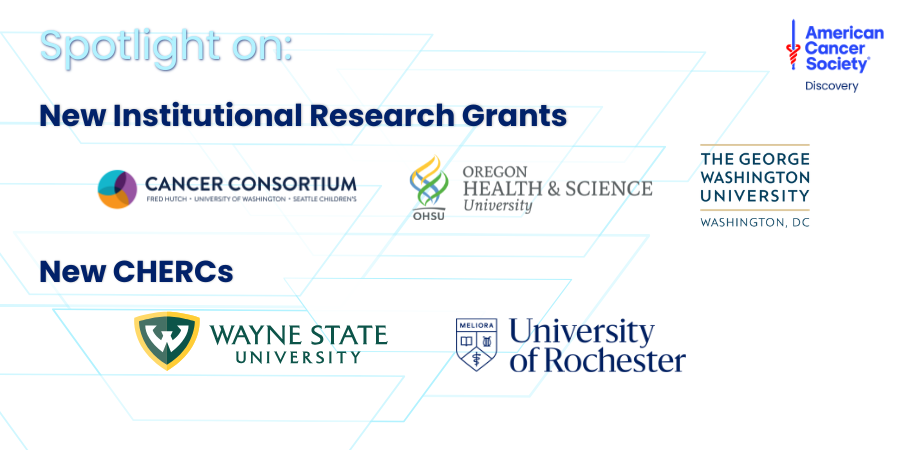
Spotlight on:
New Institutional Research Grants
- Cancer Consortium
- Oregon Health & Science University
- The George Washington University
New CHERCs
- Wayne State University
- University of Rochester
American Cancer Society Discovery
As part of its Spring grant slate, the American Cancer Society is investing directly in research ecosystems by awarding three new Institutional Research Grants (IRGs) and two new Cancer Health Research Center (CHERC) grants, while also renewing funding for nine existing IRGs.
These institution‑based awards provide flexible support that allows organizations to invest in multiple investigator‑driven projects that strengthen their capacity to conduct meaningful research. Through IRGs, institutions can identify and support their most promising early career faculty members, directing funds where they will have the greatest impact based on a deep understanding of their own researchers. CHERC grants, meanwhile, support the creation of new research centers with coordinated programs that bring scientists and communities together to address cancer prevention, outcomes, and equity in populations disproportionately affected by the disease. These grants strengthen the infrastructure behind cancer research, maximizing the reach of discovery to benefit patients and communities alike.
“These programs are about helping institutions meet the needs of their communities,” said Joanne Elena, PhD, scientific director of the Clinical and Population Science Research program at the American Cancer Society. “Whether propelling promising new faculty to success or partnering with the community to reduce cancer health disparities, these grants are a step closer to making a difference for populations that are too often overlooked.”
Today we are highlighting our new IRG and CHERC institutional grantees that are part of the larger Spring 2026 grant slate.
Institutional Research Grants
George Washington University
Washington, D.C.
Principal Investigator: Edward Seto, Ph.D.
This Institutional Research Grant will help the George Washington University Cancer Center (GWCC), a newly integrated cancer center, build a strong foundation for supporting early‑career cancer researchers. The program will provide pilot funding to junior faculty across basic, clinical, and population sciences, helping them develop innovative ideas, generate preliminary data, and compete for peer‑reviewed funding. Awardees will benefit from GWCC’s growing support infrastructure, including structured mentoring, professional development workshops, and opportunities for close collaboration with senior investigators. By pairing ACS IRG funding with institutional investment and an established partnership with local American Cancer Society staff, GWCC aims to accelerate the development of its next generation of cancer research leaders.
Oregon Health & Science University
Portland, OR
Principal Investigator: Melissa Wong, Ph.D.
This Institutional Research Grant will strengthen support for early‑career cancer researchers at the OHSU Knight Cancer Institute, Oregon’s only NCI‑designated cancer center and home to a large, growing community of junior investigators. As the Institute’s only pilot funding program dedicated to early‑stage faculty, the ACS IRG will provide critical seed funding to help launch new cancer research projects during a time of increasing competition for federal support. The program also emphasizes researcher development through broad outreach, detailed review feedback, mentorship from senior investigators, and access to professional development resources. By pairing targeted pilot funding with Knight Cancer Institute expertise and expanded collaboration with the American Cancer Society, this grant will help build a strong pipeline of future cancer research leaders at OHSU.
University of Washington
Seattle, WA
Principal Investigator: Margaret Hannon, Ph.D.
This Institutional Research Grant will support assistant‑level faculty pursuing cancer disparities research across three leading institutions: the University of Washington, Fred Hutchinson Cancer Center, and Seattle Children’s Research Institute. The program will provide pilot funding to help early‑career investigators launch new projects, build preliminary data, and strengthen their paths toward independent funding. In addition to financial support, the grant emphasizes mentorship and career development through guidance from a multidisciplinary review committee and connections with American Cancer Society staff. Together, these efforts aim to cultivate a diverse, well‑supported pipeline of early‑career researchers focused on reducing cancer disparities.
The following IRGs were also renewed as part of this funding cycle:
Case Western Reserve University
Principal Investigator: Ruth Keri, Ph.D.
Indiana University
Principal Investigator: Karen Pollok, Ph.D.
H. Lee Moffitt Cancer Center and Research Institute
Principal Investigator: Kenneth Wright, Ph.D.
Northwestern University – Chicago Campus
Principal Investigator: Leonidas Platanias, M.D., Ph.D.
University of Colorado Denver, AMC and DC
Principal Investigator: Traci Lyons, Ph.D.
University of Miami Miller School of Medicine
Principal Investigator: Allan Pollack, M.D, Ph.D.
University of Minnesota – Twing Cities
Principal Investigator: Irina Stepanov, Ph.D.
University of Pennsylvania
Principal Investigator: Katherine Nathanson, M.D.
Vanderbilt University
Principal Investigator: David Cortez, Ph.D.
Cancer Health Research Center (CHERC) Awards
University of Rochester
Rochester, NY
Principal Investigator: Charles Kamen, Ph.D.
Title: The Q Cancer Research Center
This grant will establish the Q Cancer Research Center, a nationwide “center‑without‑walls” dedicated to reducing cancer inequities faced by lesbian, gay, bisexual, transgender, queer, and other sexual and gender minority (LGBTQ+) people. The Q Center will bring together scientists, clinicians, and community advocates to address long‑standing gaps in cancer care caused by stigma, discrimination, and the lack of inclusive data and services for LGBTQ+ patients and caregivers. The Q Center will support three targeted research projects focused on improving respectful collection of sexual orientation and gender identity (SOGI) data, training patient navigators to connect LGBTQ+ patients to tailored survivorship care, and developing LGBTQ+‑specific cancer support programs. Alongside these projects, the Center will help train new researchers in LGBTQ+ cancer health equity and share findings with healthcare systems and communities, building lasting infrastructure to advance inclusive, equitable cancer care nationwide.
Wayne State University
Detroit, MI
Principal Investigator: Hayley Thompson, Ph.D.
Title: The Digitial Engagement and Cancer Outcomes (DECO) Center
This grant will establish the Digital Engagement and Cancer Outcomes (DECO) Center at the Karmanos Cancer Institute - Wayne State University to address racial disparities in cancer care linked to the digital divide in Detroit, where the majority of residents self-identify as Black/African American and many lack reliable internet access. The Center will focus on how limited access to broadband, devices, and digital skills affects cancer care for Black patients, survivors, and caregivers. The DECO Center will support three coordinated research projects that test digital equity solutions, including developing a digital financial education tool, a new Digital Health Navigator role embedded in cancer care teams, and studies of clinician bias in recommending digital tools. By strengthening connections with Detroit’s digital equity ecosystem, the Center aims to improve access to digital health resources and advance equitable cancer care and outcomes for Black communities.
To learn more about the more than 850 research grants currently being funded by the American Cancer Society, and/or to learn more about our upcoming grant opportunities, please visit the Extramural Discovery Science (EDS) homepage. To see additional highlights from this newly announced slate of grants, please be sure to check back often on this page and to connect with us on LinkedIn, Facebook, and Instagram.
American Cancer Society news stories are copyrighted material and are not intended to be used as press releases. For reprint requests, please see our Content Usage Policy.