American Cancer Society Invests in Three New Cancer Health Research Centers
New centers will bring researchers and communities together to address persistent cancer disparities and advance solutions where they are needed most.

- Infographic
- Text Alternative
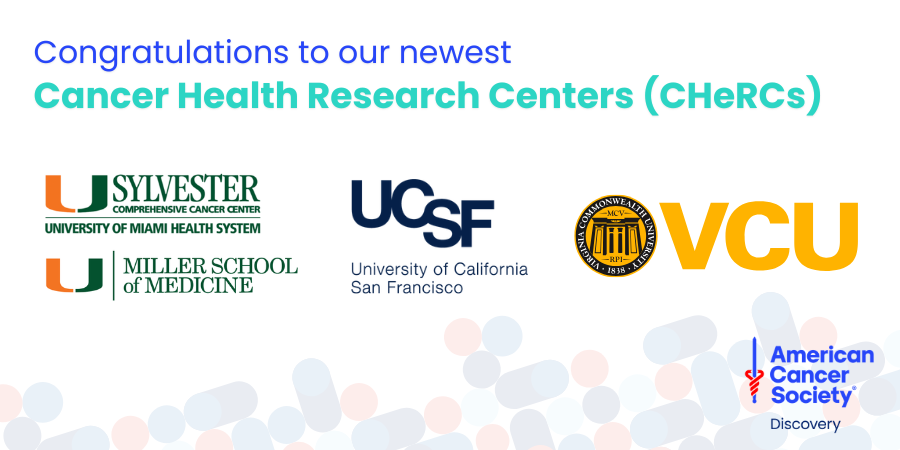
Congratulations to our newest
Cancer Health Research Centers (CHeRCs)
- Sylvester Comprehensive Cancer Center
University of Miami Health System
Miller School of Medicine
- UCSF
University of California, San Francisco
- VCU
Virginia Commonwealth University
American Cancer Society Discovery
As part of the new slate of grants recently announced by the American Cancer Society (ACS), we are proud to invest $4.95 million in three new Cancer Health Research Centers (CHERCs). These centers will support collaborative, community-engaged research designed to better understand and address the factors that contribute to unequal cancer outcomes in populations disproportionately affected by cancer.
Created as part of ACS's commitment to promoting fair and just opportunities to prevent, detect, treat, and survive cancer, the CHERC program supports institutions that are uniquely positioned to address cancer disparities affecting their local and regional communities. Each center brings together researchers, community organizations, healthcare providers, and patients to develop evidence-based approaches that can improve cancer outcomes and help ensure that advances in cancer prevention and care reach everyone who can benefit from them.
"Factors such as race/ethnicity, socioeconomic status, insurance coverage, and lived experience contribute to certain communities experiencing higher cancer burdens," said Dr. Joanne Elena, Scientific Director for Clinical and Population Science at the American Cancer Society. "These new CHERC awards address such factors and support excellent scientific teams who integrate research with sustained community partnerships to find actionable solutions. By supporting these innovative centers of cancer research, ACS demonstrates its commitment to improving the health and well-being of populations disproportionately affected by cancer."
The three centers funded this year reflect both the diversity of the communities they serve and the breadth of challenges they seek to address. Their work spans cancer prevention, screening, treatment, survivorship, and access to care, with a focus on developing sustainable, community-informed strategies that can improve health outcomes and serve as models for other communities across the country.
Details about each of the newly funded Cancer Health Research Centers are provided below.
Miller School of Medicine of the University of Miami
Coral Gables, FL
Principal Investigator: Frank Penedo, Ph.D.
Title: The Sylvester Cancer Health Equity Research Center (CHERC)
This grant will establish the Sylvester Cancer Health Equity Research Center (CHERC) to advance cancer equity for Hispanic communities by addressing barriers to cancer prevention, screening, treatment, and survivorship through culturally responsive, technology-enabled solutions. Guided by community partners and a Community Advisory Board, the Center will serve as a hub for Hispanic cancer research, training, and outreach, focusing on challenges that disproportionately affect Hispanic populations, including limited access to care, food insecurity, financial hardship, and low participation in clinical trials. CHERC will support several initial research projects, including an eHealth and self-screening initiative to increase screening for HPV-associated cancers; a program that uses electronic health record data to identify food insecurity and connect patients with virtual nutrition coaching; an online sleep health intervention for cancer survivors and their sleep partners; and a text messaging and chatbot-based approach to improve awareness of and engagement in cancer clinical trials. By combining community-driven research with innovative digital tools, the Center aims to reduce cancer disparities, improve outcomes for Hispanic individuals across the cancer continuum, and create scalable models for advancing cancer equity nationwide.
The Sylvester CHERC is generously funded in part by the Dolphins Cancer Challenge.
University of California, San Francisco
San Francisco, CA
Principal Investigator: Salma Shariff-Marco, Ph.D.
Title: Asian American Cancer Health Equity Research Center
This grant will establish the Asian American Cancer Health Equity Research Center (CHERC) to address cancer disparities among Asian American communities across California, a highly diverse population representing dozens of countries, cultures, and languages. The Center will focus on understanding how structural and social drivers of health, including immigration experiences, socioeconomic factors, anti-Asian racism, and barriers to navigating the healthcare system, contribute to cancer risk and survivorship outcomes among Asian Americans. CHERC will initially support two research projects that address emerging challenges facing these communities: the rising burden of lung cancer among Asian American women who have never smoked, and the financial toxicity experienced by Asian American cancer survivors and its effects on long-term health and quality of life. Through partnerships among researchers, trainees, and community organizations, the Center will build infrastructure for community-engaged research, advance understanding of the factors driving cancer inequities, and develop strategies to improve cancer prevention, early detection, treatment, and survivorship outcomes for Asian American populations.
Virginia Commonwealth University
Richmond, VA
Principal Investigator: Monica Baskin, Ph.D.
Title: Cancer Health Engagement and Action Research (CHEAR) Center
This grant will establish the Cancer Health Engagement and Action Research (CHEAR) Center at the Virginia Commonwealth University Massey Comprehensive Cancer Center to reduce cancer disparities across central, southern, and eastern Virginia by addressing the social drivers of health that influence cancer risk and outcomes. Working closely with community partners, the Center will focus on populations disproportionately affected by barriers related to race, geography, age, and socioeconomic status, with particular attention to Black communities and other underserved populations across the state. CHEAR will support three initial research projects focused on addressing food insecurity and its impact on cancer outcomes in the predominantly Black community of Petersburg, Virginia; combating cancer health misinformation that affects HPV vaccination and colorectal cancer screening among younger adults and vulnerable older populations; and implementing a faith-based education and navigation approach to increase colorectal and prostate cancer screening in rural and urban Black communities. Through community-engaged research, training, and dissemination efforts, the Center aims to develop sustainable strategies that address root causes of cancer inequities and improve cancer prevention and outcomes throughout Virginia.
Learn more about our latest research grants
American Cancer Society news stories are copyrighted material and are not intended to be used as press releases. For reprint requests, please see our Content Usage Policy.