Exploring Bold Ideas Through Discovery Boost Grants
New grants will support high-risk, high-reward research aimed at uncovering fundamental insights and opening new avenues for cancer prevention, detection, and treatment.
- Infographic
- Text Alternative
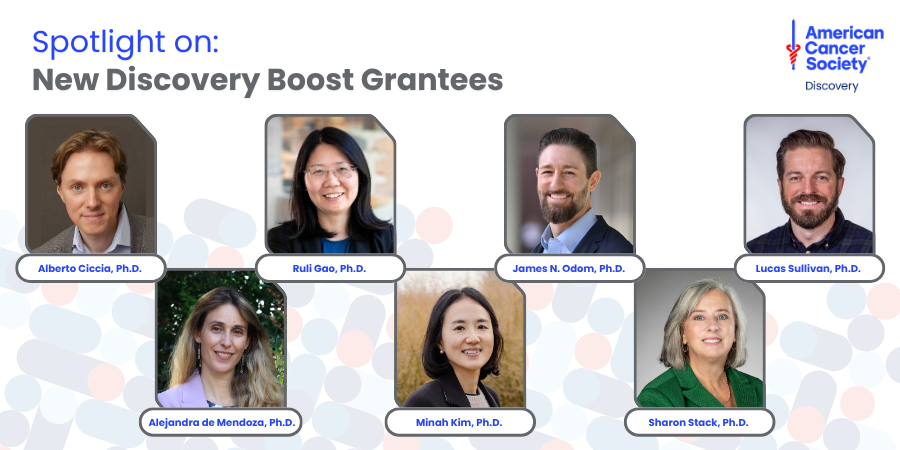
Spotlight on:
New Discovery Boost Grantees
- Alberto Ciccia, Ph.D.
- Alejandra de Mendoza, Ph.D.
- Ruli Gao, Ph.D.
- Minah Kim, Ph.D.
- James N. Odom, Ph.D.
- Sharon Stack, Ph.D.
- Lucas Sullivan, Ph.D.
American Cancer Society Discovery
As part of our recently announced slate of new grants, the American Cancer Society (ACS) is proud to support a new cohort of Discovery Boost Grant recipients. These awards are designed to help researchers pursue bold, innovative ideas that have the potential to transform our understanding of cancer and spark entirely new directions for future research.
“Through Discovery Boost Grants, ACS invests in highly innovative research that has the potential to expand our understanding of cancer and uncover new opportunities for prevention, detection, and treatment," said Paul Campbell, PhD, Scientific Director of the Cell Biology and Preclinical Cancer Research program at the American Cancer Society.
Discovery Boost Grants reflect ACS's commitment to supporting high-risk, high-reward science. By providing funding for exploratory research, these awards give investigators the opportunity to pursue creative questions and test novel concepts that may be too early-stage for traditional funding mechanisms. The goal is to accelerate promising ideas that could ultimately lead to breakthroughs across the cancer continuum.
Through this grant cycle, ACS is investing $2.67 million in Discovery Boost Grants awarded to nine investigators at eight institutions. The projects span a broad range of scientific disciplines and approaches, but all share a common focus on pushing the boundaries of current knowledge and exploring new possibilities for cancer research.
Many of the most significant advances in cancer research begin with a bold question or an unconventional idea. By supporting innovative investigators as they explore new scientific frontiers, Discovery Boost Grants help lay the groundwork for the discoveries that may shape the future of cancer prevention, detection, treatment, and survivorship.
Below, we highlight several of the researchers and projects funded through this year's Discovery Boost Grants.
Alberto Ciccia, Ph.D.
Columbia University
“Mapping Cancer Vulnerabilities Through Combinatorial Genome Editing of DNA Repair Networks”
This project will investigate how defects in DNA repair create vulnerabilities that can be targeted in cancer treatment. Building on the success of therapies that exploit DNA repair weaknesses in certain cancers, Dr. Ciccia will map how different DNA repair pathways interact, identify new therapeutic targets, and uncover mechanisms that allow tumors to develop drug resistance. He will also examine how specific DNA repair gene mutations influence treatment responses and create unique therapeutic opportunities. This work could expand precision medicine approaches and help more patients benefit from treatments tailored to the genetic features of their tumors.
Alejandra H. de Mendoza, Ph.D.
Georgetown University
“SOLAR: Promoting Skin Cancer Prevention among Hispanic Outdoor Workers”
This project will investigate ways to improve skin cancer prevention among Hispanic outdoor workers, a population at increased risk for excessive sun exposure and delayed skin cancer detection. Building on Dr. de Mendoza’s previous work developing a culturally tailored educational video, she will now evaluate whether this approach is more effective than standard educational materials at increasing sun-protective behaviors. She will also work with business owners to develop tools that support sun safety practices in outdoor workplaces. This work could help reduce skin cancer risk and improve early prevention efforts among Hispanic outdoor workers.
Ruli Gao, Ph.D.
Northwestern University – Chicago Campus
“Long read single cell transcriptomic approaches for resolving complex evolutionary fate dynamics in multi-focal lung metastasis”
This project will investigate how metastatic cancer cells change and adapt within the lungs, a process that can drive tumor growth and resistance to treatment. Building on Dr. Gao’s earlier development of new single-cell sequencing and computational tools that can track both genetic and cellular changes across thousands of tumor cells, she will analyze lung metastases from patients to identify the key factors that drive cancer evolution. She will compare tumors from different regions of the lung and across patients to uncover common mechanisms that support metastasis. This work could reveal new therapeutic targets to prevent cancer progression and overcome treatment resistance in patients with metastatic disease.
Minah Kim, Ph.D.
Columbia University
“Unraveling a Novel Therapeutic Target for Metastasis and Resistance to Antiangiogenic Therapy in PanNETs”
This project will investigate why pancreatic neuroendocrine tumors (PanNETs) often become resistant to therapies that block tumor blood vessel growth and subsequently spread to the liver. Building on her previous work identifying the VEGF-C signaling pathway as a potential driver of treatment resistance, Dr. Kim will study how this pathway supports tumor growth and metastasis and test whether blocking it can restore treatment effectiveness. She will also evaluate whether VEGF-C could serve as a biomarker to identify patients at risk of developing resistant disease. This work could lead to new strategies for preventing liver metastasis and improving outcomes for patients with advanced PanNETs.
James N. Odom, Ph.D.
University of Alabama at Birmingham
“Brief Distress Support for Family Caregivers of Persons with Advanced Cancer: The FamilyStrong Pilot Randomized Trial”
This project will investigate whether a navigator-led support program can improve the well-being of family caregivers for patients with advanced cancer. Building on Dr. Odom’s development of FamilyStrong, a program that screens caregivers for distress and connects them with tailored resources, here he will evaluate whether the intervention reduces stress, improves quality of life, and addresses unmet support needs. He will also assess whether the program can be successfully integrated into real-world cancer care settings. This work could improve the well-being of both caregivers and patients by expanding access to practical, accessible support services.
Sharon Stack, Ph.D.
University of Notre Dame
“Oncoaging and Ovarian Cancer Metastatic Success”
This project will investigate how aging changes the abdominal environment in ways that promote the spread of ovarian cancer. Building on her prior work showing that age-related changes and the accumulation of senescent cells create conditions that favor tumor growth, Dr. Stack will determine when these changes emerge and how they influence cancer progression and treatment response. She will also test novel therapies designed to eliminate senescent cells and reverse these aging-related effects. This work could identify new strategies to prevent ovarian cancer metastasis and improve outcomes for older women with ovarian cancer.
Lucas B. Sullivan, Ph.D.
Fred Hutchinson Cancer Center
“Understanding Tissue Specificity of Metabolic Mutations in Cancer”
This project will investigate why certain cancer-causing metabolic mutations lead to cancer in specific tissues, such as the brain or kidney, but not others. Building on preliminary work showing that these mutations can have different effects depending on the cell type in which they occur, Dr. Sullivan will examine how metabolic changes and cellular responses influence cancer development across tissues. He will compare how different cell types respond to cancer-promoting metabolic mutations and identify the factors that make some tissues particularly vulnerable. This work could reveal new opportunities to target cancers driven by metabolic mutations while sparing healthy tissues.
Learn more about our latest research grants
American Cancer Society news stories are copyrighted material and are not intended to be used as press releases. For reprint requests, please see our Content Usage Policy.