Breaking Barriers, Building Futures: How Two Black Women in Science Are Opening Doors for the Next Generation
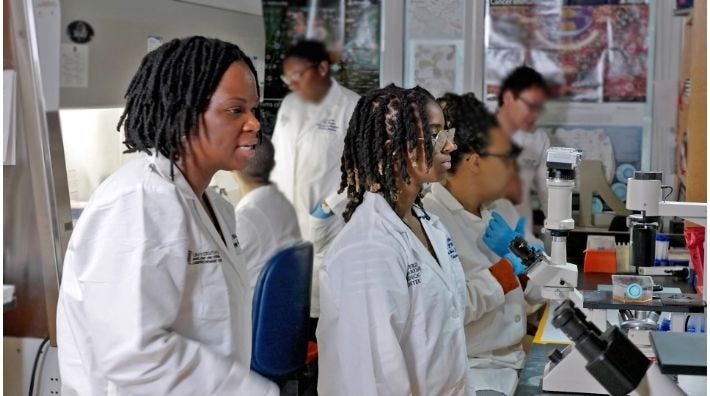
Tonya Webb, PhD, and PhD student Alena McQuarter grew up in different places and different generations. Tonya is an American Cancer Society (ACS)-funded researcher and associate director for workforce excellence and development at the University of Maryland School of Medicine (UMSOM). Alena is a second-year PhD student in cancer biology at Loma Linda University in California and one of the youngest doctoral students in the country.
But they share a common story – one familiar to many Black girls interested in science, technology, engineering, or math (STEM). They face doubts, discouraging comments, and pressure to prove themselves. Both women credit resilience, perseverance, and strong mentors for helping them move forward. And both are now working to make the road smoother for the girls coming after them.
A path to research
Tonya grew up in Charlotte, North Carolina, but her family moved often for her father's job. She attended 13 different schools before graduating from high school. Each new school required her to take placement tests for advanced math and science. Some schools doubted her test scores. A few even asked her to retest to prove she belonged in honors classes.
“It was a constant struggle,” she said. “I had to reinvent myself every year.”
Tonya received a full scholarship for pre-med studies at Prairie View A&M University in Texas. She felt honored to receive such a scholarship, especially since the university was known for successfully preparing pre-med students for medical school.
At Prairie View, Tonya was a pre-medical school student majoring in biology and minoring in chemistry. But while attending a career fair, a conversation with a Dartmouth professor changed her career path.
"He told me he thought I would be a great scientist," she said. "I was really focused on medical school, but he encouraged me to come up to Dartmouth in Vermont and spend the summer to see if I'd like research. And that was a pivotal moment. I went there and loved it."
In 2020, Tonya’s excellence in teaching and research were recognized when she became the first Black female with a PhD to receive tenure at UMSOM, securing a permanent faculty role. And in 2025, she was promoted to professor of microbiology and immunology and assistant dean for student engagement and student life in the Office of Student Affairs.
She also helps students reach their full potential through two programs funded in part by Institutional Research Grants from the American Cancer Society Extramural Discovery Science department: Internship for Mentored Projects Advancing Cancer Translation (IMPACT) and Accelerating Momentum for Professionals in Life Sciences (AMPLIFY). These programs are designed to expose students to scientific research and give them the resources they need to succeed.
A young star
Alena McQuarter is one of those students. Like Tonya, Alena excelled at a young age. She was born in Fontana, California, and raised in Fort Worth, Texas. She was reading at age 3, showed problem-solving skills at age 4, and graduated from high school at age 12.
Though Alena said she was frequently bullied because of her differences, she persevered.
“I loved school, and they weren’t going to stop me,” she said.
The youngest intern to ever work at NASA, Alena was initially interested in a career in aerospace and aeronautics. But she shifted her focus after taking a class at Arizona State University (ASU).
"I took a biological research class, and I found it really interesting. So, I made the switch and decided I was going to go into the medical field,” she said.
She graduated from ASU at 15 with a bachelor's degree in biological science. She was the youngest Black American ever to be accepted into medical school.
Alena’s accelerated academic journey has been well documented in national media, including an appearance on Good Morning America.
Today, she is in her second year of a PhD program in cancer biology at Loma Linda University.
Two women making a difference
Alena connected with Tonya in 2023 while she was visiting UMSOM.
"I encouraged her to apply to our summer program," Tonya said. "We had a really great conversation, and I told her she should do scientific research. I really wanted to get her into the lab."
That summer program was IMPACT, a UMSOM initiative funded in part by ACS. It gives undergraduate students hands-on cancer research experience. Tonya also runs AMPLIFY, a companion program to IMPACT that offers financial and support services to prepare students for a career in cancer research or clinical medicine.
"If you have a summer research opportunity that sparks that light in you, you may not have time to get everything in place for a successful application," Tonya said. "Our program gives students the time and support they need."
Alena is grateful for the mentorship Tonya has offered her, and it's something she hopes to pay forward. Even while completing her PhD, Alena is helping younger girls find their path through her nonprofit, Brown STEM Girl. The organization advocates for girls of color in STEM subjects, offering resources and programs that highlight diverse role models.
“It gives girls the chance to say, ‘I want to be like her,’” Alena said. “Representation matters."
It gives girls the chance to say, ‘I want to be like her.’ Representation matters.
The importance of representation
According to ACS, Black men and women bear a disproportionate burden of cancer incidence and death.
For instance:
-
Black men have the highest overall cancer mortality rate at 14% higher than White men.
-
Prostate cancer mortality in Black men is approximately 2 to 4 times that of men in other racial and ethnic groups.
-
Breast cancer mortality in Black women is 37% higher than White women despite a lower incidence.
Cancer disparities like this happen when people have lower incomes or fewer opportunities to access high-quality care because of where they live. But racism and discrimination often lead to unfair and unjust health disparities. For example, Tonya says the shortage of Black physicians can contribute to racial disparities in health and cancer outcomes. Representation, she said, changes patient care.
“When you go into a room and see someone who looks like you, it changes the dynamic of the conversation,” she said. "You may share different things based on your culture that you may not share with everyone else. Having someone who looks like you, can relate to you, can break some cultural barriers.”
There is also a scientific impact, she said. Researchers and physicians bring their backgrounds into the questions they ask and the problems they choose to solve.
“We need people who look at things differently,” she said. “That leads to different treatments and better care.”
Together, Tonya and Alena are showing what’s possible when young scientists are supported, encouraged, and seen. And they are opening doors for the next generation to follow.
- Reviewed by

Reviewed by the American Cancer Society communications team.