Your gift is 100% tax deductible.
Squamous Cell Carcinoma of the Skin
If you have a squamous cell carcinoma of the skin or are close to someone who does, knowing what to expect can help. Here you can find out all about this cancer, including risk factors, symptoms, how it is found, and how it is treated.
About squamous cell carcinoma of the skin
Skin cancer is by far the most common type of cancer in the United States. About 2 out of 10 skin cancers are squamous cell carcinomas (SCCs), also called squamous cell skin cancers, cutaneous squamous cell cancers, or squamous cell cancers. These cancers start in the flat cells in the upper (outer) part of the epidermis.
SCCs commonly appear on sun-exposed areas of the body such as the face, ears, neck, lips, arms, and backs of the hands. They can also develop in scars or chronic skin sores elsewhere. They sometimes start in actinic keratoses, which are described below. Less often, they form in the skin of the genital area.
Squamous cell cancers can usually be removed completely or treated in other ways. If they’re not treated, they can grow into deeper layers of skin and can sometimes spread to other parts of the body.
Understanding the skin
The skin is an organ that has several layers and is made up of several types of cells.
Epidermis
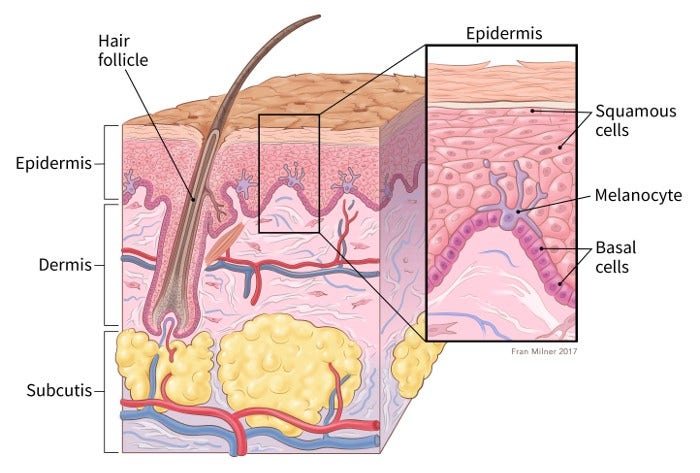
Most skin cancers start in the top layer of skin, called the epidermis. There are 3 main types of cells in this layer.
Squamous cells are flat cells in the upper (outer) part of the epidermis, which are constantly shed as new ones form. When these cells grow out of control, they can develop into SCCs.
Basal cells are in the lower part of the epidermis, called the basal cell layer. These cells constantly divide to form new cells to replace the squamous cells that wear off the skin’s surface. As these cells move up in the epidermis, they get flatter, eventually becoming squamous cells. Basal cell carcinomas are cancers that start in the basal cell layer.
Melanocytes make the brown pigment called melanin, which gives the skin its tan or brown color. Melanin acts as the body’s natural sunscreen, protecting the deeper layers of the skin from some of the harmful effects of the sun. Melanoma skin cancer starts in these cells.
Other skin layers
The basement membrane is a thin layer of tissue below the epidermis.
Two layers of skin called the dermis and the subcutis lie below the basement membrane. When a skin cancer becomes more advanced, it grows through the basement membrane and into these layers.
Precancers and other skin conditions related to squamous cell carcinoma
Some skin conditions aren’t SCC, but they’re closely related to it. Some can develop into SCC over time, and some can be hard to tell apart from it.
Actinic keratosis (AK), also known as solar keratosis, is a precancerous skin condition caused by too much exposure to the sun.
What AKs look like
AKs are usually small (less than 1/4 inch across), rough or scaly spots that are often flesh-colored or slightly darker, depending on a person’s skin tone.
Usually, they start on the face, ears, backs of the hands, and arms of middle-aged or older people with fair skin, although they can occur on other sun-exposed areas.
People who have AKs usually develop more than one. AKs tend to grow slowly and usually do not cause any symptoms, although some might be itchy or sore. They sometimes go away on their own, but they might come back.
Do AKs need to be treated?
A small percentage of AKs will turn into squamous cell skin cancers. Most AKs do not become cancer, but sometimes it can be hard for doctors to tell them apart from true skin cancers, so they often recommend treating them.
If you have AKs and they’re not treated, you and your doctor should check them regularly for changes that might be signs of skin cancer.
Squamous cell carcinoma in situ, also called Bowen disease, is the earliest form of squamous cell skin cancer. In situ means that the cells of these cancers are still only in the epidermis, the upper layer of the skin, and have not invaded deeper layers.
What Bowen disease looks like
Bowen disease typically appears as reddish patches. Compared with AKs, Bowen disease patches tend to be larger, redder, scalier, and sometimes crusted. Like AKs, Bowen disease usually doesn’t cause symptoms, although it might be itchy or sore.
Like most other skin cancers, Bowen disease most often appears in sun-exposed areas.
Bowen disease can also occur in the skin of the anal and genital areas. Some forms of SCC in situ in these areas have traditionally been called erythroplasia of Queyrat or Bowenoid papulosis. These can be related to infection with certain types of human papillomavirus (HPV).
Does Bowen disease need to be treated?
Bowen disease can sometimes progress to an invasive squamous cell skin cancer, so doctors usually recommend treating it.
People who have Bowen disease are also at higher risk for other skin cancers, so close follow-up with a doctor is important.
Keratoacanthomas (KAs) are dome-shaped tumors that often have an indent in the middle, like a volcano. These tumors tend to start on sun-exposed skin.
KAs might start out growing quickly, but their growth usually slows down. Many shrink or even go away on their own over time without any treatment. But some can continue to grow, and a few might even spread to other parts of the body.
Do KAs need to be treated?
Many doctors view keratoacanthomas as a type of SCC, although not all doctors agree. These tumors can be hard to tell apart from SCC just by looking at them, and their growth is often hard to predict, so doctors usually advise removing or destroying them, similar to how SCCs are treated.
Other types of skin cancer
Aside from SCC, there are several other types of skin cancer.
Basal cell carcinoma (BCC), also called basal cell skin cancer or basal cell cancer, is the most common type of skin cancer. About 8 out of 10 skin cancers are basal cell carcinomas.
These cancers start in the basal cell layer, which is the lower part of the epidermis.
BCCs usually develop on sun-exposed areas, especially the face, head, neck, and arms. They tend to grow slowly. It’s very rare for a basal cell cancer to spread to other parts of the body. But if BCC is left untreated, it can grow into nearby areas and invade the bones or other tissues beneath the skin.
Learn more in Basal Cell Carcinoma.
These cancers develop from melanocytes, the pigment-making cells in the epidermis. Melanomas are much less common than basal and squamous cell cancers, but they are more likely to grow and spread if left untreated.
Learn more in Melanoma Skin Cancer.
Other types of skin cancer are much less common and are treated differently. These include:
- Merkel cell skin cancer
- Kaposi sarcoma
- Skin lymphoma
- Skin adnexal tumors – tumors that start in hair follicles or skin glands
- Various types of sarcomas
Together, these cancer types account for less than 1% of all skin cancers.
Benign skin tumors
Most skin tumors are benign (not cancerous) and rarely, if ever, turn into cancer. There are many kinds of benign skin tumors, including:
- Most types of moles
- Actinic keratoses (AKs), which are small, rough, or scaly spots on the skin that often appear on sun-exposed areas. If not treated, some AKs might progress to SCC over time.
- Seborrheic keratoses, which are tan, brown, or black raised spots with a waxy texture, or occasionally a whitish, slightly rough and crumbly surface when they are on the legs (also known as stucco keratosis)
- Hemangiomas, which are benign blood vessel growths often called strawberry spots
- Lipomas, which are soft tumors made up of fat cells
- Warts, which are rough-surfaced growths caused by some types of human papillomavirus (HPV)
Quick guides
Tools and resources
News and Stories
- Written by
- References

Developed by the American Cancer Society medical and editorial content team with medical review and contribution by the American Society of Clinical Oncology (ASCO).
Brewer JD. Keratoacanthoma: Epidemiology, risk factors, and diagnosis. UpToDate. 2026. Accessed at https://www.uptodate.com/contents/keratoacanthoma-epidemiology-risk-factors-and-diagnosis on June 9, 2026.
Lim JL, Asgari M. Cutaneous squamous cell carcinoma (cSCC): Clinical features and diagnosis. UpToDate. 2026. Accessed at https://www.uptodate.com/contents/cutaneous-squamous-cell-carcinoma-cscc-clinical-features-and-diagnosis on June 9, 2026.
Lim JL, Asgari M. Cutaneous squamous cell carcinoma: Epidemiology and risk factors. UpToDate. 2026. Accessed at https://www.uptodate.com/contents/cutaneous-squamous-cell-carcinoma-epidemiology-and-risk-factors on June 9, 2026.
National Cancer Institute. Skin Cancer Treatment (PDQ®)–Health Professional Version. 2025. Accessed at https://www.cancer.gov/types/skin/hp/skin-treatment-pdq on June 9, 2026.
Padilla RS. Actinic keratosis: Epidemiology, clinical features, and diagnosis. UpToDate. 2026. Accessed at https://www.uptodate.com/contents/actinic-keratosis-epidemiology-clinical-features-and-diagnosis on June 9, 2026.
Wu PA. Basal cell carcinoma: Epidemiology, pathogenesis, clinical features, and diagnosis. UpToDate. 2026. Accessed at https://www.uptodate.com/contents/basal-cell-carcinoma-epidemiology-pathogenesis-clinical-features-and-diagnosis on June 9, 2026.
Wysong A. Squamous-cell carcinoma of the skin. N Engl J Med. 2023;388:2262-2273.
Xu YG, Aylward JL, Swanson AM, et al. Chapter 67: Nonmelanoma Skin Cancers. In: Niederhuber JE, Armitage JO, Doroshow JH, Kastan MB, Tepper JE, eds. Abeloff’s Clinical Oncology. 6th ed. Philadelphia, Pa: Elsevier; 2020.
Last Revised: August 27, 2026
American Cancer Society medical information is copyrighted material. For reprint requests, please see our Content Usage Policy.