American Cancer Society Awards New Mentored Grants to Emerging Cancer Researchers
The latest cohort of Postdoctoral Fellows and Clinician Scientist Development Grant recipients reflects ACS's commitment to supporting talented investigators at pivotal stages of their careers.
As part of our recently announced slate of new grantees, the American Cancer Society (ACS) is proud to support a new cohort of Postdoctoral Fellows and Clinician Scientist Development Grant recipients, investing in promising researchers as they build the foundations of their careers.
"Some of the most important advances in cancer research begin with investing in talented early-career investigators," said Melissa Cunningham, PhD, Senior Scientific Director of the Career Growth and Research Excellence program at the American Cancer Society. "As someone who recently joined ACS after a career supporting biomedical research, I've seen firsthand how critical mentorship and early funding can be in helping promising scientists build successful research careers. Through our Postdoctoral Fellowships and Clinician Scientist Development Grants, ACS is helping cultivate the next generation of cancer researchers and physician-scientists whose work will drive future progress against cancer."
Postdoctoral Fellowships support researchers as they continue their scientific training and prepare for independent careers, while Clinician Scientist Development Grants help practicing clinicians gain the research experience needed to translate questions from patient care into new discoveries. Together, these programs strengthen the pipeline of cancer researchers working across the continuum of prevention, detection, treatment, and survivorship.
This year's cohort includes the first fellows supported through the ACS-Lisa Dean Moseley Foundation Postdoctoral Fellows Fund and two awards made through ACS's ongoing partnership with the American Society for Radiation Oncology (ASTRO). We recently shared more about these programs and their inaugural awardees as part of the broader Winter 2025 grant slate.
The researchers funded through this cohort are tackling a wide range of challenges in cancer science, from uncovering fundamental biological mechanisms to developing new approaches for prevention and treatment. Below, we highlight a few of the investigators and projects that exemplify the innovation and promise of this year's mentored grant recipients.
- Infographic
- Text Alternative
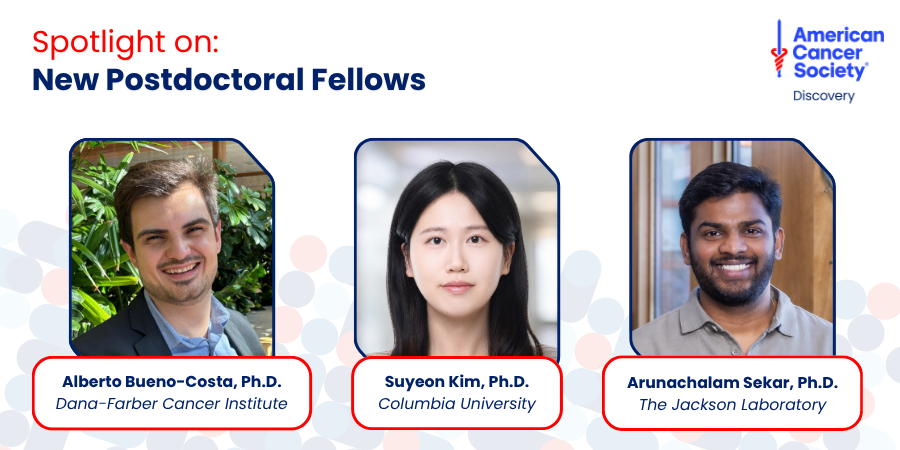
Spotlight on:
New Postdoctoral Fellows
- Alberto Bueno-Costa, Ph.D.
Dana-Farber Cancer Institute
- Suyeon Kim, Ph.D.
Columbia University
- Arunachalam Sekar, Ph.D.
The Jackson Laboratory
American Cancer Society Discovery
Postdoctoral Fellows
Alberto Bueno-Costa, Ph.D.
Dana-Farber Cancer Institute
“Uncovering the intrinsic mechanisms of B7-H3 upregulation in Ewing sarcoma to enable next-generation CAR T cell therapy”
This project will investigate how a protein called B7-H3 becomes highly expressed in Ewing sarcoma and other childhood cancers, where it may serve as a promising target for immunotherapy. Building on the development of a new B7-H3-targeted CAR T cell therapy, Dr. Bueno-Costa will study how cancer cells regulate B7-H3 production and test whether these engineered immune cells can more effectively attack tumors while reducing side effects. This work could advance safer and more effective CAR T cell therapies for children with Ewing sarcoma and other difficult-to-treat solid tumors.
Suyeon Kim, Ph.D.
Columbia University
“Therapeutic resistance to multi-RAS inhibitors in KRAS-mutant lung cancer”
This project will investigate why KRAS-mutant lung cancers eventually become resistant to a promising new class of targeted therapies known as RAS inhibitors. Building on Dr. Kim’s preliminary work identifying epigenetic regulators that help cancer cells survive treatment, she will study how changes in gene regulation and interactions with the immune system enable tumors to escape therapy. She will also test whether targeting these pathways can restore sensitivity to treatment and prevent resistance from developing. This work could lead to more durable treatment strategies for patients with KRAS-driven lung cancer.
Arunachalam Sekar, Ph.D.
Jackson Laboratory
“Therapeutic targeting of ZBP1 in cardiomyocytes to mitigate chemotherapy-induced cardiac dysfunction”
This project will investigate why a widely used chemotherapy drug can cause lasting heart damage in some cancer patients. Building on Dr. Sekar’s previous work showing that chemotherapy-induced mitochondrial damage can trigger harmful inflammation in heart cells, this project will study how this process leads to cardiac injury and test new approaches to block it without affecting cancer treatment. He will also search for early warning signs of heart damage that can be detected in the blood. This work could lead to safer, more personalized chemotherapy treatments that better protect the long-term health of cancer survivors.
- Infographic
- Text Alternative
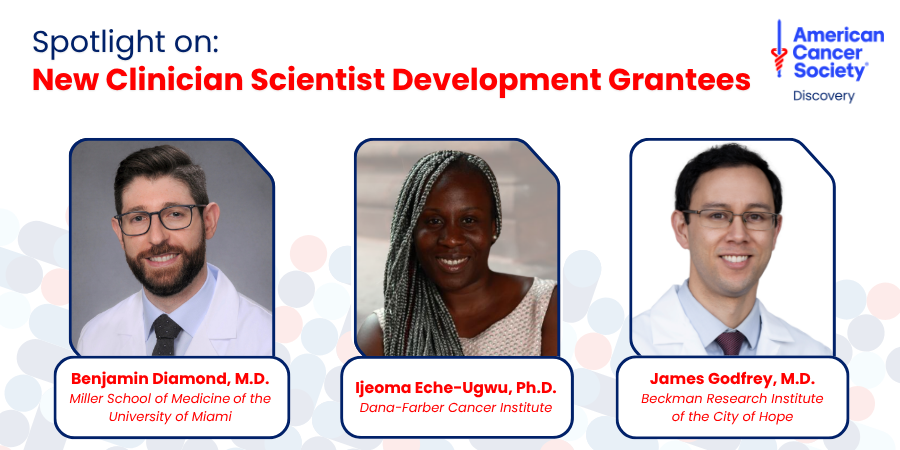
Spotlight on:
New Clinician Scientist Development Grantees
- Benjamin Diamond, M.D.
Miller School of Medicine of the University of Miami
- Ijeoma Eche-Ugwu, Ph.D.
Dana-Farber Cancer Institute
- James Godfrey, M.D.
Beckman Research Institute of the City of Hope
American Cancer Society Discovery
Clinician Scientist Development Grants
Benjamin Diamond, M.D.
Miller School of Medicine of the University of Miami
“Minimally Invasive Prediction of Response and Resistance to BCMA-directed T-Cell Redirecting Therapy in Multiple Myeloma”
This project will investigate why some multiple myeloma patients develop resistance to CAR-T cell therapies and T-cell engaging antibodies, two powerful forms of immunotherapy. Building on Dr. Diamond’s prior work showing that changes in tumor DNA can cause cancer cells to lose the targets these therapies recognize, he will identify genomic features that predict treatment response and resistance. He will also develop a blood-based test that can monitor disease throughout the body and detect resistance without the need for repeated bone marrow biopsies. This work could help guide treatment selection, improve monitoring of immunotherapy responses, and lead to more personalized care for patients with multiple myeloma.
Ijeoma Eche-Ugwu, Ph.D.
Dana-Farber Cancer Institute
“The African American Childhood Cancer Multiprong Psychosocial Nurse Intervention to Promote Equitable Psychosocial Outcomes in Pediatric Cancer Care”
This project will investigate how pediatric oncology nurses can better support African American parents of children with cancer, who often face additional emotional, social, and economic challenges that can affect their well-being during treatment. Building on prior research identifying barriers that limit nurses’ ability to provide equitable psychosocial care, Dr. Eche-Ugwu will refine and test a new intervention designed to help nurses deliver culturally responsive support. She will also identify factors that influence whether the program can be successfully implemented in real-world clinical settings. This work could improve psychosocial care for African American families affected by childhood cancer and help reduce disparities in cancer survivorship.
James Godfrey, M.D.
Beckman Research Institute of the City of Hope
“Improving outcomes of CNS lymphoma with T cell-based immunotherapy”
This project will investigate whether a promising new class of immunotherapies known as CD20 bispecific antibodies can improve outcomes for patients with central nervous system lymphoma (CNSL), an aggressive form of lymphoma that affects the brain, eyes, or spinal cord. Building on Dr. Godfrey’s previous work showing that these therapies can cross the blood-brain barrier and produce durable responses in CNSL patients, he will conduct a clinical study to evaluate their safety and effectiveness. He will also explore whether combining CD20 bispecific antibodies with CAR T cell therapy can further enhance anti-tumor immune responses. This work could expand treatment options and improve survival for patients with CNS lymphoma.
Learn more about our latest research grants
American Cancer Society news stories are copyrighted material and are not intended to be used as press releases. For reprint requests, please see our Content Usage Policy.