Your gift is 100% tax deductible.
Small Intestine Cancer (Adenocarcinoma) Stages
After someone is diagnosed with small intestine cancer, doctors will try to figure out if it has spread and, if so, how far. This process is called staging. The stage of a cancer describes the extent of the cancer in the body. It helps determine how serious the cancer is and how best to treat it. Doctors also use a cancer's stage when talking about survival statistics.
This information is about small intestine cancers called adenocarcinomas. To learn about other types of cancer that can start in the small intestine, see Gastrointestinal Carcinoid Tumors, Gastrointestinal Stromal Tumors, or Non-Hodgkin Lymphoma.
What are the stages of small intestine cancer (adenocarcinoma)?
The earliest stage small intestine cancers are called stage 0 (carcinoma in situ) and then range from stages I through IV.
As a rule, the lower the number, the less the cancer has spread. A higher number, such as stage IV, means cancer has spread more.
Although each person’s cancer experience is unique, cancers with similar stages tend to have a similar outlook and are often treated in much the same way.
How small intestine cancer typically grows
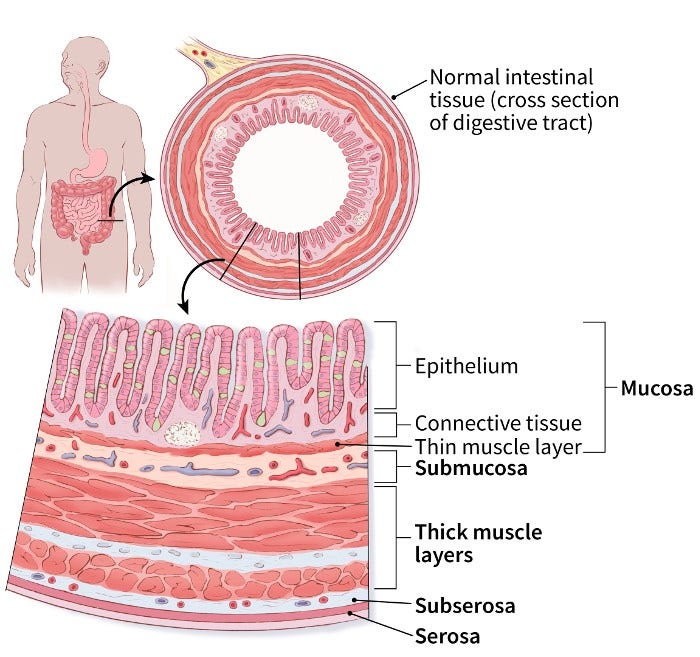
Small intestine cancers typically start in the inner lining of the intestine. As they grow, they can spread into deeper layers. These layers include:
- Mucosa: The innermost layer. It has 3 parts: the top layer of cells (epithelium), a thin layer of connective tissue (lamina propria), and a thin layer of muscle (muscularis mucosa).
- Submucosa: The fibrous tissue that lies beneath the mucosa.
- Thick muscle layers (muscularis propria): This layer of muscle contracts to move food along the GI tract.
- Subserosa and serosa (visceral peritoneum): The thin outermost layers of connective tissue that cover the GI tract.
How is the stage determined?
For small intestine cancer, doctors use the TNM system, developed by the American Joint Committee on Cancer (AJCC).
To determine the stage, doctors look at 3 key pieces of information:
- Tumor (T): How far has the cancer grown into the layers of the wall of the small intestine? Has it reached nearby structures or organs?
- Nodes (N): Has the cancer spread to nearby lymph nodes?
- Metastasis (M): Has the cancer spread to distant parts of the body? Small intestine cancer most often spreads to the liver and the inner lining of the abdomen (peritoneal cavity).
Numbers or letters after T, N, and M provide more details about each of these factors. Higher numbers mean the cancer is more advanced.
Once the T, N, and M categories have been determined, this information is combined in a process called stage grouping to assign an overall stage. For more information, see Cancer Staging.
Clinical vs. pathologic stage
There are 2 kinds of staging for small intestine cancer:
- The clinical stage is based on the results of any exams, biopsies, and imaging tests that might have been done.
- If surgery is done, the pathologic stage (or surgical stage) can also be determined. This is based on the clinical stage, plus what is found during surgery.
Stages of small intestine adenocarcinoma
The system described below is the most recent AJCC system, effective January 2018. It is only used for staging adenocarcinoma of the small intestine.
Small intestine cancer staging can be complex. If you have any questions about the stage of your cancer or what it means, ask your doctor to explain it to you in a way you understand.
Stage grouping: Tis, N0, M0
The cancer is only in the epithelium (the top layer of cells of the mucosa). It has not grown into the deeper tissue layers (Tis, also called high-grade dysplasia or carcinoma in situ).
It has not spread to nearby lymph nodes (N0) or distant parts of the body (M0).
Stage grouping: T1 or T2, N0, M0
The cancer has grown into deeper layers (the lamina propria or the submucosa) (T1) OR it has grown through the submucosa into the muscularis propria (T2).
The cancer has not spread to nearby lymph nodes (N0) or to distant parts of the body (M0).
Stage IIA (stage grouping: T3, N0, M0)
The cancer has grown through the muscularis propria and into the subserosa.
It has not started to grow into any nearby organs or structures (T3).
The cancer has not spread to nearby lymph nodes (N0) or to distant parts of the body (M0).
Stage IIB (stage grouping: T4, N0, M0)
The cancer has grown through the outer layer of tissue covering the intestine (the serosa or visceral peritoneum) or into nearby organs or structures (T4).
The cancer has not spread to nearby lymph nodes (N0) or to distant parts of the body (M0).
Stage IIIA (stage grouping: any T, N1, M0)
The cancer might have grown into any layers of the wall of the small intestine (Any T). It has spread to 1 or 2 nearby lymph nodes (N1) but not to distant parts of the body (M0).
Stage IIIB (Stage grouping: any T, N2, M0)
The cancer might have grown into any layers of the wall of the small intestine (Any T). It has spread to 3 or more nearby lymph nodes (N2) but not to distant parts of the body (M0).
Stage IV (stage grouping: any T, any N, M1)
The cancer might have grown into any layers of the wall of the small intestine (Any T).
It might or might not have spread to nearby lymph nodes (Any N).
It has spread to distant lymph nodes or organs such as the liver or the peritoneum (the inner lining of the abdomen) (M1).
Other staging categories you may see
- TX: Main tumor cannot be assessed due to lack of information.
- T0: No evidence of a main tumor.
- NX: Nearby lymph nodes cannot be assessed due to lack of information.
- Written by
- References

Developed by the American Cancer Society medical and editorial content team with medical review and contribution by the American Society of Clinical Oncology (ASCO).
American Joint Committee on Cancer. Small Intestine. In: AJCC Cancer Staging Manual. 8th ed. New York, NY: Springer; 2017:221-234.
Last Revised: February 9, 2026
American Cancer Society medical information is copyrighted material. For reprint requests, please see our Content Usage Policy.
American Cancer Society Emails
Sign up to stay up-to-date with news, valuable information, and ways to get involved with the American Cancer Society.