Your gift is 100% tax deductible.
Prostate Cancer
Prostate cancer is the most common cancer among men, after skin cancer. If you have prostate cancer or are close to someone who does, knowing what to expect can help you cope. Here you can find out all about prostate cancer, including risk factors, symptoms, how it is found, and how it is treated.
About prostate cancer
Prostate cancer begins when cells in the prostate gland start to grow out of control. The prostate is a gland found only in males.
The prostate
The prostate makes some of the fluid that is part of semen. It is below the bladder (the hollow organ where urine is stored) and in front of the rectum (the last part of the intestines).
Just behind the prostate are glands called seminal vesicles, which make most of the fluid for semen.
The urethra, which is the tube that carries urine and semen out of the body through the penis, goes through the center of the prostate.
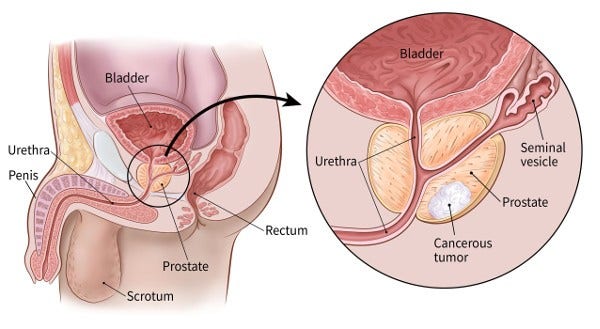
The prostate tends to grow as a man ages. In younger men, it is about the size of a walnut, but it can be much larger in older men.
Types of prostate cancer
Almost all prostate cancers are adenocarcinomas. These cancers develop from the gland cells in the prostate, which normally make the prostate fluid that is added to semen.
Other, rare types of cancer that can start in the prostate include:
- Small cell carcinoma, also known as small cell neuroendocrine carcinoma
- Other neuroendocrine tumors (NETs), including large cell carcinoma
- Transitional cell carcinoma
- Some types of soft tissue sarcomas
If you are told you have prostate cancer, it is very likely to be an adenocarcinoma.
Some prostate cancers can grow and spread quickly, but most tend to grow slowly. To learn more, see the information on prostate cancer grades in Tests to Diagnose and Stage Prostate Cancer.
Possible precancerous conditions of the prostate
Prostate cancer seems to start out as a precancerous condition, at least in some cases. These conditions are sometimes found during a prostate biopsy (removal of small pieces of the prostate to look for cancer).
Prostatic intraepithelial neoplasia (PIN)
In PIN, the prostate cells don’t look normal, but the abnormal cells don’t look like they are invading into other parts of the prostate like cancer cells would. PIN is not cancer, but it can sometimes lead to a higher risk of prostate cancer.
PIN is classified based on how the patterns of prostate cells look:
- Low-grade PIN: The patterns of cells appear almost normal. It is not thought to affect your risk of prostate cancer.
- High-grade PIN: The patterns of cells look more abnormal. If you have high-grade PIN, you have a higher risk of developing prostate cancer over time. However, most often high-grade PIN does not turn into cancer.
Proliferative inflammatory atrophy (PIA)
In PIA, the prostate cells look smaller than normal, and there are signs of inflammation in the area. PIA is not cancer, and it’s not yet clear whether PIA might lead to high-grade PIN or prostate cancer.
For more on noncancer conditions that might be seen on a prostate biopsy, including PIN, see Tests to Diagnose and Stage Prostate Cancer.
More resources
- Written by
- References

Developed by the American Cancer Society medical and editorial content team with medical review and contribution by the American Society of Clinical Oncology (ASCO).
National Cancer Institute. Prostate Cancer Treatment (PDQ®)–Health Professional Version. 2025. Accessed at https://www.cancer.gov/types/prostate/hp/prostate-treatment-pdq on July 23, 2026.
Nelson WG, Antonarakis ES, Carter HB, DeMarzo AM, DeWeese TL. Chapter 81: Prostate Cancer. In: Niederhuber JE, Armitage JO, Doroshow JH, Kastan MB, Tepper JE, eds. Abeloff’s Clinical Oncology. 6th ed. Philadelphia, Pa: Elsevier; 2020.
Yang XJ. Interpretation of prostate biopsy. UpToDate. 2026. Accessed at https://www.uptodate.com/contents/interpretation-of-prostate-biopsy on July 23, 2026.
Yang XJ. Precancerous lesions of the prostate: Pathology and clinical implications. UpToDate. 2026. Accessed at https://www.uptodate.com/contents/precancerous-lesions-of-the-prostate-pathology-and-clinical-implications on July 23, 2026.
Last Revised: October 13, 2026
American Cancer Society medical information is copyrighted material. For reprint requests, please see our Content Usage Policy.