Highlights from the New ACS Early Career Research Grantees
36 new RSGs and 13 new CSDGs have been awarded by the American Cancer Society.
- Infographic
- Text Alternative
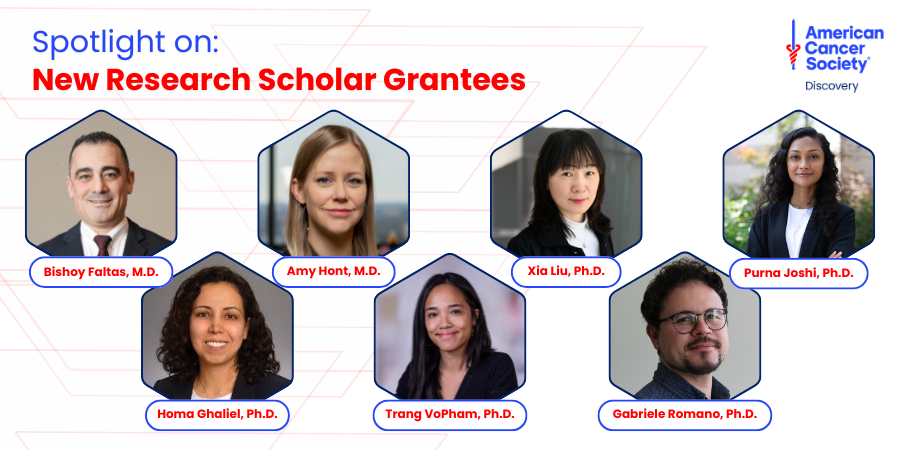
Spotlight on:
New Research Scholar Grantees
- Bishoy Faltas, MD
- Homa Ghaliel, PhD
- Amy Hont, MD
- Trang VoPham, PhD
- Xia Liu, PhD
- Gabriele Romano, PhD
- Purna Joshi, PhD
American Cancer Society Discovery
Funding received in the initial years after an investigator first establishes their research lab can be pivotal in helping to turn early promise into long-term presence and impact in cancer research. As part of our Spring 2026 grant slate, the American Cancer Society (ACS) is providing exactly this type of support through two distinct grant mechanisms: Clinician Scientist Development Grants (CSDGs) provide financial support for clinicians just transitioning into a research role while Research Scholar Grants (RSGs) provide financial support to any independent investigators within the first ten years of their careers.
“Research Scholar Grants and Clinician Scientist Development Grants have long been central to ACS’s approach to supporting high‑quality cancer research,” said Paul Campbell, PhD, scientific director of the Cell Biology and Preclinical Cancer Research program at the American Cancer Society. “Together, these programs provide investigators in the earlier stages of their research careers with the stability needed to sustain productive labs, refine their ideas, grow their scientific expertise, and continue advancing important lines of investigation.”
As part of our Spring 2026 grant slate, the American Cancer Society awarded 36 new RSGs to investigators at 30 institutions. New CSDGs were also awarded to 13 individuals at twelve institutions.
Today we are highlighting the exciting work of several of our new RSG and CSDG recipients that are part of the larger Spring 2026 grant slate. The full list of new RSGs can be found at the link above.
Research Scholar Grants
Bishoy Faltas, M.D.
Weill Cornell Medicine
Research Scholar Grant
Project Title: “Germline-somatic interactions as drivers and therapeutic targets in bladder cancer”
This project will explore new ways to treat advanced urothelial cancer of the bladder by uncovering hidden genetic weaknesses that current therapies often miss. The research focuses on inherited genetic changes that affect how cells repair DNA, which are present in a significant number of patients and can work together with cancer-specific mutations to drive disease progression. By studying how these inherited and tumor-acquired changes interact, the team aims to identify novel therapeutic targets and corresponding drug combinations that more precisely target these genetic vulnerabilities. This work could lead to more effective, personalized treatments for patients whose bladder cancer does not respond to existing options.
Homa Ghalei, Ph.D.
Emory University
Research Scholar Grant
Project Title: “Understanding the role of snoRNAs and snoRNA-guided modifications in lung cancer”
This study will investigate the molecular mechanisms by which non-coding RNAs and RNA chemical modifications contribute to the invasiveness of different lung cancer cell subpopulations that may co-exist within a single metastatic lung tumor. The research utilizes two well-characterized lung cancer cell subpopulations (one that is rare and slow-growing but highly invasive and one that is highly proliferative but noninvasive) and their parental population as a model to uncover hidden molecular features that allow cancer cells to spread and evade therapy. This work could reveal new targets for treatment and lead to strategies that better control aggressive lung cancer and improve patient survival.
Amy Hont, M.D.
Children’s Research Institute
Research Scholar Grant
Project Title: “Optimizing Immunotherapy for Enhanced Anti-tumor Activity in Pediatric Solid Tumors”
This project will test new immune-based treatments for children whose solid tumors have returned or stopped responding to standard therapy. investigates whether the use of tumor-associated antigen-specific products generated from healthy donors and matched to tumor cells (similar to bone marrow transplants) combined with chemotherapy and targeted tumor ablation can strengthen the immune system’s ability to recognize and destroy cancer cells. By pairing localized tumor destruction with more powerful immune cells, the approach aims to overcome barriers that have limited the success of past immunotherapies. This work could lead to safer, more effective treatment options and improved survival for children with some of the most difficult-to-treat cancers.
Purna Joshi, Ph.D.
University of Texas at Dallas
Research Scholar Grant
Project Title: “Obesity-driven Adipocyte Progenitor Fate and Function in Postmenopausal Mammary Cancer”
This project will explore why obesity increases both the risk of developing breast cancer and the chances of worse outcomes after diagnosis, especially in postmenopausal women. The research focuses on immature fat cells in breast tissue, which may actively shape a cancer-friendly environment and even give rise to the types of cells where breast cancer begins. By studying how these fat cell precursors behave in obesity, the team aims to uncover how excess body fat drives cancer growth and spread. This work could lead to better screening tools and new diet-based or drug treatments to prevent and treat obesity-associated breast cancer, helping reduce disparities in outcomes for women at highest risk.
Xia Liu, Ph.D.
University of Kentucky
Research Scholar Grant
Project Title: “p38d in tumor-associated "emergency" granulopoiesis and immunosuppression”
This project will investigate why immunotherapy often fails in triple-negative breast cancer (TNBC) and how it can be made more effective for more patients. The study builds on the discovery that a harmful type of immune cell (CD62L-negative neutrophils) can block the body’s ability to respond to anti-PD1 therapy, one of the few immune-based treatments available for this aggressive cancer. By targeting a key protein that drives production of these cells and identifying markers to predict who will benefit, the research aims to improve responsiveness to anti-PD1 therapy. This work could lead to more personalized, effective treatments for TNBC while sparing patients from unnecessary side effects and costs.
Tracy Liu, Ph.D.
West Virginia University
Research Scholar Grant
Project Title: “Optimizing Chemotherapy Response in Pancreatic Cancer by Targeting Tumor-Associated Myeloid Cells”
Tumor-associated myeloid cells are white blood cells that have been manipulated by the environment surrounding pancreatic cancer cells to help the cancer grow and resist treatment. Dr. Liu is working to understand how these cells contribute to treatment resistance and to find ways to target these cells to improve pancreatic treatment outcomes in response to chemotherapy. In this project, she will be testing existing drugs that are known to block the enzyme myeloperoxidase, which is found mainly in myeloid cells, with the goal of identifying compounds that can be utilized as a novel adjuvant therapy for pancreatic cancer.
Gabriele Romano, Ph.D.
Drexel University
Research Scholar Grant
Project Title: “Immune Profiling and Therapeutic Interventions in PLWH with Cutaneous Melanoma”
This project will investigate why immunotherapy is less effective for people living with HIV who develop melanoma, an aggressive skin cancer with especially poor outcomes in this group. The research focuses on understanding how long-term HIV infection alters the immune system and creates a tumor environment that weakens cancer-fighting immune cells and encourages cancer spread, including to the brain. By studying patient samples, advanced lab models, and specialized mouse models, the team will investigate drivers of this “T cell exhaustion” and test new combinations of immune therapies designed to overcome them. This work could lead to more effective, tailored cancer treatments and improved survival for people living with HIV who face melanoma.
Trang VoPham, Ph.D.
Fred Hutchinson Cancer Center
Research Scholar Grant
Project Title: “Solar Jetlag and Health Disparities in Liver Cancer”
This study will examine whether long-term disruption of sleep and daily body rhythms, or “solar jetlag”, raises the risk of developing a form liver cancer known as hepatocellular carcinoma. Solar jetlag occurs when people living in the western part of a time zone are exposed to light later at night but must still wake early, leading to chronic sleep loss and biological stress. Using detailed location data and health records from more than 23 million U.S. Veterans, the researchers will determine whether higher solar jetlag is linked to liver cancer directly or through conditions like obesity and diabetes. If confirmed, this work could identify a new, preventable risk factor for liver cancer and guide sleep-based interventions to reduce cancer risk and health disparities.
- Infographic
- Text Alternative
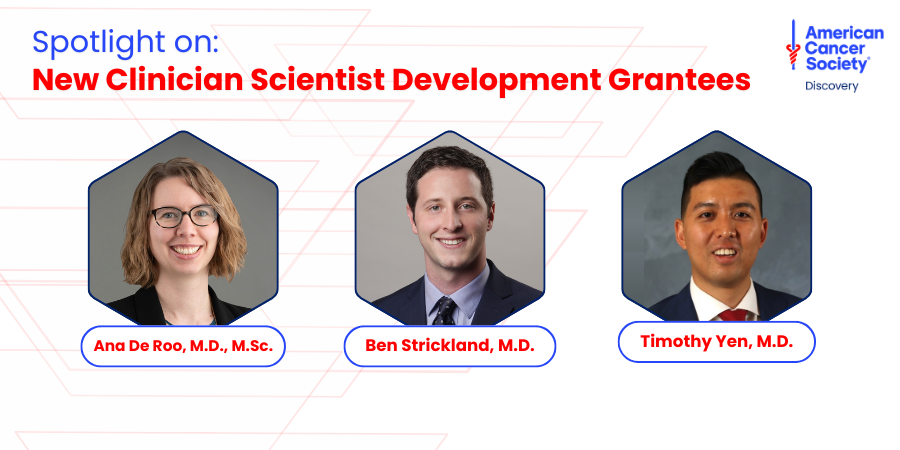
Spotlight on:
New Clinician Scientist Development Grantees
- Ana De Roo, MD, MSc
- Ben Strickland, MD
- Timothy Yen, MD
American Cancer Society Discovery
Clinician Scientist Development Grants
Ana De Roo, M.D., M.Sc.
University of Wisconsin-Madison
Clinician Scientist Development Grant
Project Title: “Promoting Patient-Centered Communication for De-Escalation of Locally Advanced Rectal Cancer Treatment”
This project aims to improve how doctors and patients discuss treatment options for rectal cancer, especially given growing recognition that some patients may be able to safely avoid either surgery or radiation. Because doctors cannot know the full scope of required treatment until they can see how the patient is responding to the initial treatments, clear communication with patients about the potential options and outcomes is essential. The study will gather input from patients and care teams to understand what information patients need most and at which stage in the treatment cycle. By adapting and teaching a proven communication framework known as Better Conversations, this work seeks to help patients make informed choices that protect both survival and quality of life.
Ben Strickland, M.D.
Medical University of South Carolina
Clinician Scientist Development Grant
Project Title: “Targeting the C5a Receptor to Reprogram Tumor Macrophages in Glioblastoma”
This project will explore a new immune-based treatment approach for glioblastoma, an aggressive brain cancer with very limited survival. The research focuses on reprogramming immune cells called macrophages that tumors use to suppress the body’s natural cancer defenses. By targeting a key molecular switch that controls whether these cells help or fight the tumor and pairing this strategy with existing immunotherapy, the study aims to restore immune attack against the cancer. This work could pave the way for more effective treatments and future clinical trials for patients with glioblastoma.
Timothy Yen, M.D.
Loma Linda University
Clinician Scientist Development Grant
Project Title: “Establishing risk factors for and lifetime cumulative risks of cancer in Lynch syndrome”
This project will identify new ways to prevent digestive cancers in people with Lynch syndrome, a common hereditary cancer syndrome that greatly increases cancer risk at younger ages than the average person. By using a large national health records database, the study will examine whether factors like high cholesterol, fatty liver disease, chronic inflammation, or use of immune suppression medications are associated with increased digestive cancer risk in individuals with Lynch syndrome. Understanding these modifiable risk factors could point to new prevention strategies beyond current screening approaches alone and reduce cancer risk among both Lynch syndrome and other hereditary cancer syndrome patients.
To learn more about the more than 850 research grants currently being funded by the American Cancer Society, and/or to learn more about our upcoming grant opportunities, please visit the Extramural Discovery Science (EDS) homepage. To see additional highlights from this newly announced slate of grants, please be sure to check back often on this page and to connect with us on LinkedIn, Facebook, and Instagram.
American Cancer Society news stories are copyrighted material and are not intended to be used as press releases. For reprint requests, please see our Content Usage Policy.