American Cancer Society Supports Researchers Advancing Bold Ideas Toward Patient Impact
New Research Scholar and Mission Boost Grants will help investigators pursue innovative discoveries and move promising findings closer to clinical application.

As part of our recently announced slate of new grants, the American Cancer Society (ACS) is proud to support a new cohort of Research Scholar Grant and Mission Boost Grant recipients. Together, these awards help ensure that innovative cancer research can move forward at critical stages, from establishing independent research programs to advancing discoveries toward testing in patients.
"Advancing cancer research requires both innovative ideas and sustained investment in the researchers who bring those ideas to life," said Douglas Hurst, PhD, Scientific Director of the Biochemistry and Immunology of Cancer research program at the American Cancer Society. "Through Research Scholar Grants, ACS supports outstanding early-career investigators as they build independent research programs, while Mission Boost Grants help accelerate promising discoveries toward testing in patients. Together, these awards reflect our commitment to fostering innovation across the research continuum and moving the most promising science closer to real-world impact."
Research Scholar Grants provide critical support for investigators in the early years of their independent careers, allowing them to pursue bold ideas and generate the foundational discoveries that can shape the future of cancer research. Through this grant cycle, ACS is investing more than $14 million in new Research Scholar Grants awarded to 15 investigators.
Mission Boost Grants build on that foundation by helping current and former ACS grantees overcome common barriers that can prevent promising discoveries from reaching patients. By supporting translational research, these awards help move innovative science beyond the laboratory and toward clinical application. In this cycle, ACS is investing $1.79 million in new Mission Boost Grants (including four Stage I grants and one Stage II grant). Notably, three of this year's new Mission Boost Grant recipients previously received ACS Research Scholar Grants, illustrating how sustained investment can help researchers advance their work from early discovery to potential patient benefit.
The projects supported through these awards span a wide range of scientific disciplines, but they share a common goal: transforming innovative ideas into advances that improve the lives of people affected by cancer. Below, we highlight several of the researchers and projects funded through this year's Research Scholar and Mission Boost Grants.
- Infographic
- Text Alternative
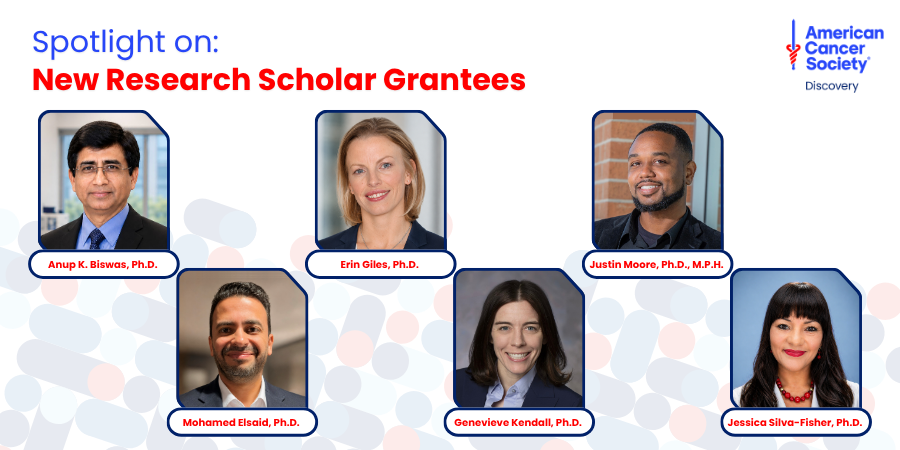
Spotlight on:
New Research Scholar Grantees
- Anup K. Biswas, Ph.D.
- Mohammed Elsaid, Ph.D.
- Erin Giles, Ph.D.
- Genevieve Kendall, Ph.D.
- Justin Moore, Ph.D., M.P.H.
- Jessica Silva-Fisher, Ph.D.
American Cancer Society Discovery
Research Scholar Grants
Anup K. Biswas, Ph.D.
Columbia University
“Identifying mediators of brain metastasis in EGFR-mutant lung cancer”
This project will investigate why brain metastases frequently develop and recur in patients with EGFR-mutant lung cancer, even after treatment with advanced targeted therapies. Building on his previous work identifying the signaling molecule IL-18 as a potential driver of brain metastasis, Dr. Biswas will study how IL-18 helps cancer cells survive in the brain and whether blocking it can prevent or reduce treatment-resistant tumors. he will also evaluate whether IL-18 levels can help identify patients at increased risk of brain relapse. This work could lead to new strategies for preventing and treating brain metastases in patients with EGFR-mutant lung cancer.
Mohamed Elsaid, Ph.D.
The Ohio State University
“Access Equity and Causal Effects of Glucagon Like Peptide 1 Agonist on HepatoCellular Carcinoma Prevention and Survivorship in Patients with Cirrhosis”
This project will investigate whether GLP-1 receptor agonists, a new class of diabetes and weight-loss medications, can help prevent liver cancer in people with cirrhosis. Using health data from millions of patients, Dr. Elsaid will examine whether these medications reduce cancer risk and improve survival while identifying barriers that may limit access among underserved populations. This work could help guide liver cancer prevention strategies and improve equitable access to therapies that reduce cancer risk.
Erin Giles, M.D.
University of Michigan
“Understanding the impact of new-generation incretin-mimetic weight loss agents in breast cancer”
This project will investigate whether tirzepatide, a widely used weight-loss and diabetes medication, can improve outcomes for women with obesity-related breast cancer. Using a preclinical model that reflects breast cancer in postmenopausal women, Dr. Giles will examine how tirzepatide affects tumor growth and whether it can reduce metabolic side effects associated with hormone therapies. She will also test whether combining tirzepatide with resistance exercise can help preserve muscle mass during weight loss. This work could identify new strategies to improve both cancer outcomes and long-term health for breast cancer patients with obesity.
Genevieve C. Kendall, Ph.D.
The Research Institute at Nationwide Children’s Hospital
“Biological Consequences of Neural Signatures in Fusion-Positive Rhabdomyosarcoma”
This project will investigate how a cancer-driving mutation called PAX3::FOXO1 promotes the development of rhabdomyosarcoma, an aggressive childhood cancer with limited treatment options. Building on decades of research identifying PAX3::FOXO1 as the primary genetic driver of this disease, Dr. Kendall will study how it alters normal developmental programs and cooperates with other genes to transform healthy cells into cancer cells. Using complementary models of rhabdomyosarcoma, she will identify critical vulnerabilities that could be targeted with new therapies. This work could reveal novel treatment strategies for children with this aggressive form of cancer.
Justin X. Moore, Ph.D., M.P.H.
University of Kentucky Research Foundation
“Systemic Discrimination, Cumulative Stress, and Cancer Disparities among LGBTQ populations”
This project will investigate how discrimination and chronic stress contribute to cancer risk among LGBTQ+ adults. Using large-scale health data, surveys, and interviews, Dr. Moore will examine how experiences of unfair treatment influence stress, health behaviors, and access to cancer prevention and screening services. He will also identify barriers that may place LGBTQ+ individuals at increased risk for poor cancer outcomes. This work could help guide interventions that improve access to cancer prevention, screening, and supportive care for LGBTQ+ communities.
Jessica Silva-Fisher, Ph.D.
Washington University in St. Louis
“Identifying and characterizing RNA modifications in relapsed or refractory multiple myeloma”
This project will investigate how chemical modifications to RNA contribute to the progression of multiple myeloma and the development of treatment resistance. Building on Dr. Silva-Fisher’s previous work identifying a modified RNA molecule called LINC00342 that is elevated in relapsed disease and promotes cancer cell survival, here she will study how these RNA modifications influence tumor growth and identify other modified RNA molecules associated with disease progression. This work could reveal new therapeutic targets and lead to novel treatment strategies for patients with relapsed or treatment-resistant multiple myeloma.
- Infographic
- Text Alternative
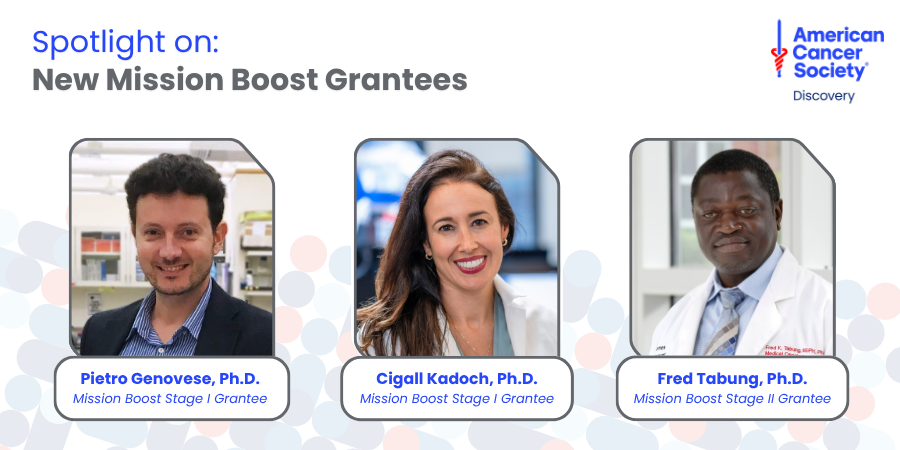
Spotlight on:
New Mission Boost Grantees
- Pietro Genovese, Ph.D.
Mission Boost Stage I Grantee
- Cigall Kadoch, Ph.D.
Mission Boost Stage I Grantee
- Fred Tabung, Ph.D.
Mission Boost Stage II Grantee
American Cancer Society Discovery
Mission Boost Grants
Pietro Genovese, Ph.D.
Boston Children’s Hospital
Mission Boost Stage I Grant
“Manufacturing an Immunotherapy-Resistant Hematopoiesis to Treat Acute Myeloid Leukemia”
This project will advance a novel immunotherapy strategy for acute myeloid leukemia (AML), an aggressive blood cancer that frequently recurs after treatment. Building on promising preclinical studies, Dr. Genovese has developed a precise gene-editing approach that modifies donor blood stem cells to protect them from FLT3-targeted immune therapies while preserving their ability to regenerate healthy blood cells. He will establish a clinical-scale manufacturing process for these edited stem cells, develop methods to collect the cells needed for treatment, and complete the regulatory and clinical preparations required for a first-in-human trial. This work could enable safer and more effective immunotherapies for patients with high-risk AML and provide a platform for treating other difficult-to-treat cancers.
Cigall Kadoch, Ph.D.
Dana-Farber Cancer Institute
Mission Boost Stage I Grant
“SMARCA4/2 Inhibition as a Therapeutic Strategy for POU2F3-positive Small Cell Lung Cancer”
This project will advance a targeted treatment strategy for a distinct subtype of small cell lung cancer (SCLC), an aggressive disease with limited treatment options. Dr. Kadoch’s research team recently identified a protein complex called mSWI/SNF as a key regulator of the transcription factor POU2F3, which drives tumor growth in approximately 12% of SCLCs. Building on this work, Dr. Kadoch will use patient-derived models to better understand why POU2F3-positive tumors are especially sensitive to FHD-286, a clinical-stage inhibitor of mSWI/SNF activity, and generate the data needed to support a clinical trial. This work could lead to a new precision medicine approach for patients with POU2F3-positive SCLC and improve outcomes for a patient population with significant unmet need.
Fred Tabung, Ph.D.
The Ohio State University
Mission Boost Stage II Grant
“Low-insulinemic dietary pattern for breast cancer prevention among high-risk women: A phase II randomized-controlled dietary pattern intervention”
This project will evaluate a novel dietary intervention designed to reduce breast cancer risk among women at elevated risk for the disease. With support from Dr. Tabung’s prior Stage I Mission Boost Grant, his team demonstrated that a low-insulinemic eating pattern, known as the rEDIH diet, was highly acceptable to participants and was associated with improvements in dietary behaviors and early signs of improvements in blood sugar, cholesterol, and inflammation. In Stage II, Dr. Tabung will conduct a six-month study comparing the rEDIH diet to the Dietary Guidelines for Americans and assess its effects on metabolic, inflammatory, and quality-of-life measures. This work could provide evidence for a personalized nutrition strategy to reduce breast cancer risk and guide future prevention efforts for high-risk women.
Learn more about our latest research grants
American Cancer Society news stories are copyrighted material and are not intended to be used as press releases. For reprint requests, please see our Content Usage Policy.