Your gift is 100% tax deductible.
Filling in the Research Gaps About High-Tobacco-Burden US States
ACS Researchers published a special supplement with 10 original articles on tobacco-related disparities in the 13 states with the most cigarette smokers.
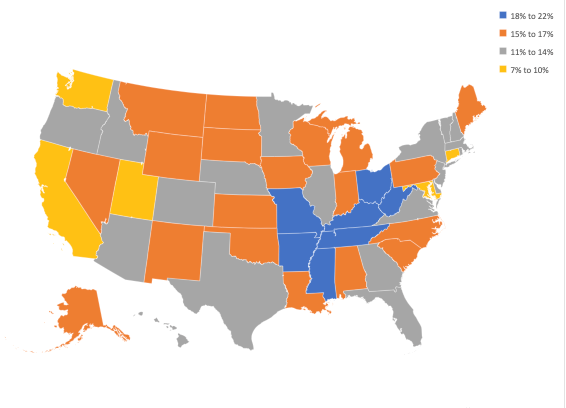
Current Cigarette Smoking Prevalence by State for Adults Age 18 and Older in 2022
This United States map shows the states with the highest cigarette smoking prevalence in blue: Alabama, Arkansas, Kentucky, Mississippi, Missouri, Ohio, Tennessee, and West Virginia. The next highest use states (in orange) are Indiana, Louisiana, Michigan, Oklahoma, and South Carolina. Yellow and gray states have a lower prevalence of cigarette smoking.
More than 60 years ago, the United States Surgeon General reported that using tobacco was deadly. Since then, smoking in the US has continually decreased—from 42% in 1965 to 10% in 2024. Yet, using tobacco is still the leading cause of disease, disability, and preventable death in the US.
Progress has not been equal across the country, and it’s most delayed in the states where many people smoke. Scientists describe these Midwest and Southern regions as high-tobacco-burden states. In these states, the prevalence of tobacco use is 35%:
- Alabama
- Arkansas
- Indiana
- Kentucky
- Louisiana
- Michigan
- Mississippi
- Missouri
- Ohio
- Oklahoma
- South Carolina
- Tennessee
- West Virginia
In comparison, stronger tobacco control in 4 low-tobacco-burden states—California, Illinois, Maryland, and Virginia—reduces the use to 28%.
The highest overall tobacco use is in Arkansas—at 43%. Cigarette smoking is highest in West Virginia—at 26%. (California has the lowest cigarette use at 11%.)
Another problem in these high-use states is the widespread use of new, rapidly evolving tobacco products. These include e-cigarettes and nicotine pouches. Plus, it’s now common for people to use more than one type of tobacco or nicotine product at a time or using tobacco with another substance like cannabis or alcohol. Regions with a high density of cigarette smoking may be most vulnerable because of this “polytobacco use.” The result may not only increase the risk of tobacco-related health problems but also make it harder for people to quit using tobacco.
Despite the dense tobacco use in these states, few have explored what causes them to be different from the rest of the country. In February 2026, the American Cancer Society (ACS) offered scientific evidence in a supplement of the American Journal of Preventive Medicine (AJPM) focused on: “Mitigating Tobacco-Related Disparities: A Subnational View of Tobacco Use Behaviors and Tobacco Control in High-Tobacco-Burden US States.”
The ACS goal was for their regionally focused research to improve the understanding about the relationships between social, economic, and policy issues driving the use of tobacco. With that data, the ACS and others can develop tailored tobacco control plans that will reduce the geographic differences in tobacco-related health problems.
To speed progress against the inequities within these states requires changing tobacco control policies to better target the needs of the region and for at-risk subgroups.”