Full-Body MRIs: What Are the Risks?
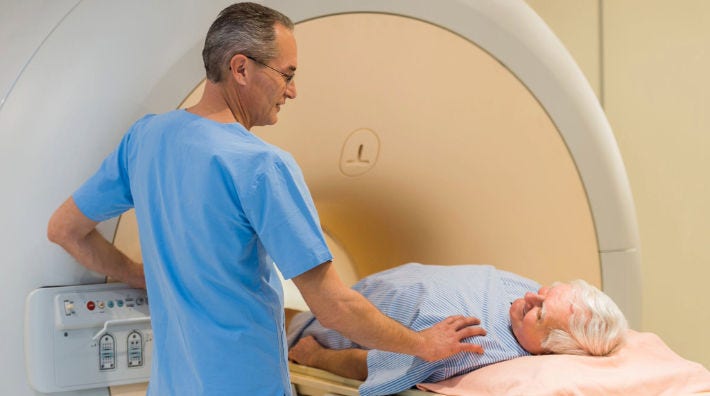
Ads and social media influencers have been singing the praises of full-body MRIs recently. People who recommend these scans often suggest that they can find cancer before someone notices any symptoms.
Despite the hype around full-body MRIs, no major medical groups, including the American College of Radiology, recommend these scans for people without specific health needs, such as a very high risk of certain cancers.
Healthcare professionals generally support being proactive about your health. But a full-body MRI “just gives you the illusion of knowledge. All you’ve gotten is information, and information without context is not knowledge,” said Clifton David Fuller, MD, PhD, a member of the American Society of Clinical Oncology (ASCO) and radiation oncologist at MD Anderson Cancer Center.
To understand why so many experts do not recommend a full-body MRI to predict cancer in the general public, it helps to understand how this technology works and how it’s used.
What is a full-body MRI?
Magnetic resonance imaging (MRI) is a type of scan commonly used to look at the inside of the body. For example, someone with a knee injury might get an MRI of their knee to help their doctor figure out what’s wrong. Or a doctor might recommend a breast MRI for a patient with a high risk of developing breast cancer. These types of MRIs produce images only of the body part being examined and are specialized for that body part.
But a full-body MRI, also called a whole-body MRI, is different. It scans the whole body in one session, rather than scanning a specific area. The time it takes to get a full-body MRI can depend on the technology available and the health history of the person getting the scan. Some companies claim the full-body scan offers an easy and noninvasive way to find cancer before it can cause health problems. But medical experts say it’s not that simple.
What are the risks of a full-body MRI?
Unlike x-ray tests and other imaging techniques, an MRI does not expose a person to radiation. “The risk comes from the possible downstream effects,” said Dr. Fuller.
Risks of this kind of scan include:
Anxiety: A full-body scan can show “spots” or “shadows” that could be something serious but are often just normal variations in the body. These are called “incidentalomas.” Without more information about a person’s symptoms or family history, a doctor may not be able to tell if the finding could be harmful. This can cause stress and worry.
Unnecessary procedures: If the scan does find a variation, you may need to get more tests. “Those workups have individual risks,” said Dr. Fuller. So you may wind up taking on additional risk to explore a medical problem that may not be real.
Misplaced confidence: “If you have a whole-body MRI and it finds nothing, that may give you a false sense of security,” said Dr. Fuller. These scans can miss existing issues (false negatives), although that’s less common than “finding” cancer that isn’t really there (false positives). In addition, a clean or “normal” scan today doesn’t mean cancer won’t develop later. You might even think you don’t need recommended screening tests, but they’re still the best way to find certain cancers early.
High cost: Full-body MRIs are expensive. Because they are not part of standard medical care, insurance companies rarely pay for them.
Reasons to avoid a full-body MRI
It’s important to note that the MRI machine uses a powerful magnet, so it isn’t safe for everyone. You may want to avoid this scan if you have:
- Metal in your body: The magnet can pull on or damage devices like pacemakers, ear implants, or older brain clips. It can also cause metal fragments, like shrapnel or certain tattoo inks, to shift or heat up.
- Claustrophobia: The machine is a very narrow, enclosed tube. This can cause some people to feel trapped or panicky.
- Trouble lying still: For the machine to get a clear picture, you must stay perfectly still for 45 to 90 minutes. If you move, the images will be too blurry for a doctor to use.
- Sensitivity to loud noises: The machine makes heavy thumping and knocking sounds. Even with headphones or earplugs, people with sensitive hearing or sensory issues may find these sounds challenging.
When are full-body MRIs recommended?
In some cases, a full-body MRI is the right choice. These scans are usually reserved for people with very specific health needs, including:
- Screening in family cancer syndromes: Doctors use whole-body MRIs to catch tumors early in people with genetic conditions that make it highly likely they’ll develop cancer at some point. One example is Li-Fraumeni syndrome.
- Monitoring advanced cancer: Doctors can use these scans to follow cancer that has spread to other parts of the body. Full-body MRIs are especially useful for cancers that tend to spread to the bones, such as prostate cancer and multiple myeloma.
A “spot” on a scan is more likely to indicate potential harm in people with these types of special health needs. So in specific cases like these, the benefits of finding cancer early outweigh the risks of the scan.
What are alternatives to full-body MRIs?
One of the best ways to stay on top of your health is to get regular cancer screening as recommended. American Cancer Society cancer screening guidelines are backed by years of science and high-quality data, such as findings from studies on mammograms, colonoscopies, and cervical cancer checks.
“If you’re thinking about getting a whole-body MRI, sit down with a healthcare provider you trust,” said Dr. Fuller. They’ll help you figure out why you want the scan, its pros and cons, and what you could do instead, based on your health history.
Again, keep in mind that full-body MRIs are not recommended by major medical groups for cancer detection in the general public. Still, if you are interested in this type of scan, ask your doctor:
- Based on my health history, am I a candidate for a full-body MRI?
- Do I have an elevated risk of cancer? How do you know?
- What types of cancer screening do you recommend based on my age and risk?
- If I get a full-body MRI and it finds an abnormality, what are the follow-up steps? What are the risks?
- What does it mean if I get a full-body MRI and it doesn’t find any abnormalities?
Learn more from the American Cancer Society:
- Cancer Risk and Prevention
- Find Cancer Early
- Cancer Prevention & Early Detection Facts & Figures
- CancerRisk360 assessment tool
Dr. Fuller is an ASCO member.
- Written by

Written by the American Society of Clinical Oncology (ASCO) with medical and editorial review by the American Cancer Society content team.