Your gift is 100% tax deductible.
Financial Hardship and Economic Burden of Cancer
American Cancer Society (ACS) Health Services researchers examine the costs of a cancer diagnosis for patients and families and how financial hardship can result, which may negatively affect care and patient outcomes, like quality-of-life and survival.
More broadly, ACS researchers also examine the economic costs of a cancer diagnosis to society, including health care spending and loss of wages due to premature deaths from cancer.
How Medical Financial Hardship May Cause Breakdowns in Care
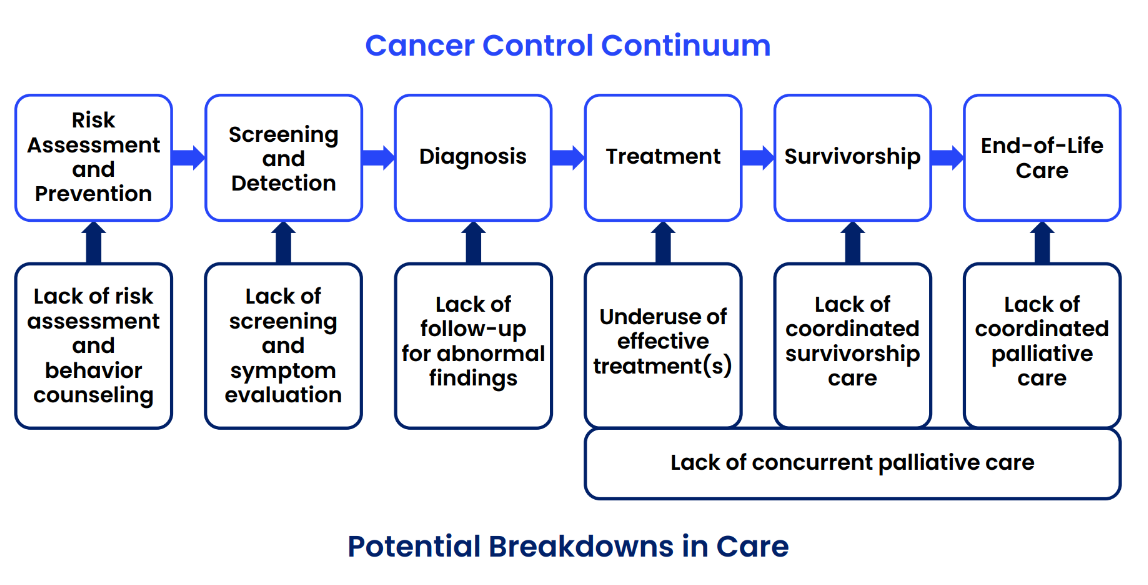
The top row of boxes shows the cancer control continuum, starting with risk assessment and prevention and ending with end-of-life care. The second row shows potential breakdowns in care that may occur due to medical financial hardship experienced by patients and families. The breakdowns are aligned with the part of the cancer control continuum they affect.
Cancer is one of the most expensive health conditions to treat. And the amount patients and their families spend on cancer care is only one piece of the economic burden after a diagnosis. Other pieces include loss of household income due to time away from work during treatment for patients and informal caregivers, additional travel to and from care, and additional childcare. Any one of these unplanned costs alone could cause some people to experience medical financial hardship.
Medical financial hardship can:
- Affect a person’s access to care across the cancer control continuum
- Make it hard for patients and their families to pay medical bills
- Create stress and worry about health care costs
- Result in delaying or forgoing care due to cost
- Worsen pre-existing financial hardship
- Worsen health outcomes
People with medical financial hardship may have breakdowns in care in one or more places across the cancer control continuum.
Prevention and screening breakdowns may occur because people experiencing financial hardship may not be able to afford a usual source of care to recommend it.
When screening does occur, people with financial hardship are less likely to receive timely follow-up of any abnormal findings because such follow-up care isn't always covered by insurance. That may leave patients and their families to pay the costs of follow-up care themselves. Delayed follow-up care after screening has the potential to result in a diagnosis at a later stage of disease, which may result in poor health outcomes.
When people are diagnosed with cancer and they are experiencing financial hardship they are less likely to receive timely treatment that is consistent with guidelines, including palliative care. That delay in care may contribute to people with financial hardship being more likely to have poor health outcomes, including quality of life and worse survival.
At the end of life, people with financial hardship are less likely to receive quality end-of-life care, including palliative care.
ACS researchers have collaborated extensively with scientists from the National Cancer Institute (NCI) and the Centers for Disease Control and Prevention (CDC) on studies about health care spending, costs associated with patient (and caregiver) time, and productivity losses due to morbidity and years of life lost due to premature death from cancer. Our research findings are routinely used by scientists in cost-effectiveness simulation models of cancer control interventions.
Our Research Focus
ACS Health Services researchers examine the costs of a cancer diagnosis for patients and families by evaluating the cost of treatments, lost wages, and reduced activities and productivity. As part of this work, the team studies:
- Healthcare spending
- Productivity losses for patients and informal family caregivers
- Medical financial hardship
- Disruptions in employment or other employment challenges
More broadly, ACS researchers also examine the economic costs of a cancer diagnosis to society, including total health care spending and loss of wages due to premature deaths from cancer.