Your gift is 100% tax deductible.
Health Services Research
The American Cancer Society (ACS) Health Services Research team examines factors at the level of the patient and family, provider, health system, environment, and local, state, and federal policy that can be modified to improve access to and receipt of affordable and high-quality cancer prevention, screening, treatment, survivorship, and end-of-life care. The underlying goals of this research are to identify modifiable factors to reduce disparities and improve equity in cancer outcomes for all patients.
Our Work
The goals of our research are to reduce disparities by identifying modifiable factors and improve equity in cancer outcomes for all patients.



We Study Factors Associated with Affordability, Access to Quality Care, and Patient Outcomes
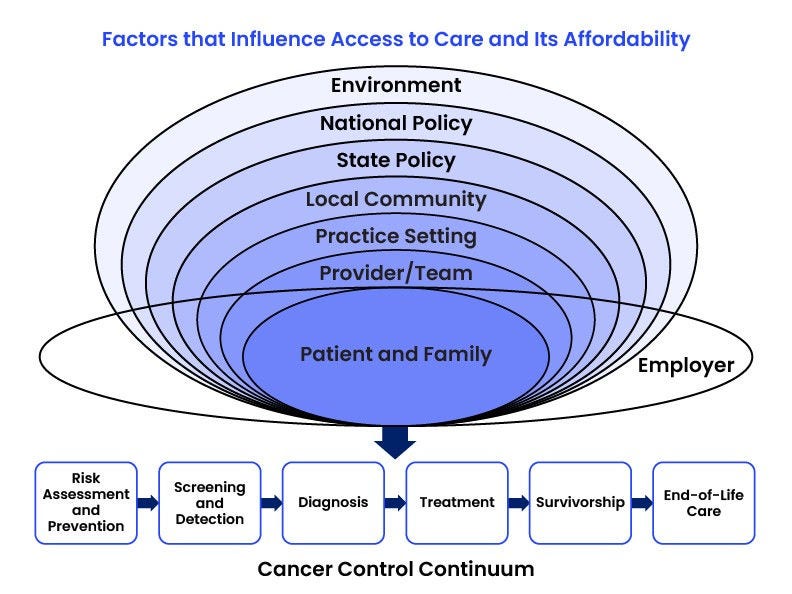
The concentric circles on the top part of this graphic show the inter-relationship and -dependency between factors that influence patients’ and families’ access to care and its affordability anywhere along the cancer care continuum, from risk assessment and prevention to end-of-life care, shown in the bottom part of the graphic. The factors include:
- Where patients and families live and how they receive health care from their health care team, its practice setting including health systems, and their local community resources
- State and national policies
- The environment
- Employers, including the types of work in the community and benefits offered to workers—such as whether employers offer health insurance coverage and if so, which type
Our research may focus on any of the factors shown in the concentric circles above that may influence cancer care and outcomes.
Health consumers or patients and their families. Care at this level may be affected by:
- Health insurance coverage, if any, type of coverage, and patient costs (premiums, deductibles, copayments, and coinsurance)
- Food and housing security
- Reliable, safe, and affordable transportation
- Household resources
- Health care and health insurance literacy
- Paid leave and workplace accommodation for patients and informal caregivers
Provider team. Access to quality care at this level is affected by local availability of primary care providers and specialists. Care can be influenced by their training and expertise, use of electronic health records, scheduling flexibility, and availability of translation services for office visits.
The local community may include public health and private resources. Availability of safety net clinics as well as community-level social drivers of health (availability of affordable housing, nutritious food, transportation) can influence access to care.
Local, state, and national policies affect access to and coverage of cancer care. National, state, and local policies can determine health insurance eligibility and covered benefits, and availability of paid leave and workplace accommodations for working individuals, including patients and informal caregivers.
The natural or man-made environment. Care may be delayed by extreme weather events, which are increasingly common due to climate change because they can lead to power outages and shut down hospitals and patient treatments.
Employers. Workplaces often provide health insurance and usually cover part of the monthly costs (premium).
In the graphic above, the employer’s oval shape crosses each circular factor, showing:
- How the natural and man-made environments, federal, state, and local policies can influence employers
- How employers' decisions about whether to offer health insurance coverage, time off and paid sick leave, and workplace accommodations (flexible hours and locations) can influence the accessibility and affordability of care for patients
These benefits can also influence whether patients can maintain employment and household income during cancer treatment and importantly, employer-sponsored health insurance coverage.
Because informal caregivers (spouses, children, siblings, and parents) may also be working and frequently accompany patients to cancer care and assist during recovery, their employers’ decisions about health insurance, benefits, and workplace accommodations can also influence accessibility of cancer care for patients.
The ACS Health Services Research Team
These Health Services researchers are part of the larger Surveillance, Prevention, & Health Services Research (SPHeRe) department:
Robin Yabroff, PhD, MBA, Scientific Vice President
Xuesong Han, PhD, Scientific Director
Leticia Nogueira, PhD, MPH, Scientific Director
Zhiyuan (Jason) Zheng, PhD, Senior Principal Scientist
Qinjin Fan, PhD, Senior Scientist
Jingxuan Zhao, PhD, MPH, Principal Scientist
Kewei (Sylvia) Shi, MPH, Associate Scientist II
Nova Yang, MSPH, Associate Scientist
Nicole Caston, PhD, MPH, Associate Scientist
Glossary for Nonscientists
Health-related social needs
Needs that are not met for a person because of adverse social and economic conditions that directly affect physical and mental health, which in turn can worsen health outcomes and increase health care costs. Effective health policies and program strategies at the national, state, and local levels can support new ways to identify and address health-related social needs.
Health-related social needs include:
- Inadequate and lack of affordable meals and nutrition, known as food insecurity
- Lack of safe, reliable, and affordable transportation to get to places for nutritious food or special diets, doctor’s appointments, work, and more
- A lack of safe and affordable places to live, known as housing instability
- Inability to afford basic living expenses and medications as well as lack of steady employment and income, known as financial hardship
- Social isolation and loneliness