Your gift is 100% tax deductible.
Disparities in Health Insurance Coverage
ACS Health Services researchers examine how cancer care and outcomes are affected by having or not having health insurance as well as by the types of coverage and benefit design, including deductibles, copayments, and co-insurance. The team also studies how the Affordable Care Act affects insurance coverage and cancer diagnosis, treatment, and survival.
How No or Inadequate Health Insurance Coverage May Cause Breakdowns in Care
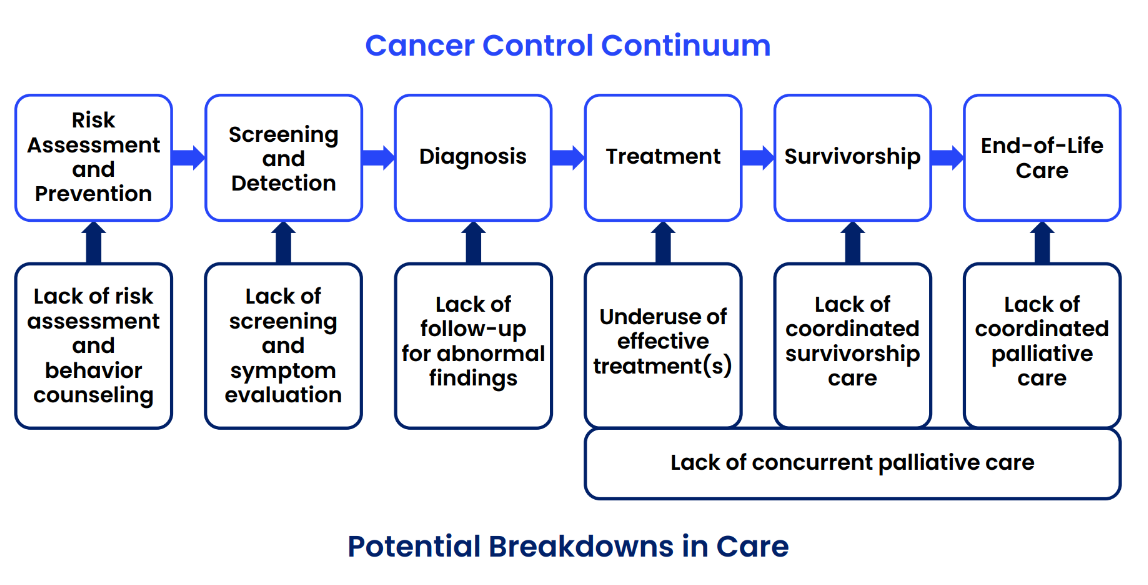
The top row of boxes shows the cancer control continuum, starting with risk assessment and prevention and ending with end-of-life care. The second row shows potential breakdowns in care that can occur, aligned with the part of the cancer control continuum they affect. Breakdowns may result from either a lack of health insurance or a plan without adequate coverage.
Unlike most developed countries, the United States does not have universal health insurance. Instead, health insurance coverage is delivered through a complex mix of public (federal and state) and private (employer-sponsored and individually purchased) options, with wide variation in benefits, premiums, and cost-sharing, which includes copayments, coinsurance, and deductibles. The Affordable Care Act (ACA), enacted in 2010, significantly reshaped the US health insurance landscape.
As the graph above shows, in the US, whether or not a person has health insurance determines their access to care across the cancer control continuum. Health insurance can also determine whether or not a person can access care for other conditions, such as diabetes and heart conditions.
People without health insurance or with inadequate coverage may have breakdowns in care in one or more places across the cancer control continuum.
Prevention and screening breakdowns may occur because without quality health insurance coverage, people are less likely to have a usual source of care to recommend it.
When screening does occur, people with no or inadequate health insurance coverage are less likely to receive timely follow-up of any abnormal findings, which has the potential to result in a diagnosis at a later stage of disease.
When people are diagnosed with cancer and they have no or inadequate health insurance coverage, they are less likely to receive timely treatment that is consistent with guidelines, including palliative care. People with no or inadequate health insurance also have worse survival following a cancer diagnosis.
At the end of life, people without health insurance or with inadequate coverage are less likely to receive quality end-of-life care.
Our Research Focus
ACS health services researchers examine how having or not having health insurance—as well as the type of insurance and completeness of that coverage—affects the patient’s ability to access and receive cancer care and how both health insurance and receipt of care affect patient outcomes. As part of this work, the team studies:
- Health insurance coverage status, source, and type of coverage
- Disruptions and continuity of health insurance coverage
- The effects of provisions of the Affordable Care Act, including:
- Elimination of cost-sharing for effective preventive services, including cancer screening
- Dependent coverage expansion allowing young adults to remain on parents’ private insurance until age 26
- Marketplace for individuals to purchase health insurance that doesn't exclude pre-existing conditions
- Medicaid expansion
- Emerging Policies
Recent Studies
Health Insurance Coverage
Health Insurance Coverage Disruptions/Coverage Continuity
Affordable Care Act (ACA)
Medicaid Expansion
Emerging Policies and Cancer Care
Coming Soon