Your gift is 100% tax deductible.
Surgery for Prostate Cancer
Surgery is a common choice to try to cure prostate cancer that has not spread beyond the prostate. Radical prostatectomy is used to try to cure prostate cancer that has not spread beyond the prostate, while other procedures, such as TURP or orchiectomy, may be used to manage symptoms or as part of hormone therapy.
Radical prostatectomy
The main type of surgery used for prostate cancer is a radical prostatectomy. It involves removing the entire prostate gland plus the seminal vesicles. Sometimes nearby lymph nodes are removed as well.
A radical prostatectomy can be done in 2 main ways:
- Laparoscopic prostatectomy: the surgeon makes several smaller incisions (cuts) and uses long, thin surgical tools to remove the prostate and nearby tissues. This is done most often as a robot-assisted prostatectomy or robotic prostatectomy.
- Open prostatectomy: The surgeon operates through a single long incision to remove the prostate and nearby tissues.
Laparoscopic surgery is done through several small incisions in the abdomen, rather than one large incision. The surgeon inserts a long, thin tube called a laparoscope, with a light and tiny video camera on the end, through one of the openings so they can see inside the body. Long, thin surgery instruments are then inserted through the other incisions to perform the operation.
Robotic prostatectomy
This is the most common way prostatectomy is done in the United States. It is also called robotic-assisted laparoscopic radical prostatectomy or robot-assisted prostatectomy.
The surgeon sits at a control panel in the operating room and moves robotic arms to operate through several small incisions, usually in the abdomen, but sometimes in the perineum. The robotic system helps the surgeon move the instruments more precisely than if they were holding the laparoscopic tools directly in their hands.
This type of surgery is done less often than in the past, as robotic prostatectomy has become more common. But it's still a good option for men who have had major abdominal surgery before. That's because this approach stays outside the belly (abdominal) cavity, so it avoids scar tissue from earlier surgeries. There are 2 main approaches for an open prostatectomy, based on where the incision is made.
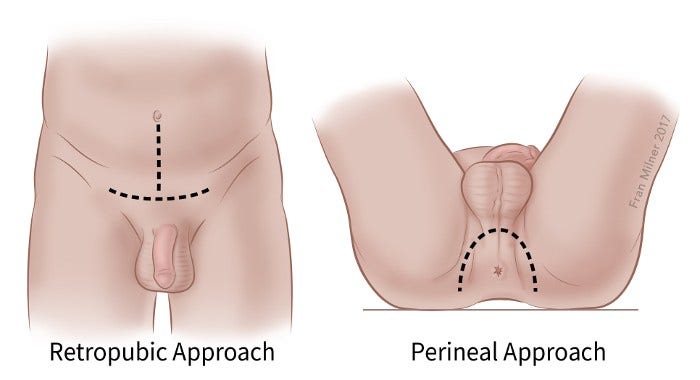
Radical retropubic prostatectomy (retropubic approach)
For this operation, the surgeon makes an incision in your lower abdomen, from the belly button down to the pubic bone, as shown in the picture above.
Radical perineal prostatectomy (perineal approach)
This approach is only rarely used, when robotic prostatectomy cannot be done. For this operation, the surgeon makes the incision between the anus and scrotum (the perineum), as shown in the picture above. It has two disadvantages:
- Lymph nodes cannot be removed to help stage the cancer.
- It can be harder for the surgeon to spare the nerves that control erections.
After surgery
After the surgery, and while you are still under anesthesia, a catheter (thin, flexible tube) will be put in your penis to help drain your bladder. The catheter usually stays in place for about 1 to 2 weeks while you are healing. You will be able to urinate on your own after the catheter is removed.
You will probably stay in the hospital for a few days after the surgery, and your activities will be limited for about 4 to 6 weeks.
Robotic vs. open radical prostatectomy
Robot-assisted prostatectomy is the most common surgery to treat prostate cancer in the United States (and most other high-income countries). That is largely because this operation has some short-term advantages over open radical prostatectomy. For example, it usually results in:
- Less blood loss during the operation
- Less pain after the operation
- A shorter hospital stay
- A quicker recovery time
- Less time the urinary catheter needs to stay in place
- A lower risk of some rare but potentially serious side effects
However, the results of robotic and open prostatectomy seem to be about the same when it comes to the long-term side effects that many men are most concerned about, including erection problems and trouble holding urine (incontinence).
There also doesn’t appear to be much difference between robotic and open prostatectomy when it comes to long-term outcomes. Studies haven’t shown that either approach is clearly better than the other when it comes to how likely the cancer is to return after surgery or how likely a man is to die from prostate cancer. Both approaches generally result in good outcomes when done by experienced surgeons.
In some instances, there might be clear reasons to favor one approach over the other.
But no matter which prostatectomy approach you choose, the biggest factor in the success of your surgery is likely to be the experience and skill of your surgeon. Because of this, it’s very important to find an experienced surgeon whom you’re comfortable with and whom you can trust.
Lymph node removal
With either type of radical prostatectomy, the surgeon may also remove some nearby lymph nodes to check for cancer. This is called a pelvic lymph node dissection.
Doctors may use calculation tools called nomograms to help decide whether this step is needed. These tools look at factors such as your PSA level and prostate biopsy results to estimate how likely it is that the cancer has reached the lymph nodes. Doctors may also use special imaging tests, such as a PSMA-targeting PET scan, to help plan which lymph nodes to remove.
Removing lymph nodes can help in a few ways:
- It shows whether the cancer has spread beyond the prostate.
- It helps guide decisions about treatment after surgery, such as radiation or hormone therapy.
However, removing the lymph nodes hasn't been shown to help you live longer or lower the chance of the cancer coming back.
If the surgeon finds cancer in the lymph nodes during the operation, current guidelines recommend continuing with the prostatectomy rather than stopping. Studies have found that removing the prostate can still help some men even when the cancer has reached nearby lymph nodes, especially when combined with other treatments afterward.
Risks of prostatectomy
The risks with any type of radical prostatectomy are much like those of any major surgery. Problems during or shortly after the operation can include:
- Reactions to anesthesia
- Bleeding from the surgery
- Blood clots in the legs or lungs
- Damage to nearby organs
- Infections at the surgery site
Rarely, part of the intestine (usually the rectum) might be injured during surgery, which could lead to infections in the abdomen and might require more surgery to fix. This type of injury is less common with robotic surgery than with the open or laparoscopic approach.
If lymph nodes are removed, a collection of lymph fluid called a lymphocele can form and may need to be drained either through a percutaneous or surgical approach.
Your risks depend, in part, on your overall health, your age, and the skill of your surgical team.
Side effects of prostatectomy
The major possible side effects of radical prostatectomy are:
- Urinary incontinence (being unable to control urine)
- Erectile dysfunction (problems getting or keeping erections)
These side effects can also occur with some other forms of prostate cancer treatment.
Other side effects are also possible.
You may not be able to control your urine, or you may have leakage or dribbling after your surgery. Being incontinent can affect you not only physically, but also emotionally and socially. The major types of incontinence are:
- Stress incontinence: Urine might leak when coughing, laughing, sneezing, or exercising. Stress incontinence is the most common type after prostate surgery. It’s usually caused by problems with the valve that keeps urine in the bladder (the bladder sphincter). Prostate cancer treatments can damage this valve or the nerves that keep the valve working.
- Overflow incontinence: The bladder may not empty completely. This can mean it takes a long time to urinate or the urine stream is weak or dribbling. Overflow incontinence is usually caused by blockage or narrowing of the bladder outlet by scar tissue.
- Urge incontinence: A person may have a sudden need to urinate. This happens when the bladder becomes too sensitive to stretching as it fills with urine. This is less common after surgery than after having radiation therapy.
- Continuous incontinence: Very rarely after surgery, a person can lose all ability to control their urine.
After surgery for prostate cancer, bladder control usually improves slowly over several weeks or months. But doctors can’t predict for sure how any person will be affected. In general, older men tend to have more incontinence problems than younger men. People treated at large cancer centers, where prostate surgery is done often and surgeons have a lot of experience, generally report fewer problems with incontinence.
Incontinence can be treated. Even if your incontinence can’t be corrected completely, it can still be helped. To learn about managing and living with incontinence, see Bladder and Bowel Incontinence.
Erectile dysfunction means you can’t get an erection sufficient for sexual penetration.
Erections are controlled by bundles of nerves that run along either side of the prostate. If you’ve been able to have erections before surgery, the surgeon will try to use a nerve-sparing approach during the prostatectomy to avoid damaging the nerves. But if the cancer is growing into or very close to the nerves, the surgeon will need to remove them.
Your ability to have erections after prostatectomy depends on your age, your ability to get an erection before the operation, and whether the nerves are removed:
- If both nerves are removed, you won’t be able to have spontaneous erections, but you might still be able to have erections using some of the aids described below.
- If the nerves on only one side are removed, you might still have erections, but the chance is lower than if neither were removed.
- If the nerve bundles can be preserved, you might have normal erections at some point after surgery.
Erectile dysfunction is more common than incontinence after surgery. Most men will probably have at least some loss of ability to have an erection, but the younger you are, the less likely you are to be seriously affected.
Surgeons who do many prostatectomies tend to report better rates of erection function among their patients than those who do the surgery less often. A wide range of rates have been reported in the medical literature, but each person’s situation is different, so the best way to get an idea of your chances for recovering erections is to ask about your doctor’s success rates and what the outcome is likely to be in your case.
If your ability to have erections does return after surgery, it often returns slowly. In fact, it can take from a few months to 2 or more years. During the first few months, you will probably not be able to have a spontaneous erection, so you may need to use medicines or other treatments.
Many doctors feel that regaining potency is helped along by trying to get an erection as soon as possible once the body has had a chance to heal (usually several weeks after the operation). Some doctors call this penile rehabilitation. Medicines (see below) may be helpful at this time, although it’s not clear whether they work better if taken daily or just on an as-needed basis. Be sure to talk to your doctor about your situation.
There are several options for treating erectile dysfunction:
- Phosphodiesterase-5 (PDE5) inhibitors, such as sildenafil (Viagra), vardenafil (Levitra), tadalafil (Cialis), and avanafil (Stendra), are pills that can help with erections. These drugs won’t work if both nerves that control erections have been damaged or removed. Common side effects of these drugs include headache, flushing (skin becoming red and feeling warm), upset stomach, light sensitivity, and runny or stuffy nose. Rarely, these drugs can cause prolonged erections requiring medical attention or vision problems, possibly even blindness. Some other drugs such as nitrates, which are used to treat heart disease, can cause problems if you are taking a PDE5 inhibitor, so be sure your doctor knows what medicines you take.
- Alprostadil is a lab-made version of prostaglandin E1, a substance naturally made in the body that can produce erections. It can be injected almost painlessly into the base of the penis 5 to 10 minutes before intercourse or placed into the tip of the penis as a suppository. You can even increase the dosage to prolong the erection. You might have side effects, such as pain, dizziness, and prolonged erection, but they are not usually serious.
- Vacuum devices are another option to create an erection. These are clear, plastic tubes connected to pumps that are placed over the penis. The pump sucks the air out of the tube, which draws blood into the penis to produce an erection. After the device is removed, the erection is maintained by placing an elastic ring around the base of the penis, which keeps the blood from draining out. The ring is then removed after sex.
- Penile implants might restore your ability to have erections if other methods don’t help. Surgery is needed to put them inside the penis. There are several types of penile implants, including those using silicone rods or inflatable devices.
For more on coping with erection problems and other sexuality issues, see Sexual Side Effects.
After surgery, the sensation of orgasm should still be pleasurable, but there is no ejaculation of semen, meaning the orgasm is “dry.” This is because the glands that make most of the fluid for semen (the seminal vesicles and prostate) were removed during the prostatectomy, and the pathways used by sperm (the vas deferens) were cut. For some men, orgasms might become less intense. Less often, men might have pain with orgasm.
During a radical prostatectomy, the surgeon cuts the vas deferens, which are the pathways between the testicles (where sperm are made) and the urethra (through which sperm leave the body). Your testicles will still make sperm, but the sperm can’t leave the body when you ejaculate. This means you can no longer have a biological child through sex.
Often, this is not an issue, as men with prostate cancer tend to be older. But if it is a concern for you, ask your doctor about options, including banking your sperm before the operation. To learn more, see Fertility Problems.
This is a rare but possible complication of removing many of the lymph nodes around the prostate. Lymph nodes normally provide a way for fluid to return to the heart from all areas of the body. When nodes are removed, fluid can collect in the legs or genital region over time, causing swelling and pain.
Lymphedema can usually be treated with physical therapy, although it may not go away completely. See Lymphedema to learn more.
Many men notice a decrease in penis length after radical prostatectomy. It's usually most noticeable in the weeks after surgery and may improve somewhat over the next year, though it may not fully return to its prior length.
Doctors don't fully understand why this happens. It was once blamed on simply removing the portion of urethra inside the prostate, but studies haven't found a link between prostate size and length loss. More likely causes include:
- The urethra and bladder shifting position as they're reconnected during surgery
- Nerve injury and reduced blood flow, which can affect penile tissue over time
A prostatectomy increases your chance of developing an inguinal (groin) hernia in the future.
Transurethral resection of the prostate (TURP)
This surgery is not used to try to cure prostate cancer. Instead, it’s more often used to:
- Treat a non-cancerous enlargement of the prostate called benign prostatic hyperplasia (BPH).
- Help relieve symptoms, such as trouble urinating, for men with locally advanced prostate cancer.
During this operation, the surgeon removes the inner part of the prostate gland that surrounds the urethra (the tube through which urine leaves the bladder). No incision is needed. Instead, an instrument called a resectoscope is passed through the tip of the penis and into the urethra to reach the prostate.
Once it's in place, either electricity is passed through a wire to remove tissue, or a laser is used to cut, vaporize, or remove the tissue in one piece (a technique called enucleation).
A laser procedure called holmium laser enucleation of the prostate (HoLEP) is increasingly used instead of traditional TURP. Studies show it provides similar symptom relief with less bleeding, though it's a more specialized technique and isn't available everywhere.
This operation is done with either spinal anesthesia (which numbs the lower half of your body) or general anesthesia (where you are in a deep sleep), and it usually takes about an hour.
After surgery, a catheter (thin, flexible tube) is inserted through the penis and into the bladder. It remains in place for about a day to help urine drain while the prostate heals. You can usually leave the hospital after 1 to 2 days and return to normal activities in 1 to 2 weeks.
You will probably have some blood in your urine after surgery.
Other possible side effects from TURP include infection and any risks that come with the type of anesthesia used.
Orchiectomy (castration)
In this operation, the surgeon removes the testicles, where most of the testosterone (male hormone) is made. Although this is a type of surgery, its main effect is as a form of hormone therapy. To learn more about this operation, see Hormone Therapy for Prostate Cancer.
More information about surgery
For more general information about surgery as a treatment for cancer, see Cancer Surgery.
To learn about some of the side effects listed here and how to manage them, see Managing Cancer-related Side Effects.
- Written by
- References

Developed by the American Cancer Society medical and editorial content team with medical review and contribution by the American Society of Clinical Oncology (ASCO).
Barnas JL, Pierpaoli S, Ladd P, et al. The prevalence and nature of orgasmic dysfunction after radical prostatectomy. BJU Int. 2004;94:603-605.
Bekelman JE, Rumble RB, Chen RC, et al. Clinically Localized Prostate Cancer: ASCO Clinical Practice Guideline Endorsement of an American Urological Association/American Society for Radiation Oncology/Society of Urologic Oncology Guideline. J Clin Oncol. 2018;32:3251-3258.
Chang P, Wagner AA, Regan MM, et al. Prospective multicenter comparison of open and robotic radical prostatectomy: The PROST-QA/RP2 Consortium. J Urol. 2022;207(1):127-136.
Gandaglia G, Ploussard G, Valerio M, et al. The Role of Radical Prostatectomy and Lymph Node Dissection in Clinically Node Positive Patients. Front Oncol. 2019;9:1395.
Manfredi C, Doubrava R, Caverzasi I, et al. Pelvic lymph node dissection at time of radical prostatectomy: guideline of guidelines. BJU Int. 2026. doi:10.1111/bju.70277.
Mungovan SF, Carlsson SV, Gass G, et al. Impact of pelvic anatomical changes caused by radical prostatectomy. Cancers (Basel). 2022;14(13):3050.
National Comprehensive Cancer Network (NCCN). Practice Guidelines in Oncology: Prostate Cancer. Version 5.2026. Accessed at https://www.nccn.org/professionals/physician_gls/pdf/prostate.pdf on June 5, 2026.
Nelson WG, Antonarakis ES, Carter HB, et al. Chapter 81: Prostate Cancer. In: Niederhuber JE, Armitage JO, Doroshow JH, Kastan MB, Tepper JE, eds. Abeloff's Clinical Oncology. 6th ed. Philadelphia, Pa: Elsevier; 2020.
Spratt DE, Srinivas S, Adra N, et al. Clinically Localized Prostate Cancer: AUA/ASTRO Guideline. J Urol. 2026.
Sun M, Lughezzani G, Alasker A, et al. Comparative study of inguinal hernia repair after radical prostatectomy, prostate biopsy, transurethral resection of the prostate or pelvic lymph node dissection. J Urol. 2010;183:970-975.
Tamalunas A, Keller P, Schott M, et al. Propensity score-matched evaluation of palliative transurethral resection and holmium laser enucleation of the prostate for bladder outlet obstruction in patients with prostate cancer. Prostate Cancer Prostatic Dis. 2025;28(1):153-159.
Wedderburn A, Patel A, Bott S. Incidence of rectal injury after radical prostatectomy: a systematic review and meta-analysis. Eur Urol Open Sci. 2023.
Zelefsky MJ, Morris MJ, Eastham JA. Chapter 70: Cancer of the Prostate. In: DeVita VT, Lawrence TS, Rosenberg SA, eds. DeVita, Hellman, and Rosenberg's Cancer: Principles and Practice of Oncology. 11th ed. Philadelphia, Pa: Lippincott Williams & Wilkins; 2019.
Last Revised: July 27, 2026
American Cancer Society medical information is copyrighted material. For reprint requests, please see our Content Usage Policy.
American Cancer Society Emails
Sign up to stay up-to-date with news, valuable information, and ways to get involved with the American Cancer Society.