Your gift is 100% tax deductible.
PSA Screening Test for Prostate Cancer
Screening is testing to find cancer in people before they have symptoms. The American Cancer Society recommends that men be screened for prostate cancer with the prostate-specific antigen (PSA) blood test, starting at age 50 if they are at average risk, or at age 45 if they are at higher risk. To learn more, see American Cancer Society Guideline for Prostate Cancer Early Detection.
What is the prostate-specific antigen (PSA) blood test?
Prostate-specific antigen (PSA) is a protein made by cells in the prostate gland. A small amount of PSA enters the blood, where it can be detected as a biomarker by a blood test.
The PSA level is measured in units called nanograms per milliliter (ng/mL).
What PSA level might mean cancer?
PSA is made by both normal cells and cancer cells in the prostate, so it’s normal to find some PSA in any man’s blood.
The chance of having prostate cancer goes up as the PSA level goes up, but there is no set cutoff point that means for certain a man has cancer.
Doctors might use different PSA cutoff points when deciding if a man might need further testing. The American Cancer Society recommends further testing if the PSA level is 3 ng/mL or higher in men younger than 70. Some doctors might recommend further testing starting at different PSA levels, such as 2.5 or 4. If you’re getting a PSA test, ask your doctor what cutoff level they use when deciding whether further testing might be needed.
Age-specific PSA
PSA levels are normally higher in older men than in younger men, even when there is no cancer. For this reason, some screening guidelines use age as a factor in determining the cutoff PSA level for when further testing should be done, especially in older men. For men aged 70 and older, the American Cancer Society recommends further testing starting at a PSA level of 6.5 ng/mL.
Other ways to look at PSA
Because the PSA level itself can’t tell for sure whether a man has prostate cancer, doctors have looked for other ways to help make the PSA results more meaningful.
|
PSA levels are higher in men with larger prostate glands. To adjust for this, your doctor may determine your PSA density (PSAD).
To find the PSAD, the doctor measures the volume (size) of the prostate gland with either multiparametric MRI (mpMRI) or transrectal ultrasound (TRUS). The PSA value is then divided by the prostate volume to determine the PSAD. A higher PSAD indicates a greater likelihood of cancer.
The PSA velocity is not a separate test. It is a measure of how fast the PSA rises over time. Normally, PSA levels go up slowly with age. Some research has found that these levels go up faster if you have cancer, but studies have not shown the PSA velocity to be more helpful than the PSA level itself in finding prostate cancer. For this reason, most doctors do not use PSA velocity as part of screening for prostate cancer.
What else affects PSA levels?
One reason it’s hard to use a set cutoff level with the screening PSA test is that factors other than prostate cancer can also affect PSA levels.
Factors that might raise PSA levels include:
- Having an enlarged prostate: Conditions such as benign prostatic hyperplasia (BPH), a noncancerous enlargement of the prostate that affects many men as they grow older, can raise PSA levels.
- Prostatitis: This is an infection or inflammation of the prostate gland, which can raise PSA levels.
- Ejaculation: This can make the PSA go up for a short time. Your doctor might suggest abstaining from ejaculation for a couple of days before testing.
- Riding a bicycle: Some studies have suggested that cycling may raise PSA levels for a short time, possibly because the seat puts pressure on the prostate.
- Certain urologic procedures: Some medical procedures that affect the prostate, such as a prostate biopsy or cystoscopy, can raise PSA levels for a short time. Some studies have suggested that a digital rectal exam (DRE) might raise PSA levels slightly, although other studies have not found this.
- Certain medicines: Taking male hormones like testosterone, or other medicines that raise testosterone levels, may cause a rise in PSA.
Some things might lower PSA levels, even if a man has prostate cancer:
- 5-alpha reductase inhibitors: Certain drugs used to treat BPH or urinary symptoms, such as finasteride (Proscar or Propecia) or dutasteride (Avodart), can lower PSA levels. These drugs can also affect prostate cancer risk (discussed in Can Prostate Cancer Be Prevented?). Tell your doctor if you are taking one of these medicines. Because they can lower PSA levels, the doctor might need to adjust for this.
- Herbal mixtures: Some mixtures that are sold as dietary supplements might mask a high PSA level. This is why it’s important to let your doctor know if you are taking any type of supplement, even ones that are not necessarily meant for prostate health. Saw palmetto, an herb used by some men to treat BPH, does not seem to affect PSA.
- Certain other medicines: Some research has suggested that long-term use of some other medicines, such as aspirin, statins (cholesterol-lowering drugs), and thiazide diuretics (such as hydrochlorothiazide) might lower PSA levels. More research is needed to confirm these findings.
It’s important to talk to your doctor about anything you’re taking that might affect your PSA level, because it might affect the accuracy of your test result.
Can I use an at-home PSA test?
Some companies now offer PSA test kits that let you collect a blood sample at home, typically from a finger stick, and then send it to a lab for testing. This could be more convenient for some men, and it might even allow some men to be tested who otherwise might not be.
However, at-home testing might not give you the chance to talk with a healthcare provider about the pros and cons of prostate cancer screening before being tested. This informed decision-making is an important part of the American Cancer Society Guideline for Prostate Cancer Early Detection.
Another important issue is that PSA blood test results can’t tell you for sure whether you have prostate cancer. If you get an at-home PSA test, it’s important to discuss the test results with a health professional who understands what the results mean for you.
What happens if my PSA screening test result isn’t normal?
Having a high PSA level doesn’t always mean you have prostate cancer. But if a screening test shows your PSA level is higher than normal, further testing will be needed to find out why. Your doctor may recommend one of these options:
- Waiting a while and then repeating the PSA test
- Getting another type of test to get more information about whether a prostate biopsy is needed
- Getting a prostate biopsy to find out if you have cancer
Talk with your doctor about your options, including their possible risks and benefits. Factors that might affect which option is best for you include:
- Your age and overall health
- The likelihood that you have prostate cancer based on tests done so far
- Your own comfort level with waiting or getting further tests
If your initial PSA test was ordered by your primary care provider, you may be referred to a urologist, a doctor who treats prostate cancer and other diseases of the genital and urinary tract, for this discussion or for further testing.
Repeating the PSA test
Your blood PSA level can vary over time for a number of reasons, so doctors typically recommend waiting at least a couple of weeks and then repeating the test if the initial PSA result is abnormal. You might be advised to avoid activities that could raise your PSA level, such as bicycling or ejaculation, in the days before the repeat PSA test.
Repeat testing is most likely to be a reasonable option if the PSA level is slightly higher than normal. For very high PSA levels, doctors are more likely to recommend getting other tests, or even going straight to a prostate biopsy.
Getting other tests
If your initial or repeat PSA result is higher than normal, your doctor will likely recommend other types of tests to help decide whether you need a prostate biopsy.
|
If you haven’t already had a DRE, your doctor may suggest this exam.
The DRE is not recommended as a main screening test for prostate cancer. Studies have found DRE is less effective at finding prostate cancer than the PSA blood test, and it doesn’t add much if the PSA test is already being done. Because of this, it’s more often done only if your PSA test is abnormal.
As shown in the picture below, the prostate is just in front of the rectum. Prostate cancers often begin in the back part of the gland, and these tumors can sometimes be felt during a rectal exam.
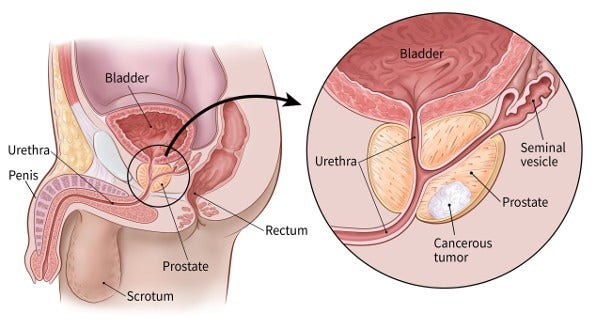
For a DRE, the doctor inserts a gloved, lubricated finger into the rectum to feel for any bumps or hard areas on the prostate that might be cancer. This exam can be uncomfortable (especially for men who have hemorrhoids), but it usually isn’t painful and only takes a short time.
For many men with an elevated PSA, an imaging test of the prostate, such as a multiparametric MRI (mpMRI) or transrectal ultrasound (TRUS), might be recommended as the next step. For more on these, see Tests to Diagnose and Stage Prostate Cancer.
Tests that look at certain substances (biomarkers) in the blood or urine, often including different types of PSA, can also be helpful. These tests typically provide a score to help determine how likely it is that someone with a high PSA has prostate cancer, particularly cancer that might need treatment. This can help determine whether you should have a prostate biopsy.
Blood tests
- The Prostate Health Index (PHI) combines the results of total PSA, free PSA, and proPSA.
- The 4Kscore test combines the results of total PSA, free PSA, intact PSA, and human kallikrein 2 (hK2), along with some other factors.
- IsoPSA looks at different forms of PSA in the blood.
- Stockholm3 combines PSA, free PSA, hK2, other biomarkers, and some other factors.
- Percent-free PSA (%fPSA), also called the free/total PSA ratio (f/t PSA), shows how much of the total PSA in the blood is in the free PSA form. A lower %fPSA means prostate cancer is more likely.
Urine tests
- ExoDx Prostate (IntelliScore), or EPI, looks at levels of the biomarkers PCA3, ERG, and SPDEF in a urine sample.
- SelectMDx looks at the levels of certain forms of RNA (linked to certain cancer-related genes) in the urine, along with other factors.
- My Prostate Score 2.0 (MPS2) checks the urine after a DRE for changes in 18 genes, including PCA3 and TMPRSS2:ERG.
- Sentinel PCa Test looks for certain pieces of RNA in the urine.
Getting a prostate biopsy
A prostate biopsy is a procedure in which small samples of the prostate are removed and looked at under a microscope. A biopsy might be recommended after a screening PSA test, especially if the level is very high. More often, a biopsy is recommended if the results of one or more of these other types of tests are concerning.
A biopsy is the only way to know for sure whether you have prostate cancer. If prostate cancer is found on a biopsy, this test can also help tell how likely it is that the cancer will grow and spread quickly, which can help determine whether it needs to be treated right away.
For more details on the prostate biopsy, including how it is done and what the results might mean, see Tests to Diagnose and Stage Prostate Cancer.
Does insurance cover prostate cancer screening?
The American Cancer Society (ACS) supports legislation ensuring that men have insurance coverage for prostate screening tests. Men shouldn’t be prevented from getting prostate cancer screening because of testing costs, lack of health insurance coverage, or lack of access to testing.
State efforts to ensure prostate cancer screening coverage
Many states have laws requiring that private health insurers cover tests to detect prostate cancer, including the PSA test and DRE. Some states also ensure that public employee benefit health plans provide coverage for prostate cancer screening tests.
Most state laws ensure annual coverage for men ages 50 and over and for high-risk men, ages 40 and over. “High-risk men” typically refers to Black men and/or men with a family history of prostate cancer. Some states have slightly different coverage requirements.
Laws on coverage vary from state to state, so check with your insurer or with your state insurance commissioner’s office to learn what’s covered.
Medicare coverage
Medicare Part B covers a PSA blood test and a DRE once a year for all men with Medicare age 50 and over.
PSA test: You pay nothing for a yearly PSA blood test. If you get the test from a doctor who doesn’t accept Medicare assignment, you may have to pay a fee for the doctor’s services, but not for the test itself.
Digital rectal exam: If your doctor does this test, you pay 20% of the Medicare-approved amount for a yearly DRE and for your doctor’s services related to the exam. The Part B deductible applies. If the DRE is done in a hospital outpatient setting, there is a copayment.
Medicaid coverage
Medicaid coverage of prostate cancer screening varies by state.
People who qualify for Medicaid based on their state’s decision to expand Medicaid under the Affordable Care Act (ACA) are entitled to the same screening services as people covered by private insurance.
For people who qualify for Medicaid based on other pathways, prostate cancer screening coverage is determined by the state. Most Medicaid programs do cover screening.
To learn more about prostate cancer screening coverage in your state, contact your state’s Medicaid office.
- Written by
- References

Developed by the American Cancer Society medical and editorial content team with medical review and contribution by the American Society of Clinical Oncology (ASCO).
Chang SL, Harshman LC, Presti JC Jr. Impact of common medications on serum total prostate-specific antigen levels: Analysis of the National Health and Nutrition Examination Survey. J Clin Oncol. 2010;28:3951-3957.
Freedland S. Measurement of prostate-specific antigen. UpToDate. 2026. Accessed at https://www.uptodate.com/contents/measurement-of-prostate-specific-antigen on September 4, 2026.
Hoffman RM, Wolf AMD, Etzioni R, et al. American Cancer Society guideline for the early detection of prostate cancer, 2026. CA Cancer J Clin. 2026; e70112. doi:10.3322/caac.70112.
National Comprehensive Cancer Network. NCCN Clinical Practice Guidelines in Oncology: Prostate Cancer Early Detection. Version 2.2026. Accessed at https://www.nccn.org/ on September 4, 2026.
National Cancer Institute. Prostate Cancer Screening (PDQ®)–Health Professional Version. 2025. Accessed at https://www.cancer.gov/types/prostate/hp/prostate-screening-pdq on September 4, 2026.
Preston MA. Screening for prostate cancer. UpToDate. 2026. Accessed at https://www.uptodate.com/contents/screening-for-prostate-cancer on September 4, 2026.
US Centers for Medicare & Medicaid Services. Your Medicare Coverage: Prostate Cancer Screenings. Accessed at https://www.medicare.gov/coverage/prostate-cancer-screenings on September 4, 2026.
Last Revised: November 12, 2026
American Cancer Society medical information is copyrighted material. For reprint requests, please see our Content Usage Policy.
American Cancer Society Emails
Sign up to stay up-to-date with news, valuable information, and ways to get involved with the American Cancer Society.