Your gift is 100% tax deductible.
Laryngeal and Hypopharyngeal Cancer
Laryngeal and hypopharyngeal cancers start in the lower part of the throat. If you have one of these cancers or are close to someone who does, knowing what to expect can help. Here you’ll find information about laryngeal and hypopharyngeal cancers, including risk factors, symptoms, how these cancers are found, and how they are treated.
About laryngeal and hypopharyngeal cancers
- Laryngeal cancer starts in the larynx (voice box).
- Hypopharyngeal cancer starts in the hypopharynx (lower throat).
Both types of cancer are covered here because these structures are close to each other.
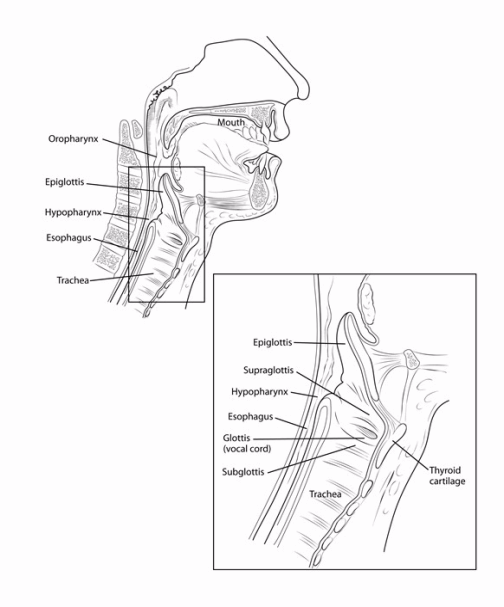
The larynx (voice box)
Your larynx is your voice box. It includes your vocal cords, one of the organs that helps you speak. It is found in the neck, above the opening of the trachea (windpipe).
Parts of the larynx
The larynx has 3 parts. Treatment options for laryngeal cancer depend on what part of the larynx the cancer starts in.
- The supraglottis is just above the vocal cords. It includes the epiglottis, a flap of tissue that closes off your larynx when you swallow. This keeps food and fluids from entering your trachea and going into your lungs. About one-third of laryngeal cancers start here.
- The glottis contains the vocal cords. Most laryngeal cancers start here.
- The subglottis is below the vocal cords. Only about 5% of laryngeal cancers start here.
What the larynx does
Your larynx and vocal cords help you speak, swallow, and breathe.
- The larynx produces sound for speaking. The vocal cords move and come together to change the sound and pitch of your voice.
- The larynx protects your airway when you swallow. The epiglottis and vocal cords close tightly when you swallow to keep food and fluids from entering your lungs.
- The vocal cords open naturally when you breathe so air can get in and out of your lungs.
The hypopharynx (lower throat)
Your hypopharynx is the lower part of your throat that lies right behind your larynx.
The hypopharynx is the entrance into the esophagus, the tube that connects your throat to your stomach. When you swallow food and liquids, they pass through your hypopharynx to your stomach. Your hypopharynx helps make sure food does not go into your larynx but instead goes around it and into your esophagus.
Ask your healthcare team to explain or show you where your cancer is. Explore the 3D interactive model here to learn more.
Types of laryngeal and hypopharyngeal cancer
Your larynx and hypopharynx are made up of several parts. Each part contains different types of cells. Cancer can start in any of these cell types.
Along with the cancer’s exact location in the larynx or hypopharynx, the type of cells the cancer started in can help guide your treatment options and outlook.
The information in this guide focuses on squamous cell carcinomas.
Squamous cell carcinomas
Almost all laryngeal and hypopharyngeal cancers are squamous cell carcinomas, also called squamous cell cancers. These cancers start in squamous cells, which are thin, flat cells that make up the inner lining of the larynx and hypopharynx.
- Squamous cell carcinoma in situ (CIS): This is the earliest form of squamous cell cancer. If the cancer is in situ, the cancer cells are only seen in the cells lining the larynx or hypopharynx. They have not grown into deeper layers or spread to other parts of the body. Most of these early cancers can be cured.
- Invasive squamous cell carcinoma: If CIS is not treated, it can develop into an invasive squamous cell cancer that can destroy nearby tissues and spread to other parts of the body.
Other cancers
Other rare types of cancer can also start in the larynx or hypopharynx.
Some parts of the larynx and hypopharynx have tiny glands under their lining called minor salivary glands. These glands make mucus and saliva to lubricate and moisten the area. Cancer rarely develops from the cells of these glands.
See salivary gland cancers to learn more.
The larynx and hypopharynx are shaped by a framework of connective tissues and cartilage. Cancers like chondrosarcomas or synovial sarcomas can start in the connective tissues of the larynx or hypopharynx, but this is extremely rare.
See Soft Tissue Sarcoma to learn more.
Other rare types of laryngeal cancer include:
- Lymphomas
- Neuroendocrine tumors
- Plasmacytomas
Quick Guide
- Written by
- References

Developed by the American Cancer Society medical and editorial content team with medical review and contribution by the American Society of Clinical Oncology (ASCO).
Leeman JE, Katabi N, Wong, RJ, Lee NY, and Romesser PB. Chapter 65 - Cancer of the Head and Neck. In: Niederhuber JE, Armitage JO, Doroshow JH, Kastan MB, Tepper JE, eds. Abeloff’s Clinical Oncology. 6th ed. Philadelphia, Pa: Elsevier; 2020.
Mendenhall WM, Dziegielewski PT, Pfister DG. Cancer of the Head and Neck. In: DeVita VT Jr, Lawrence TS, Rosenberg SA, editors. DeVita, Hellman, and Rosenberg’s Cancer: Principles & Practice of Oncology. 12th ed. Philadelphia, PA: Wolters Kluwer; 2023.
National Cancer Institute. Physician Data Query (PDQ). Hypopharyngeal Cancer Treatment. 2/12/2025. Accessed at https://www.cancer.gov/types/head-and-neck/patient/adult/hypopharyngeal-treatment-pdq on February 29, 2026.
National Cancer Institute. Physician Data Query (PDQ). Laryngeal Cancer Treatment. 2/12/2025. Accessed at https://www.cancer.gov/types/head-and-neck/patient/adult/laryngeal-treatment-pdq on February 29, 2026.
National Comprehensive Cancer Network (NCCN). NCCN Clinical Practice Guidelines in Oncology: Head and Neck Cancers. Version 1.2026 – December 08, 2025. Accessed at www.nccn.org/professionals/physician_gls/pdf/head-and-neck.pdf on February 20, 2026.
Last Revised: May 28, 2026
American Cancer Society medical information is copyrighted material. For reprint requests, please see our Content Usage Policy.