Your gift is 100% tax deductible.
Breast-conserving Surgery (Lumpectomy)
Breast-conserving surgery can be used as part of treatment for many early-stage breast cancers. It is sometimes called a lumpectomy or a partial mastectomy.
What is breast-conserving surgery?
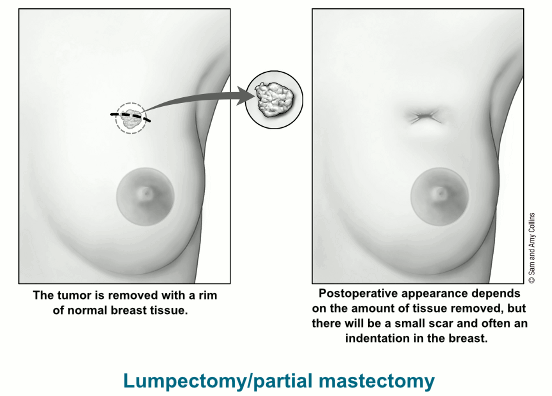
Breast-conserving surgery removes cancer in the breast while leaving as much of the breast in place as possible. Usually, some healthy tissue around the tumor and some lymph nodes are also removed. The amount of breast tissue removed will depend on the size and location of your tumor, your breast size, and other factors.
Breast-conserving surgery is not an option for everyone. Talk to your cancer care team to find out if it is a possibility for you.
Who can have this surgery?
Breast-conserving surgery is an option for many women with early-stage breast cancer.
This surgery might be an option for you if:
- You are willing and able to have radiation therapy and can get to the appointments.
- The breast has not already been treated with radiation therapy or breast-conserving surgery. (There are exceptions to this.)
- There is only one area of cancer in the breast. Or there are multiple areas in one quadrant (multifocal) that are close enough to be removed together without changing the look of the breast too much.
- The tumor is smaller than 5 cm (2 inches) and small relative to the size of your breast.
- You do not have inflammatory breast cancer.
Breast-conserving surgery might not be possible if you are pregnant, because radiation therapy can harm a fetus. If you are pregnant but do not need radiation right away, breast-conserving surgery might still be an option.
The same is true for some people with autoimmune and connective tissue diseases. If you have one of these diseases, your breast surgeon and radiation oncologist will look closely at your condition to see if radiation is safe for you.
What to know before breast-conserving surgery
Breast-conserving surgery lets you keep most of your breast. But you may also need radiation.
- After this type of surgery, many women need radiation therapy.
- Women who have a mastectomy for early-stage breast cancers are less likely to need radiation.
- Some women might also need hormone therapy, chemotherapy, or other treatments.
Choosing breast-conserving surgery plus radiation does not affect your chances of long-term survival.
- Thousands of women have been studied over more than 20 years.
- For early-stage cancers, the chance of survival is the same for breast-conserving surgery plus radiation as it is for mastectomy.
Ask about breast reconstruction before you have surgery to remove your tumor.
- If possible, discuss reconstruction with your breast surgeon and a plastic surgeon before your breast-conserving surgery.
- This gives the surgical team time to plan out your options, even if you wait until later to have the reconstructive surgery.
Recovering from surgery
Breast-conserving surgery is typically done in an outpatient surgery center. You usually do not need to stay overnight in the hospital.
How long does it take to recover?
Most people should be able to return to their regular activities within 2 weeks. You may need help at home while you recover. This will depend on how extensive your surgery was.
How do I care for myself after surgery?
Before you go home, your healthcare team will tell you how to care for yourself during your recovery. You will probably get written instructions.
These often include:
- How to care for the surgery area and dressing
- How to manage your drain, if you have one. This is a small tube coming out of the surgery area. It removes fluid that collects as you heal.
- How to tell if an infection is starting
- When and how to bathe or shower
- When to call your healthcare team
You will also get information about recovery and daily activities, such as:
- When to use your arm again and how to do exercises to prevent stiffness
- When you can wear a bra
- What medicines to take, including pain medicine and possibly antibiotics
- Any limits on physical activity
Your team will also explain what to expect as you heal, including:
- Possible numbness or changes in feeling in your breast and arm
- Emotional changes and feelings about body image
- When to return for follow-up visits
Possible side effects
As with any surgery, bleeding and infection at the surgery site are possible. Other side effects of breast-conserving surgery can include:
- Pain, tenderness, or a tugging sensation in the breast
- Temporary swelling of the breast
- Buildup of blood in the wound (hematoma)
- Buildup of clear fluid in the wound (seroma)
- Hard scar tissue and/or a dimple that forms at the surgical site
- Change in the shape of the breast
Nerve pain (neuropathic pain) that doesn’t go away can happen in the chest wall, armpit, and/or arm. This is sometimes described as burning or shooting pain. It can also happen after a mastectomy, and it is called post-mastectomy pain syndrome or PMPS.
Lymphedema and other side effects can happen if axillary lymph nodes were also removed. Lymphedema is swelling in the arm or chest.
Was all the cancer removed?
During breast-conserving surgery, the surgeon removes the cancer along with a small amount of healthy tissue around it. This can sometimes be hard to do, depending on where the cancer is located.
After your surgery, a doctor called a pathologist will look at the removed tissue under a microscope. They will check the margins (edges) to see if any cancer cells are there.
- Negative (clear) margins: No cancer cells are found at the edges of the tissue.
- Positive margins: Cancer cells are found at the edge of the tissue.
- Close margins (for DCIS): Cancer cells are near the edge, meaning there is less than 2 mm of healthy tissue. For ductal carcinoma in situ (DCIS), doctors usually prefer at least 2 mm of healthy tissue between the cancer and the edge.
What happens if the margins are positive?
If the margins are positive, it may mean some cancer is still in your breast. You will often need another surgery to remove more tissue. This is called a re-excision.
If cancer is still found after a second surgery, your surgeon may recommend a mastectomy.
Breast reconstruction after breast-conserving surgery
Before your breast-conserving surgery, ask your surgeon how it might change the way your breast looks. You are more likely to see a change in the shape of your breast if you have a larger portion removed.
If your breasts look very different from one another after the cancer is removed, you might be able to have surgery to make them look more symmetrical (even). It may be possible to do this during the surgery to remove your cancer.
- Reconstructive surgery can help return the breast closer to its original size and shape after cancer surgery.
- When this is done at the same time as breast-conserving surgery (lumpectomy), it is sometimes called oncoplastic surgery.
- Surgery on the unaffected breast could reduce its size and make the two breasts more symmetrical.
Planning ahead: It's very important to talk with your breast surgeon before your cancer surgery. You might also talk to a plastic surgeon. They can tell you about your options and give you an idea of how your breasts might look afterward.
Insurance coverage: Insurance companies usually cover breast reconstruction, but you should check with your insurance so you know what’s covered.
Treatment after breast-conserving surgery
Radiation: Most women need radiation therapy to the breast after breast-conserving surgery. To make it easier to aim the radiation, small metallic-like clips are sometimes placed inside the breast during surgery. This marks the area where the cancer was removed. The clips will show up on x-rays.
Choosing a lumpectomy plus radiation gives you the same long-term survival odds as having a full mastectomy.
Hormone therapy: Many women start endocrine therapy (hormone therapy) after surgery to help lower the risk of the cancer coming back. Some women might also need chemotherapy after surgery.
- Written by
- References

Developed by the American Cancer Society medical and editorial content team with medical review and contribution by the American Society of Clinical Oncology (ASCO).
Henry NL, Shah PD, Haider I, Freer PE, Jagsi R, Sabel MS. Chapter 88: Cancer of the Breast. In: Niederhuber JE, Armitage JO, Doroshow JH, Kastan MB, Tepper JE, eds. Abeloff’s Clinical Oncology. 7th ed. Philadelphia, PA: Elsevier; 2024.
Jagsi R, King TA, Lehman C, Morrow M, Harris JR, Burstein HJ. Chapter 79: Malignant Tumors of the Breast. In: DeVita VT Jr, Lawrence TS, Rosenberg SA, eds. DeVita, Hellman, and Rosenberg’s Cancer: Principles and Practice of Oncology. 12th ed. Philadelphia, PA: Wolters Kluwer; 2023.
National Comprehensive Cancer Network (NCCN). Practice Guidelines in Oncology: Breast Cancer. Version 2.2026. Accessed at https://www.nccn.org/professionals/physician_gls/pdf/breast.pdf March 9, 2026.
Veronesi U, Cascinelli N, Mariani L, Greco M, Saccozzi R, Luini A, Aguilar M, Marubini E. Twenty-year follow-up of a randomized study comparing breast-conserving surgery with radical mastectomy for early breast cancer. N Engl J Med. 2002 Oct 17;347(16):1227-32.
Last Revised: July 1, 2026
American Cancer Society medical information is copyrighted material. For reprint requests, please see our Content Usage Policy.
American Cancer Society Emails
Sign up to stay up-to-date with news, valuable information, and ways to get involved with the American Cancer Society.