Your gift is 100% tax deductible.
Types of Breast Cancer
A breast cancer's type is determined by the specific cells in the breast that become cancer. There are many types of breast cancer and different ways to describe them.
Ductal and lobular carcinoma
Most breast cancers are carcinomas, which are cancers that start in the epithelial cells that line organs and tissues throughout the body. Most of these are a type of carcinoma that starts in glandular tissue, which is called an adenocarcinoma.
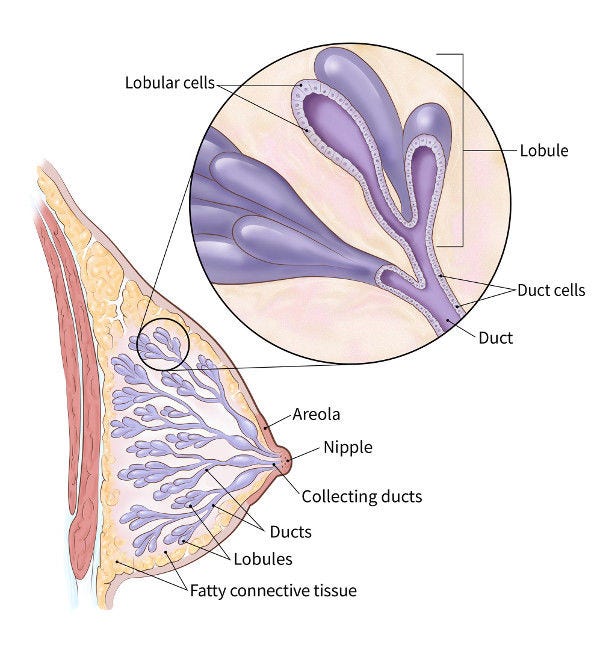
The breasts contain ducts, which are thin tubes that carry milk toward the nipple, and lobules, small sacs where milk is made. Breast cancer can develop from the cells that line either one.
Doctors group breast carcinomas into 2 main types, ductal and lobular, based on how the cancer cells look and grow under a microscope.
- Ductal carcinomas form solid clusters or tubes of cells, similar to the shape of a duct.
- Lobular carcinomas grow in single-file lines or spread out, rather than forming a cluster. This happens because the cancer cells lose a protein that normally holds cells together.
In situ vs. invasive breast cancer
The type of breast cancer can also refer to whether the cancer has spread or not.
- In situ breast cancer, also called carcinoma in situ or CIS, grows within the lining layer of cells where it started, but it isn’t growing into (invading) deeper layers of the breast.
- Invasive (or infiltrating) breast cancer describes any type of breast cancer that has invaded deeper layers of breast tissue.
Less common types of invasive breast cancer
Other less common types of breast cancer are typically named after features of the cancer cells, such as the way the cells are arranged.
Some tend to have a better prognosis (outlook) than the more common IDC:
- Adenoid cystic carcinoma (adenocystic carcinoma)
- Cribriform carcinoma
- Low-grade adenosquamous carcinoma (a type of metaplastic carcinoma)
- Medullary carcinoma
- Mucinous carcinoma (colloid carcinoma)
- Tubular carcinoma
Some types tend to have the same or possibly a worse outlook than IDC. These include:
- Metaplastic carcinoma (most types, including spindle cell and squamous, except for low-grade adenosquamous carcinoma)
- Micropapillary carcinoma
- Mixed carcinoma (cancers that have features of both IDC and ILC)
- Tubulolobular carcinoma
Breast cancers with specific features
Some types of invasive breast cancer have special features or develop in different ways, which can influence their treatment and outlook.
Breast sarcomas and lymphomas
Breast sarcomas start to grow in cells besides the breast ducts and lobules. These cancers are much less common, and sometimes need different types of treatment.
Other cancers that rarely start in the breast include soft tissue sarcomas and some types of non-Hodgkin lymphomas.
- Written by
- References

Developed by the American Cancer Society medical and editorial content team with medical review and contribution by the American Society of Clinical Oncology (ASCO).
Anders CK, Carey LA. ER/PR negative, HER2-negative (triple-negative) breast cancer. UpToDate. 2026. Accessed at https://www.uptodate.com/contents/er-pr-negative-her2-negative-triple-negative-breast-cancer on March 31, 2026.
Bleiweiss IJ. Pathology of breast cancer. UpToDate. 2026. Accessed at https://www.uptodate.com/contents/pathology-of-breast-cancer on March 31, 2026.
Henry NL, Shah PD, Haider I, Freer PE, Jagsi R, Sabel MS. Chapter 88: Cancer of the Breast. In: Niederhuber JE, Armitage JO, Doroshow JH, Kastan MB, Tepper JE, eds. Abeloff’s Clinical Oncology. 6th ed. Philadelphia, Pa: Elsevier; 2020.
Jagsi R, King TA, Lehman C, Morrow M, Harris JR, Burstein HJ. Chapter 79: Malignant Tumors of the Breast. In: DeVita VT, Lawrence TS, Lawrence TS, Rosenberg SA, eds. DeVita, Hellman, and Rosenberg’s Cancer: Principles and Practice of Oncology. 11th ed. Philadelphia, Pa: Lippincott Williams & Wilkins; 2019.
Merajver SD. Inflammatory breast cancer: Pathology and molecular pathogenesis. UpToDate. 2026. Accessed at https://www.uptodate.com/contents/inflammatory-breast-cancer-pathology-and-molecular-pathogenesis on March 31, 2026.
National Comprehensive Cancer Network. NCCN Clinical Practice Guidelines in Oncology: Breast Cancer. Version 2.2026. Accessed at https://www.nccn.org on March 31, 2026.
Sabel MS, Weaver DL. Paget disease of the breast (PDB). UpToDate. 2026. Accessed at https://www.uptodate.com/contents/paget-disease-of-the-breast-pdb on March 31, 2026.
Last Revised: August 26, 2026
American Cancer Society medical information is copyrighted material. For reprint requests, please see our Content Usage Policy.
American Cancer Society Emails
Sign up to stay up-to-date with news, valuable information, and ways to get involved with the American Cancer Society.