Your gift is 100% tax deductible.
Invasive Lobular Carcinoma
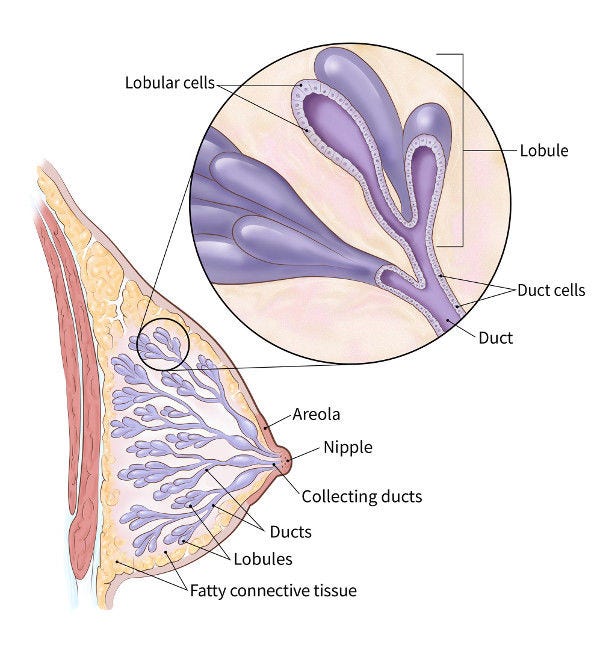
Breast cancers that have spread into surrounding breast tissue are known as invasive breast cancers. One of the most common types is invasive lobular carcinoma.
What is invasive lobular carcinoma (ILC)?
About 10% to 15% of invasive breast cancers are ILCs, also known as infiltrating lobular carcinomas.
Instead of forming a firm lump like many breast cancers, ILC tends to grow in thin strands throughout the breast tissue. This can make it harder to feel during a breast exam or to see on an imaging test such as a mammogram or ultrasound.
When ILC is looked at under a microscope, the cancer cells tend to grow in single-file lines or spread out, rather than forming a cluster. This happens because the cancer cells lose a protein that normally holds cells together.
Compared with other kinds of invasive breast cancer, ILC is more likely to affect both breasts. About 1 in 5 women with ILC have cancer in both breasts at the time they are diagnosed.
Spread and recurrence
ILC is called an invasive cancer because the cells have broken through the wall where they started and invaded (grown into) nearby breast tissues. At this point, the cancer might be able to metastasize (spread) to other parts of the body through the lymph system and bloodstream.
Like other breast cancers, ILC can spread to the bones, brain, liver, and lungs. ILC is also more likely than other breast cancers to spread to some other parts of the body, such as the digestive tract, the ovaries, or the lining of the belly, and is less likely to spread to the lungs.
If ILC recurs (comes back) after treatment, it often comes back later than the more common invasive ductal carcinoma (IDC), sometimes more than 10 years after the original diagnosis.
Treating invasive lobular carcinoma
While there are some differences between ILC and other types of invasive breast cancer, they’re treated largely the same way. The type of breast cancer can sometimes play a role when deciding on certain treatments, but in general, other factors are more important, including:
- How advanced the cancer is (the stage of the cancer)
- Whether the cancer cells have hormone receptors, too much of the HER2 protein, or certain other gene or protein changes
ILCs are usually hormone receptor-positive (HR-positive), and they generally tend to grow more slowly than most other breast cancers.
Most people will have some type of surgery to remove the tumor in the breast. Depending on how advanced the cancer is and other factors, other types of treatment might be needed as well, either before or after surgery, or sometimes both.
- Written by
- References

Developed by the American Cancer Society medical and editorial content team with medical review and contribution by the American Society of Clinical Oncology (ASCO).
Albasha H, Khoshpouri P, Hosseiny M, Nikpanah M. Metastatic invasive lobular carcinoma of the breast. RadioGraphics. 2023;43(10):e230206.
Bleiweiss IJ. Pathology of breast cancer. UpToDate. 2026. Accessed at https://www.uptodate.com/contents/pathology-of-breast-cancer on August 19, 2026.
Corso G, Shen S, Criscitiello C, et al. Invasive lobular carcinoma: Strategies and perspectives from the lobular breast cancer research group. Cancer Treat Rev. 2025;140:103001.
Henry NL, Shah PD, Haider I, Freer PE, Jagsi R, Sabel MS. Chapter 88: Cancer of the Breast. In: Niederhuber JE, Armitage JO, Doroshow JH, Kastan MB, Tepper JE, eds. Abeloff’s Clinical Oncology. 6th ed. Philadelphia, Pa: Elsevier; 2020.
Van Baelen K, Sawyer E, Van Cauwenberge J, et al. Clinical challenges and proposed solutions for patients with invasive lobular breast cancer. Ann Oncol. 2025;36(11):1285-1298.
Yu B, Yan L, Wang HY, Yang J, Yang J. Invasive lobular carcinoma of the breast: metastatic patterns and treatment modalities—a review. Front Oncol. 2025;15:1631670.
Last Revised: August 26, 2026
American Cancer Society medical information is copyrighted material. For reprint requests, please see our Content Usage Policy.
American Cancer Society Emails
Sign up to stay up-to-date with news, valuable information, and ways to get involved with the American Cancer Society.