
Your gift is 100% tax deductible.
Adding Density to Breast Cancer Risk Models May Lead to More Targeted Screening
The time to start screening for breast cancer is currently based only on age, but a more comprehensive risk model may pave the way for personalized risk-based screening strategies.
The Challenge
Having dense breasts increases the risk of developing breast cancer; yet women with dense breasts are not considered to have a high risk for developing the disease. That means women with dense breasts follow the screening guidelines for women with an average risk.
Since September 2024 in the United States, women must be told after a mammography if they have dense breasts. If they do, they’re advised to speak with their doctors about the best screening schedule and imaging tests for their individual situation.
One issue for doctors to consider is that dense breasts decrease the sensitivity of mammography, meaning small lumps may not show up. But there’s not enough evidence to recommend for or against additional screening with ultrasound or MRI for women with dense breasts.
How Adding Breast Density to Current Breast Cancer Risk Models Reclassifies the Risk for European-ancestry Women in the United States, Ages 50 to 70
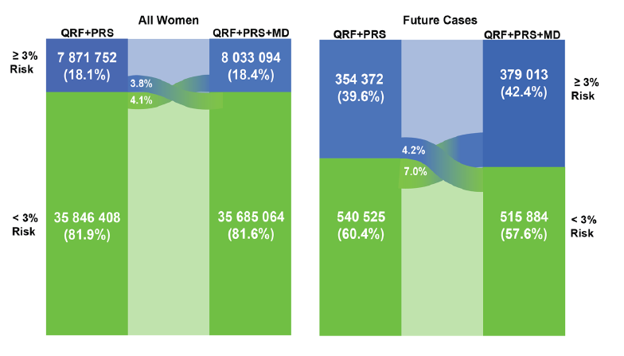
These graphics show the projected numbers of women and future cases (over 5 years) identified at high risk for developing breast cancer (blue) or low risk (green). “All Women” refers to the European-ancestry women in the US between the ages of 50 and 70 years. “Future Cases” refer to the women in that population who are expected to develop breast cancer over 5 years in the future. High risk is greater than or equal to a 3% risk of developing cancer in the next 5 years. Low risk is less than a 3% risk of developing cancer in the next 5 years.
Each graphic shows a comparison between two risk models (with and without breast density):
- Left columns show the proportion of women estimated to have a high or low risk using the risk model without breast density, which is based on questionnaire answers about personal risk factors and family history (QRF) and polygenic risk score (PRS).
- Right columns show the proportion of women estimated to have a high or low risk using the new risk model developed for this study, which used QRF and PRS and added mammographic (breast) density (MD).
- The middle columns’ curved bars show how women identified at high or low by the model without breast density were reclassified based on the model used in this study that included breast density.
The Research
Given that mammographic breast density is a strong independent risk factor for breast cancer, robust evaluation of its contribution in improving models with comprehensive questionnaire-based risk factors and a polygenic risk score would inform its effectiveness in risk-tailored screening and prevention.
American Cancer Society (ACS) researcher Parichoy Pal Choudhury, PhD, was the senior author of a study recently published in npj Breast Cancer that evaluated the benefit of adding breast density into a prospectively validated breast cancer risk model. The researchers’ goal was to improve risk stratification for tailored screening and prevention.
What Is a Breast Cancer Risk Model?
Breast cancer risk models are statistical tools that help doctors estimate the chance a person might develop breast cancer in the future.
The models use personal and family data, such as:
age , age at first period, age at first live birth, age at menopause
- BMI and height
- family history of breast cancer and personal history of breast cancer biopsies
- mammographic (breast) density (MD)
- number of childbirths
- polygenic risk score (PRS)
- use of alcohol
- use of hormone replacement therapy and use of oral contraceptives
The result is an estimate of absolute risk. Doctors can use these estimates to guide recommendations for an individual woman’s health care, including how often she should be screened for breast cancer. For instance, doctors may advise women with higher absolute risk about receiving supplemental screening and/or genetic counseling as well as following lifestyle cancer prevention strategies.
What they found. They found a “modest improvement” in risk stratification and reclassification after incorporating breast density in the risk model.
Additional work on risk model development and validation is needed for non-European ancestry populations to ensure racial and ethnic minority groups benefit from risk-stratified prevention and screening approaches.
The team built a new risk model that included mammographic (breast) density (MD) scores and compared the results from their model with the risk model without MD.
To build new models, the team used the tool called the Individualized Coherent Absolute Risk Estimator (iCARE). This tool implements general methods to build, validate, and apply absolute risk models. Dr. Pal Choudhury is a primary developer of iCARE.
The researchers used iCARE to build and validate a literature-based model (iCARE-Lit) to estimate the 5-year absolute risk of breast cancer. This validated breast cancer risk model uses this information about risk factors:
- QRF, which is based on women’s answers on a questionnaire about their personal risk factors and family history for developing breast cancer
- PRS, a single number that estimates an individual’s genetic susceptibility of developing breast cancer based on a combination of the tiny, individual impact of 313 common genetic variants associated with the disease
The new iCARE-Lit mode also evaluates risk by integrating information on QRF, PRS and mammographic (breast) density score from BI-RADS (Breast Imaging Reporting and Data System). The score represents how much of a woman’s breast tissue is fatty vs glands and fibrous connective tissue. The nonfatty tissue is more dense and makes it harder to see potential tumors with a mammography.
Who they studied. Using their newly developed risk prediction tool, they assessed data from 20,572 White women of European ancestry (1,468 with breast cancer and 19,104 without breast cancer), ages 27 to 75, from 3 prospective cohorts: the US Nurses’ Health Study, Mayo Mammography Health Study, and Swedish Karolinska Mammography Project for Risk Prediction of Breast Cancer.
What the study evaluated. The researchers conducted prospective validation of their new risk prediction model to see how including the density of breast tissue affected the model’s performance in predicting the 5-year absolute risk of developing breast cancer.
Their results are demonstrated in the graphics above. The center columns use curved bars to show the proportion of women whose risk was reclassified after incorporating breast density in the risk model (QRF + PRS + MD).
For example, the left graphic demonstrating risk predictions for all women, shows:
- 3.8% of women who were classified as high risk using the standard risk model (QRF + PRS) were reclassified as low risk using the model that incorporated breast density (QRF + PRS + MD).
- 4.1% of women who were classified at low risk using the standard model (QRF + PRS) were reclassified as high risk based on the model that added breast density (QRF + PRS+ MD).
“The model’s ability to stratify more women above and below clinically meaningful risk levels would lead to more women being rightfully allocated to high and low-risk categories, and therefore, able to qualify for risk-reducing strategies,” the authors wrote.
The model’s ability to stratify more women above and below clinically meaningful risk levels would lead to more women being rightfully allocated to high and low-risk categories, and therefore, able to qualify for risk-reducing strategies.”

What they found. They found a “modest improvement” in risk stratification and reclassification after incorporating breast density in the risk model.
Additional work on risk model development and validation is needed for non-European ancestry populations to ensure racial and ethnic minority groups benefit from risk-stratified prevention and screening approaches.
Why It Matters
A “substantial percentage” of women who develop breast cancer were not classified as high risk.
Women designated as high risk can be targeted for certain types of interventions such as enhanced screening and surveillance, chemoprevention and/or endocrine therapy, or risk-reducing surgery.
The ACS and public health organizations, for example, recommend that women take these measures to reduce their risk of developing breast cancer:
- Maintain a healthy BMI
- Increasing physical activity
- Limiting alcohol
Before implementing the addition of breast density or other risks in breast cancer risk models, an enhanced breast cancer risk model would need a formal assessment of benefits and harms regarding its use in a clinical setting.
From the Cancer Research Glossary for Nonscientists
BI-RADS
Also called Breast Imaging Reporting and Data System.
BI-RADS is the most widely used clinical scoring system to classify breast density. The score is one part of the report a woman gets after having a mammogram, ultrasound, or MRI.
Radiologists evaluate breast density, using an A-D scoring system:
A. Almost entirely fatty
B. Mostly fatty, with some scattered areas of dense tissue
C. Having more dense areas than fatty ones
D. Extremely dense
Dense tissue is made of glands and fibrous connective tissue. It is harder for radiologists to spot potentially cancerous areas through dense tissue, so women with extremely dense breasts have a higher risk of developing breast cancer.
Polygenic risk score (PRS)
A PRS adds up the tiny effects of numerous single nucleotide changes in DNA to produce a score that assesses a person’s chances of having or developing a certain medical condition, like cancer, based on their genetics alone. There can be 100s or even 1000s of variants per disease.
Risk stratification
Risk stratification is the process used to sort people into different groups based on absolute risks for developing cancer. This stratification helps guide medical decisions and so create treatment plans that are specific to a patient’s needs (tailored intervention).



