Your gift is 100% tax deductible.
Home Testing Rose, Colonoscopies Fell During the Pandemic
ACS researchers found that during the COVID-19 pandemic, screening for all types of cancer dropped—except for colorectal cancer.
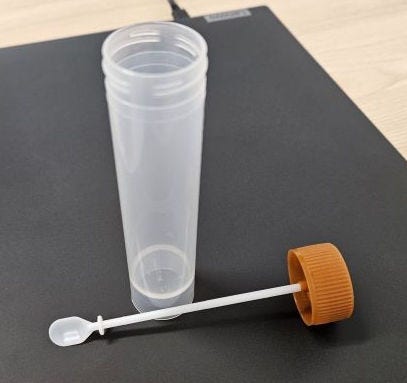
Home-based Stool Test in Brief
This photo shows an example of a bottle used to collect a small sample(s) of stool in a home-based stool test. Home test kits usually include a special envelope or box for mailing sample(s) to a lab, where the stool will be checked for traces of blood or specific DNA changes. If either is detected, additional colorectal cancer testing is required to screen for cancer.
The Challenge
Screening for cancer saves lives. From 1975 to 2020 in the United States, 4.75 million deaths from breast, cervical, colorectal, lung, and prostate cancers were averted because of cancer prevention and screening efforts.
In 2020 and 2021 during the COVID-19 pandemic and the healthcare disruptions that occurred, the prevalence of many cancer screenings declined because people were just not able to schedule or get to those appointments.
Featured Term:
Screening prevalence
The proportion of people in a population who receive cancer screening during a defined time period. Screening prevalence is often expressed as a percentage.
From the Glossary for Nonscientists
As the proportion of people who got screened decreased, fewer cancers were caught early when they are more easily treatable and when survival is markedly higher compared to a late-stage diagnosis. For example, when people are diagnosed with colorectal cancer at an early stage, they have about a 91% chance of being alive 5 years after their diagnosis (or start of treatment).
But if colorectal cancers aren't diagnosed until they've spread away from the colon or rectum (late stage), survival rates are much lower. People diagnosed with late-stage (also called distant) colorectal cancer have only a 15% chance to be alive 5 years after their diagnosis (or start of treatment).
So, it's essential that we track screening prevalence, the risks that result if the numbers decline, and what worked or didn’t work to get screening prevalence back to the levels they were—or better than—before the COVID-19 pandemic. In fact, it can truly be a matter of life and death.
Colorectal Cancer Screening Guidelines
There's more than one way to screen for colorectal cancer. For people with an average risk of developing colorectal cancer, the ACS Screening Guideline for early detection is:
Starting at age 45, get one of these screening tests at the recommended frequency:
Every year: Get one of these home-based stool tests: A gFOBT (g is for guaiac-based and refers to the coating on the test cards to make them detect blood) OR a FIT (fecal immunochemical test) test OR
Every 3 years: A multi-targeted stool DNA (MT-sDNA) test OR
Every 5 years: A sigmoidoscopy OR a CT (computed tomography) colonography OR
Every 10 years: A colonoscopy
For people who are in good health, screening should continue through age 75.
People age 76 through 85 who are in good health may choose to be screened.
The Research
From the start of the COVID-19 pandemic, the American Cancer Society (ACS) Surveillance, Prevention, and Health Services Research team (SPHeRe) team has analyzed the role of the pandemic on cancer screening. The team published studies every year.
Combining data from 3 of their published studies about the COVID-19 pandemic and cancer screening provide a good picture of how screening prevalence changed from before the pandemic (2019) to during it (2021) and after it (2023).
- In 2023, the team published a study about past-year screening prevalence during the second year of the COVID-19 pandemic for breast, cervical, colorectal, and prostate cancer in the Journal of Clinical Oncology.
- In 2025, they published a study about past-year screening prevalence 3 years after the onset of the pandemic in JAMA for the same cancer screenings except for prostate cancer.
- The team published another 2025 study in Cancer Epidemiology, Biomarkers, & Prevention about the status of up-to-date cancer screenings, major modifiable cancer risk factors, and HPV vaccination.
All studies included leadership from ACS surveillance researchers on the including Jessica Star, MA, MPH, Priti Bandi, PhD, and Ahmedin Jemal, DVM, PhD.
Prevalence for Any Type of Colorectal Cancer Screening for People 50 to 75 Before, During, and After the Pandemic
The blue boxes below display up-to-date colorectal cancer screening, using any screening strategy, including FOBT or FIT, sigmoidoscopy, colonoscopy, CT colonography, or multitarget stool DNA test.
Up-to-date with Any Type of Colorectal Cancer Screening Strategy
Before the COVID-19 Pandemic
During the COVID-19 Pandemic
After the COVID-19 Pandemic
During the quarantines for the COVID-19 pandemic, the prevalence the prevalence of breast, cervical, and prostate cancer screening declined. However, as you can see from the boxes above, up-to-date colorectal cancer screening prevalence increased during the early years of the COVID-19 pandemic, from 66.5% in 2019 to 69% in 2021 and remained high into 2023: 68.9%.
Screening was also measured in the past-year because this is an acute measure (in contrast to up-to-date screening which is over a longer time frame) of changes during the pandemic. In terms of past-year colorectal cancer screening, prevalence increased from 21.2% in 2019, to 22.3% in 2021, to 24.3% in 2023.
Screened for Colorectal Cancer in the Past Year Using any Type of Test
Before the COVID-19 Pandemic
During the COVID-19 Pandemic
After the COVID-19 Pandemic
This increase can be attributed to home-based screening options for colorectal cancer which increased during the pandemic whereas the prevalence of screening with colonoscopy declined during the pandemic.
Colonoscopy Prevalence for People 50 to 75 Before, During, and After the COVID-19 Pandemic
Up-to-date with colonoscopy recommendations (which can occur anytime in the past 10 years) is a longer-term measure that more closely tracks with the eventual cancer burden. In terms of up-to-date colonoscopy screening, prevalence remained similar before, during, and after the pandemic.
Up-to-date Colonoscopy
Before the COVID-19 Pandemic
During the COVID-19 Pandemic
After the COVID-19 Pandemic
Because opportunities to get a colonoscopy to screen for colorectal cancer during the pandemic quarantines were limited, the prevalence of people who were able to get a screening colonoscopy in the last year declined from 15.4% to 13.8% during the first 2 years of the pandemic. However, last-year colonoscopy screening rebounded 3 years (2023) after the COVID-19 pandemic, climbing back to roughly the same prevalence for screening as before the pandemic started (2019)
Colonoscopy in the Past Year
Before the COVID-19 Pandemic
During the COVID-19 Pandemic
After the COVID-19 Pandemic
Stool Testing Prevalence for People 50 to 75 Before, During, and After the COVID-19 Pandemic
Unlike colonoscopies, home-based stool tests are readily accessible by mail, so people don't need to leave home for testing in a doctor's office or facility.
The prevalence of screening with a stool test at home increased by 59% during the COVID-19 pandemic and continued to rise after it.
Before the COVID-19 Pandemic
During the COVID-19 Pandemic
After the COVID-19 Pandemic
People who have a positive stool test need follow-up colonoscopy, but for many years, high out-of-pocket costs have kept many people from getting the follow-up test. The result is an increasing risk of death from colorectal cancer.
In January 2022, the US federal government required certain private health insurance groups to cover the full cost of a follow-up colonoscopy after a positive home stool test or after a screening procedure (other than colonoscopy) that allows doctors to see directly inside the colon, such as with sigmoidoscopy or CT colonography. However, the number of people who get a follow-up colonoscopy remains very small.
Up-to-Date Screening Differences in Prevalence Based on Population Characteristics
All facts below are for people ages 45 to 75, from 2023 data, unless otherwise noted.
By Race
Overall prevalence for any type of colorectal cancer screening and colonoscopy-only screening prevalence was higher in White adults (66.5% and 57.6% respectively) and lower in Hispanic adults (53.3% and 42.7% respectively).
In comparison, stool testing prevalence was higher for Black (19%) and Hispanic (18.8%) populations and lower in White adults (14.9%).
Prevalence for Asian and AIAN populations fell in the middle for any type of screening, colonoscopy, and stool tests.
By Health Insurance Coverage
Overall, people age 65 and older covered by Medicare had higher prevalence, at 82.5%, for any type of colorectal cancer screening of, 73.9% for screening colonoscopy, and 24.5% for stool tests.
People with private health insurance consistently had the second higher prevalence: 68.1% for any type of colorectal cancer screening, 58.8% for screening colonoscopy, and 14.7% for stool testing.
People covered by Medicaid or public health insurance as well as people who are dual eligible (covered by Medicare and Medicaid) were in the middle of the prevalence range for any kind of screening, colonoscopy, and stool tests.
People without health insurance had lower colorectal screening prevalence by far: 23.9% for any kind of screening, 18.1% for colonoscopy, and 6.2% for stool tests.
By Sexual Orientation
Gay and lesbian populations had higher prevalence for any type of colorectal cancer screening (73%) as well as for screening colonoscopy (64.1%).
Bisexual populations had a higher prevalence for stool tests (23.3%). However, bisexual populations had a lower prevalence for screening with colonoscopy only (53.4%).
Heterosexual populations had lower prevalence for any type of colorectal cancer screening (63.6%) and screening stool tests (16%).
By Age, Education, and US Status
In general, a higher proportion of people with these characteristics received any type of colorectal cancer screening:
- Older people (age 65 and above) compared to people 45 to 64
- People with higher levels of education compared to those with lower levels.
- People born in the US compared to those in the US for 10 years or more and those in the US for less than 10 years
Why It Matters
These studies underscore the value of having home-based test screening options for cancer.
Increasing the number and availability of home-based screening tests may help the US be better prepared for major disruptions to delivery of care in doctor’s offices or hospitals. However, for home tests to be beneficial, colonoscopy testing as a follow up for positive stool test results is essential.
To help keep colorectal screening available for everyone, the study authors suggest that the US federal and state governments and policy makers use system-level and educational interventions that have been shown to improve screening prevalence and reduce screening disparities:
- Maintain the Affordable Care Act (ACA) provisions for screening and follow-up colonoscopy coverage without any cost to the patient (no cost-sharing).
- Pursue health care navigation programs that guide patients through the screening continuum.
- Continue ongoing surveillance with reliable ways to represent a variety of populations and national-, state-, and local-level datasets to track progress and develop interventions.