
Types of HPV
There are more than 200 types of HPV (human papillomavirus). Each type is identified by a number. HPV tests check to see whether you are infected with a high-risk or oncogenic HPV type. These types of HPV are known to cause cancer.
HPV 16 and HPV 18 cause the majority of HPV cancers.
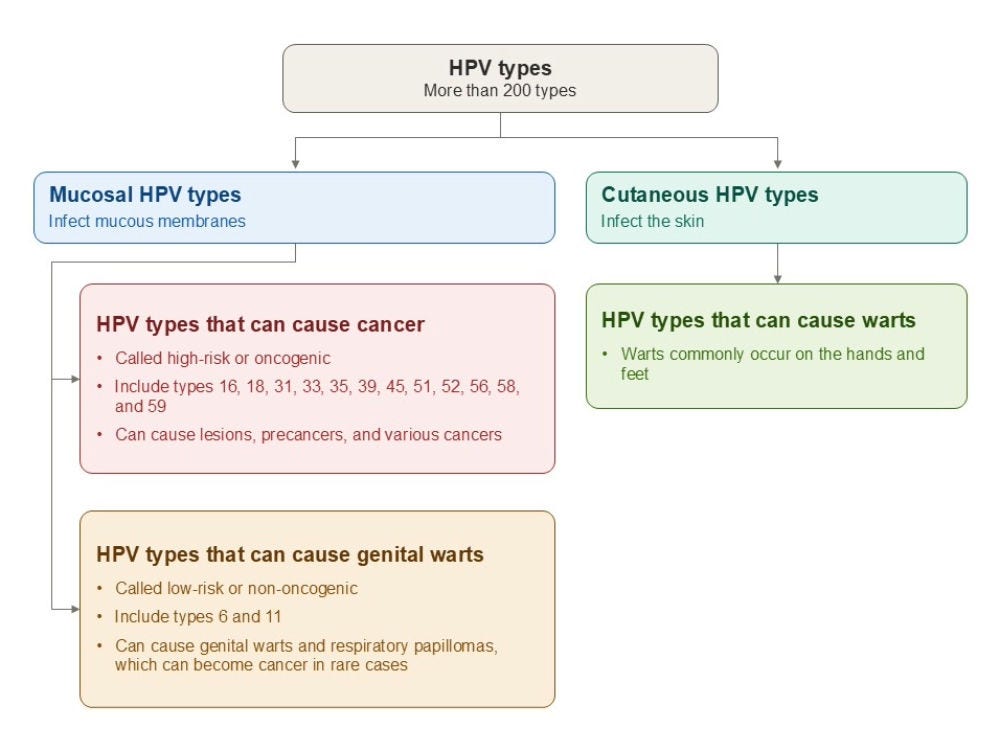
How are HPV types grouped?
HPV types are grouped based on differences in their DNA. All HPV types infect epithelial cells, which are cells that line tissues throughout the body. However, different HPV types infect different areas of the body and can cause different problems.
- Cutaneous HPV types infect dry areas of skin, like the hands.
- Mucosal HPV types infect moist surfaces and membranes in the body.
Cutaneous (skin) HPV types
Cutaneous HPVs infect the surface of the skin. Most cutaneous HPV types do not cause any symptoms or problems, but certain types can cause warts (papillomas). Warts commonly occur on the hands, feet, arms, and legs.
These warts are not the same as genital warts, which are caused by certain mucosal HPV types.
Mucosal HPV types
Mucosal HPVs infect moist surfaces and membranes, including those found in the:
- Vagina, cervix, and vulva (the visible area around the female genitals)
- Anus
- Penis
- Mouth and throat
- Upper airways in the nose, throat, and lungs
Certain mucosal HPV types can cause genital warts or cancer.
Mucosal HPVs that can cause genital warts
HPV 6 and HPV 11 are considered low-risk or non-oncogenic mucosal HPVs. They tend to cause genital warts, but they can cause cancer in rare cases. Warts can form in or around the genitals or anus.
These HPV types can also form papillomas (wart-like growths) in the respiratory tract, although this is very rare.
Mucosal HPVs that can cause cancer
Twelve HPV types are known to cause cancer in humans. These are called high-risk or oncogenic mucosal HPV types. They include HPV 16, 18, 31, 33, 35, 39, 45, 51, 52, 56, 58, and 59.
HPV 16 and HPV 18 cause about 3 out of 4 cervical cancers.
HPV testing checks for infection with high-risk HPV types. It helps determine whether someone should be treated for any problems HPV might be causing.
- Written by
- References

The American Cancer Society medical and editorial content team
Our team is made up of doctors and oncology certified nurses with deep knowledge of cancer care as well as editors and translators with extensive experience in medical writing.
Centers for Disease Control and Prevention (CDC). Chapter 11: Human papillomavirus. In: Epidemiology and Prevention of Vaccine-Preventable Diseases. Pink Book. Accessed at https://www.cdc.gov/pinkbook/hcp/table-of-contents/chapter-11-human-papillomavirus.html on September 3, 2026.
Egawa N, Egawa K, Griffin H, Doorbar J. Human papillomaviruses; epithelial tropisms, and the development of neoplasia. Viruses. 2015;7(7):3863-3890. doi:10.3390/v7072802
International Agency for Research on Cancer (IARC). Global attribution of HPV genotypes to invasive cervical cancer: A systematic analysis. Press release 353. Lyon, France: IARC; August 1, 2024. Accessed at https://www.iarc.who.int/wp-content/uploads/2024/07/pr353_E.pdf on September 3, 2026.
National Institute on Deafness and Other Communication Disorders (NIDCD). Recurrent respiratory papillomatosis (RRP) or laryngeal papillomatosis. Accessed at https://www.nidcd.nih.gov/health/recurrent-respiratory-papillomatosis on September 3, 2026.
Wei F, Georges D, Man I, Baussano I, Clifford GM. Causal attribution of human papillomavirus genotypes to invasive cervical cancer worldwide: a systematic analysis of the global literature. Lancet. 2024;404(10451):435-444. doi:10.1016/S0140-6736(24)01097-3
Last Revised: September 3, 2026
American Cancer Society medical information is copyrighted material. For reprint requests, please see our Content Usage Policy.
American Cancer Society Emails
Sign up to stay up-to-date with news, valuable information, and ways to get involved with the American Cancer Society.