Cell Tower Radiation and Cancer
As cell phone use has grown, so have the number of cell phone towers, or base stations. Living or spending time near them may raise concerns about cancer risk. Understanding the research can help you make informed choices and protect your health.
Do cell phone towers cause cancer?
Cell phone towers use radiofrequency (RF) radiation, also known as RF waves, to send signals. Some people may worry that living, working, or going to school near a cell phone tower might increase their risk of cancer. There isn't a lot of evidence to support this idea. More research on cell tower radiation is needed to be sure.
What expert agencies say
In general, the American Cancer Society (ACS) does not determine whether something should be considered a carcinogen. Instead, ACS looks to other respected organizations for help with this. Based on animal and human evidence, several expert agencies have evaluated the cancer-causing potential of cell phone towers:
- The International Agency for Research on Cancer (IARC) classifies RF radiation as “possibly carcinogenic to humans,” based on limited evidence of a possible increase in risk for brain tumors among cell phone users, and inadequate evidence for other types of cancer. An IARC advisory group has suggested this topic as a high priority for reevaluation by 2029.
- The US National Toxicology Program (NTP) has not included RF radiation in its Report on Carcinogens, which lists exposures that are known to be or reasonably anticipated to be human carcinogens. Some NTP lab studies in rats suggested a link between cancer and high levels of RF radiation, but other animal studies did not show associations with tumors.
- The US Federal Communications Commission (FCC) states that current evidence does not show that using wireless devices causes cancer or other illnesses. Experts looking at potential risks agree that more and longer-term studies are needed to explore whether current safety standards for RF radiation exposure with wireless devices are adequate.
- The US Food and Drug Administration (FDA) states that current research doesn’t provide enough evidence to show that exposure to RF radiation directly causes tumor formation.
What studies show
Researchers generally use 2 types of studies to try to determine if something might cause cancer:
- Lab studies are done using lab animals or cells in lab dishes.
- Studies in people compare groups to see if people with higher exposures are more likely to develop cancer.
Often, neither type of study provides enough evidence on its own. Experts usually look at both types of studies when trying to figure out if something can cause cancer.
Lab studies
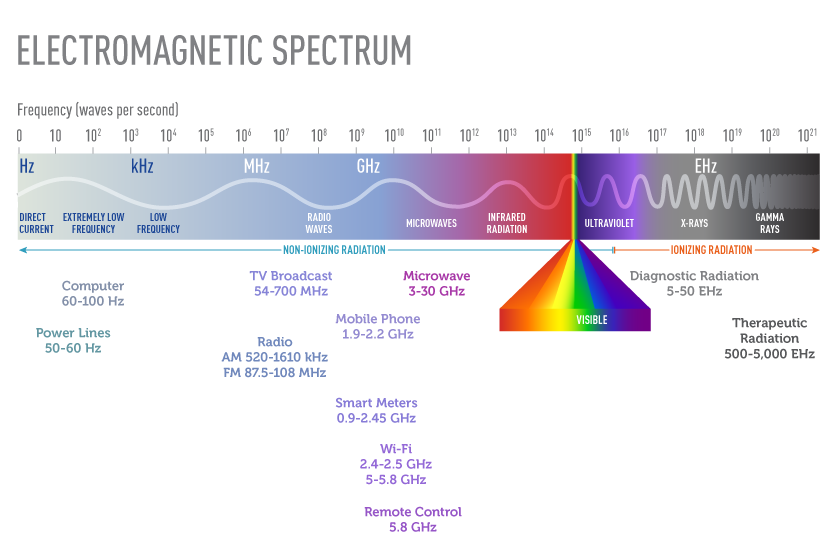
RF waves from cell phone towers are a type of non-ionizing radiation. They don’t have enough energy to directly damage DNA or heat body tissues, so it's not clear how exposure from these towers could lead to cancer.
Some studies have reported high rates of certain types of cancers in lab animals exposed to RF radiation. However, the results of these studies have not been consistent.
Large studies that exposed lab animals’ bodies to high levels of RF radiation, like that from cell phone towers, for most of their lives found more rare heart tumors and possible increases in some brain and adrenal gland cancers in male rats, but not in female rats or mice. Expert reviews of these studies note important limitations and say the results are not directly relevant to cancer risk from RF energy in humans.
Studies in people
Generally, research has not found a clear connection between RF radiation exposure from cell phones and cell towers and cancer risk. This includes childhood cancers.
A large international review of about 60 studies by the World Health Organization (WHO) looked at research on RF radiation exposure from cell phones and towers over decades. The review found no link between RF exposure and brain cancer or childhood cancer. Also, the review noted that brain cancer rates remained stable as cell phone use increased.
These studies relied on estimates of RF radiation exposure. The actual exposure of people to RF waves from nearby cell phone towers was not measured.
The conclusion from these studies is that the science generally points towards no link with cancer. However, these studies have limitations that make it hard to be entirely certain about this. For some cancer links, there isn’t enough data to say one way or another.
To learn more, see Cell Phones and Cancer Risk.
How do cell phone towers expose people to RF radiation?
Cell phone towers can be free-standing or antennas mounted on existing tall structures, such as trees, water tanks, or buildings. They are positioned high enough to provide coverage to the surrounding area. They are usually about 50 to 200 feet above the ground.
Cell phone towers communicate with cell phones by sending and receiving RF waves, a type of energy in the electromagnetic spectrum between FM radio waves and microwaves. Like FM radio waves, microwaves, visible light, and heat, RF waves are non-ionizing radiation. This type of radiation does not have enough energy to directly damage the DNA inside cells. In contrast, ionizing radiation such as x-rays, gamma rays, and ultraviolet (UV) rays, can damage DNA and may increase cancer risk.
When a person makes a cell phone call, the phone sends a signal to the nearest tower or antenna. The tower or antenna receives the signal and sends information back and forth during the call.
As the tower or antenna receives these signals, RF radiation is released into the surrounding area. People that are nearby may be exposed to low levels of RF radiation.
RF radiation on the ground near a cell phone tower
RF radiation from a cell phone tower or antenna is directed toward the horizon (parallel to the ground). Some energy can spread down toward the ground. Cell towers use a lot less power than stations that broadcast radio and TV signals. The energy from RF waves drops quickly as distance from the antenna increases. Because of this, RF radiation exposure to at ground level is much lower than it is close to the antenna.
At ground level near typical cell towers, the energy from RF waves is hundreds to thousands of times less than the limits for safe exposure set by the FCC and other regulatory authorities. It is very unlikely that a person could be exposed to RF radiation levels that exceed these limits just by being near a cell phone tower.
On a roof with a cellular antenna
When a cellular antenna is mounted on a rooftop, people on the roof could be exposed to higher RF radiation levels than those typically found on the ground. However, levels near or above safety guidelines set by FCC are usually found very close to and directly in front of the antennas. For this reason, access to these areas should be limited.
Inside a building where a cell tower is mounted
Waves inside buildings where a base station or antenna is mounted usually have lower levels than outside. Antennas send signals away from the building. The energy level behind an antenna is lower than in front of it.
Also, wood, brick, and concrete reduce RF energy. So, if an antenna is mounted on the side of a building, the exposure level in the room directly behind the wall is typically well below the recommended limits.
What about 5G networks?
Fifth-generation (5G) cellular networks are used in most of the US and in many other countries. They can transmit larger amounts of data more quickly than previous network generations. 5G networks use some higher frequency signals in addition to lower frequency signals in older networks.
While these are higher frequencies, the signals are still non-ionizing radiation, which means they don’t have enough energy to directly damage DNA.
Higher frequency signals used by 5G networks travel shorter distances and don’t go through objects, such as buildings and trees, as well as lower frequency signals. Because of this, smaller versions of base stations, often called small cells, are placed on streetlights, utility poles, and buildings to make coverage better.
This placement could result in the antennas being closer to people, exposing them to more RF radiation. However, small cells typically operate at much lower power levels overall. This 5G set-up could expose people to more RF waves, but this exposure is less likely to penetrate the body.
Current evidence has not shown that RF radiation exposure from 5G networks is a health concern. Research on long-term exposure is ongoing.
Where to find more information
Centers for Disease Control and Prevention (CDC)
Facts abut Cell Phones and Your Health
Federal Communications Commission
Radiofrequency Radiation FAQ
Food and Drug Administration
Cell Phones
National Cancer Institute
Cell Phones and Cancer Risk
Electromagnetic Fields and Cancer
National Institute of Environmental Health Sciences
Electric and Magnetic Fields
Cell Phone Radio Frequency Radiation
- Written by
- References

The American Cancer Society medical and editorial content team
Our team is made up of doctors and oncology certified nurses with deep knowledge of cancer care as well as editors and translators with extensive experience in medical writing.
Federal Communications Commission, Office of Engineering and Technology. RF Safety FAQ. 2015. Accessed at https://www.fcc.gov/engineering-technology/electromagnetic-compatibility-division/radio-frequency-safety/faq/rf-safety on March 12, 2026.
Food & Drug Administration. Review of Published Literature between 2008 and 2018 of Relevance to Radiofrequency Radiation and Cancer. 2020. Accessed at https://www.fda.gov/media/135043/download on March 11, 2026.
International Commission on Non-Ionizing Radiation Protection (ICNIRP). ICNIRP Note: Critical Evaluation of Two Radiofrequency Electromagnetic Field Animal Carcinogenicity Studies Published in 2018. Health Phys. 2020 Aug 27.
Leonard UL, Leydon CL, Arranz E, Kiely ME, Impact of consuming an environmentally protective diet on micronutrients: a systematic literature review, Am J Clinical Nutrit, 2024;119(4):927-948.
National Institute of Environmental Health Sciences. Cell Phone Radio Frequency Radiation Studies. 2026. Accessed at https://ntp.niehs.nih.gov/research/topics/cellphones on March 12, 2026.
Seomun G, Lee J, Park J. Exposure to extremely low-frequency magnetic fields and childhood cancer: A systematic review and meta-analysis. PLoS One. 2021;16(5):e0251628. Published 2021 May 14.
Last Revised: June 26, 2026
American Cancer Society medical information is copyrighted material. For reprint requests, please see our Content Usage Policy.
American Cancer Society Emails
Sign up to stay up-to-date with news, valuable information, and ways to get involved with the American Cancer Society.