How to Protect Your Skin from UV Rays
It’s not possible to avoid sunlight completely, but there are ways to limit how much sun you get when you are outdoors. Knowing how to protect your skin can help prevent skin damage.
Protect yourself from ultraviolet (UV) rays
Some people think about sun protection only when they spend a day outdoors at the lake, beach, or pool. But sun exposure adds up day after day, and it happens every time you are in the sun. Regardless of the season, UV rays can be strong enough to cause skin damage when your skin is not protected.
Sunlight is not the only form of UV you need to protect against. You can also protect yourself by avoiding tanning beds, booths, sunlamps, and other artificial sources of UV radiation. And if you have UV exposure at work, use protective clothing, UV shields, and filters.
Sunburns can greatly increase your risk of skin cancer, including basal and squamous cell cancers and melanoma. UV exposure increases the risk of skin cancer even for people who don’t usually get sunburned.
Know and check the UV index
The US National Weather Service and the Environmental Protection Agency (EPA) have developed the UV Index. Knowing the expected UV Index gives you an idea of how strong the UV light is in your area on any given day.
The UV Index reports the intensity (strength) of UV rays on a scale from 1 to 11+. A higher number means there is a greater risk of exposure to UV rays. It also means a higher chance of sunburn and skin damage that could lead to skin cancer. The UV Index is part of many weather forecasts and is reported on many weather apps.
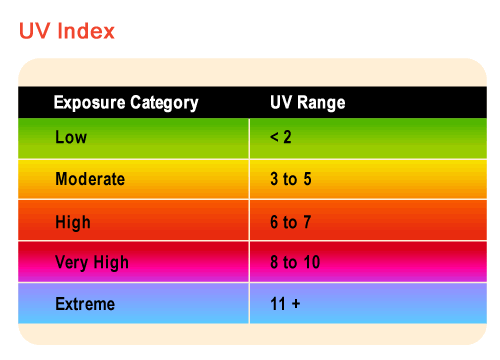
Image courtesy of epa.gov
The UV Index tells you the strength of the UV rays, but the amount of UV exposure you have also depends on:
- Time spent outdoors for work or recreation
- How long your skin is exposed
- Whether your skin is protected with clothing or sunscreen
- The pattern of your exposure over time
You can check the UV Index by watching or listening to a weather forecast. Or you can find it using a weather app for your location.
If you aren't sure of the UV Index in your area or when you will be exposed to direct sunlight, you can do the shadow test. If your shadow is shorter than you are, this tells you the sun’s rays are the strongest.
Ways to protect your skin from UV rays
There are many ways to protect your skin from UV rays. Use as many of these as you can, especially when you’re outdoors for a long time or during peak UV hours.
Seek shade
The best way to limit your exposure to UV light is to avoid being outdoors in direct sunlight too long. This is especially important between the hours of 10 a.m. and 4 p.m., when UV rays are the strongest. When you are outdoors, try to stay under trees, umbrellas, and canopies, or use a portable sunshade.
Even when you’re in the shade, UV rays can still reach you by reflecting off other surfaces. Be careful on the beach or in snowy areas because snow, sand, and water can reflect sunlight. This increases the amount of UV radiation you get. UV rays can also reach below the water’s surface, so you can still get a sunburn even if you’re in the water and don’t feel the sun’s heat.
It’s a good idea to protect your skin in other ways, such as wearing protective clothing and using sunscreen.
Protect your skin with clothing
When you’re in the sun, wear clothing to cover your skin. Clothes provide different levels of UV protection. Covering up doesn’t block all UV rays. If you can see light through a fabric, UV rays can get through, too.
Here are some tips to help you choose clothing to protect your skin:
- Long-sleeved shirts, long pants, or long skirts cover the most skin and are the most protective.
- Dark colors generally provide more protection from UV rays than light colors. They absorb more UV radiation, helping to keep it from reaching your skin.
- A tightly woven fabric protects better than loosely woven clothing.
- Dry fabric is generally more protective than wet fabric.
Clothing with UV protection factor (UPF)
You can buy clothing that’s lightweight, comfortable, and protects against UV rays even when wet. The fabric for these items tends to be more tightly woven, and some have special coatings to help absorb UV rays.
Sun-protective clothes may have a label listing the UV protection factor (UPF) value. This shows the level of protection the garment provides from the sun’s UV rays, on a scale from 15 to 50+. A higher UPF means more protection from UV rays.
Some detergents can increase the UPF value of clothes you already own. They add tiny crystals to clothes when washed, which adds a layer of UV protection without changing the color or texture. However, it’s not clear exactly how much added protection this provides.
Use sunscreen
Sunscreen helps protect your skin by filtering UV rays, but it doesn’t block them fully. Apply sunscreen generously, making sure to cover all parts of your body that aren’t covered by clothing. This includes your face, ears, neck, arms, the tops of your feet, and your scalp and hairline. Protect your lips by using lip balm with sunscreen.
Choose sunscreen with broad spectrum protection (against both UVA and UVB rays) and a sun protection factor (SPF) of 30 or higher.
Sunscreen comes in many forms, including lotions, creams, and sprays. If you have sensitive skin, choose a sunscreen that doesn't irritate or cause a reaction. Always read the label carefully.
Reapply sunscreen at least every 2 hours, and more often if you are sweating or swimming. Remember that no sunscreen can protect you completely. Even if you use sunscreen with a high SPF, it doesn't mean you can stay in the sun longer.
Learn more in How to Use Sunscreen.
Wear a hat
A hat with at least a 3-inch brim all around is ideal for sun protection. It protects areas that are often exposed to intense sun, such as the ears, eyes, forehead, nose, and scalp. A dark, non-reflective underside to the brim can also help lower the amount of UV rays reaching the face from reflective surfaces, such as water.
A shade cap looks like a baseball cap with about 7 inches of fabric draping down the sides and back. This is also a good choice and will provide more protection for the neck. These are often sold in sporting goods and outdoor supply stores. If you don’t have a shade cap or a wide-brimmed hat available, you can make one by wearing a large handkerchief or bandana under a baseball cap. People who need to wear hard hats for work can use this technique, too. Or they can find a hard hat with a built-in sunshade.
Keep in mind a baseball cap protects the front and top of the head but does not protect the neck or the ears, where skin cancers commonly develop. Straw hats are not as protective as hats made of tightly woven fabric since they let more UV rays through.
Wear sunglasses that block UV rays
UV-blocking sunglasses are important for protecting the eyes and the delicate skin around them. Research has shown that spending long hours in the sun without protecting your eyes increases your chance of developing certain eye diseases, possibly including eye cancer.
The ideal sunglasses should block 99% to 100% of UVA and UVB rays. Before you buy, check the label to make sure they do. If sunglasses have no label, don’t assume they provide any UV protection.
- Labels that say, “UV absorption up to 400 nm,” “100% UV protection,” or “Meets ANSI UV Requirements” mean the glasses block at least 99% of UV rays.
- Darker glasses are not necessarily better. UV protection comes from an invisible chemical that is in or is applied to the lenses. The protection does not come from the color or darkness of the lenses. Look for an ANSI label.
Large-framed and wraparound sunglasses are more likely to protect your eyes from light coming in from different angles. Protect the eyes of children with smaller versions of real, protective adult sunglasses, not toy sunglasses.
Some brands of eyeglasses and contact lenses offer protection against UV rays. Don’t assume this is true for lenses you wear unless it’s clearly stated on the product label or you confirm this with your eye care professional. Of course, glasses come in many shapes and sizes, and smaller lenses will cover and protect smaller areas. Contact lenses don’t cover the whole eye and surrounding areas, so they are not enough eye protection when used alone.
Protect children from the sun
Children tend to spend more time outdoors than adults. They also tend to sunburn more easily. Young children are focused on playing, and they may not notice the sun’s effects. They may not realize how long they’ve been in the sun. That’s why it’s important you take steps to keep their skin protected.
Protect children from excess sun exposure by using these:
- Seek shade
- Use protective clothing
- Apply and reapply sunscreen
- Put on a hat and sunglasses
Keep babies younger than 6 months out of direct sunlight and protect them from the sun using hats, stroller covers, umbrellas, and protective clothing.
It’s important to protect children and babies as fully as possible, no matter their skin color or tone.
Common questions about UV protection
Here are answers to questions people often ask about protecting their skin from UV rays.
Does getting a tan or having darker skin protect from UV rays?
Anyone who spends time outdoors in the sun is at risk of skin damage from UV radiation. People with lighter skin have a higher risk of skin damage and skin cancer from UV rays. But people of any ethnicity or skin color can be affected.
Skin can tan when it absorbs UV rays. This happens because UV rays can cause an increase in the activity and number of melanocytes. Melanocytes are the cells that make a brown pigment called melanin. Melanin helps block out some damaging UV rays, but not all of them. This is why people with naturally darker skin are less likely to get a sunburn.
People with lighter skin have less melanin. Their skin is more likely to burn from UV rays rather than tan. How quickly a person’s skin burns may vary. But usually, lighter skin burns faster than darker skin.
Do windows provide protection from UV rays?
Some UV rays can pass through windows. This means even if you don’t feel you’re getting burned, your skin may still be damaged. UV radiation that comes through windows probably isn’t a big risk to most people. It’s more of a concern for people who spend long periods of time close to a window that gets direct sunlight.
- Typical car, home, and office windows block most UVB rays, but they block fewer UVA rays.
- Tinted windows help block more UVA rays, but this depends on the type of tint. Check local laws before you have your car windows tinted, as some states regulate this.
- You can buy solar shades, blinds, and coverings for your car, home, or workplace. Many are made with ultraviolet protection factor (UPF) fabric to help limit exposure.
- Written by
- References

The American Cancer Society medical and editorial content team
Our team is made up of doctors and oncology certified nurses with deep knowledge of cancer care as well as editors and translators with extensive experience in medical writing.
American Academy of Dermatology. Sun protection. Accessed at https://www.aad.org/public/everyday-care/sun-protection on August 13, 2026.
American Academy of Dermatology. Sunscreen FAQs. Updated February 11, 2025. Accessed at https://www.aad.org/media/stats-sunscreen on August 13, 2026.
American Academy of Ophthalmology. UV-blocking contact lenses won’t protect your eyes from the sun. Updated July 26, 2022. Accessed at https://www.aao.org/eye-health/tips-prevention/uv-blocking-contact-lens-sun-protection on August 14, 2026.
American Academy of Pediatrics. Sun safety: Information for parents about sunburn & sunscreen. Healthychildren.org. Updated August 9, 2024. Accessed at https://www.healthychildren.org/English/safety-prevention/at-play/Pages/Sun-Safety.aspx on August 27, 2026.
American Society of Clinical Oncology (ASCO). Protecting your skin from the sun. Accessed at cancer.net. Content is no longer available.
Lu JT, Ilyas E. An overview of ultraviolet-protective clothing. Cureus. 2022;14(7):e27333. doi:10.7759/cureus.27333
Skin Cancer Foundation. Sun protection. Accessed at https://www.skincancer.org/skin-cancer-prevention/sun-protection/ on August 13, 2026.
Skin Cancer Foundation. Sun-safe babies. Updated August 2025. Accessed at https://www.skincancer.org/blog/sun-safe-babies/ on August 27, 2026.
Skin Cancer Foundation. The sun and your eyes. Accessed at https://www.skincancer.org/skin-cancer-prevention/sun-protection/eye-protection/ on August 13, 2026.
Skin Cancer Foundation. UV Window film and tint. Updated December 2024. Accessed at https://www.skincancer.org/skin-cancer-prevention/sun-protection/uv-window-film/ on August 14, 2026.
US Environmental Protection Agency (EPA). UV index overview. Updated March 24, 2026. Accessed at https://www.epa.gov/enviro/uv-index-overview on August 12, 2026.
US Food and Drug Administration (FDA). Sunscreen: How to help protect your skin from the sun. 2023. Accessed at https://www.fda.gov/drugs/understanding-over-counter-medicines/sunscreen-how-help-protect-your-skin-sun on August 13, 2026.
US Food and Drug Administration (FDA). The risks of tanning. Updated May 16, 2023. Accessed at https://www.fda.gov/radiation-emitting-products/tanning/risks-tanning on August 14, 2026.
US Food and Drug Administration (FDA). Tips to stay safe in the sun: From sunscreen to sunglasses. Updated May 9, 2024. Accessed at https://www.fda.gov/consumers/consumer-updates/tips-stay-safe-sun-sunscreen-sunglasses on August 13, 2026.
Patient education: Staying safe in the sun (the basics). UpToDate. Accessed at on August 27, 2026.
Young AR, Tewari A. Sunburn. 2026. UpToDate. Accessed at https://www.uptodate.com/contents/sunburn on August 11, 2026.
Last Revised: August 27, 2026
American Cancer Society medical information is copyrighted material. For reprint requests, please see our Content Usage Policy.
American Cancer Society Emails
Sign up to stay up-to-date with news, valuable information, and ways to get involved with the American Cancer Society.