Power Lines, Electrical Devices, and Extremely Low Frequency Radiation
When radiation is mentioned, people often think of specific kinds of radiation, such as x-rays and nuclear reactors. But many other types of radiation can cause concern about people’s health. Most people encounter extremely low frequency (ELF) radiation and electromagnetic radiation every day. Power lines, household wiring, and any device that uses electricity can generate ELF radiation.
The electromagnetic spectrum
Types of radiation are often described by how much energy their particles (photons) carry. Radiation exists along a range from very low-energy (low-frequency) radiation to very high-energy (high-frequency) radiation. This range is called the electromagnetic spectrum.
Examples of high-energy radiation include x-rays and gamma rays, as well as some higher energy ultraviolet (UV) rays. These are forms of ionizing radiation, which have enough energy to remove an electron from (ionize) an atom. This can damage the DNA (genes) inside cells, which can sometimes lead to cancer.
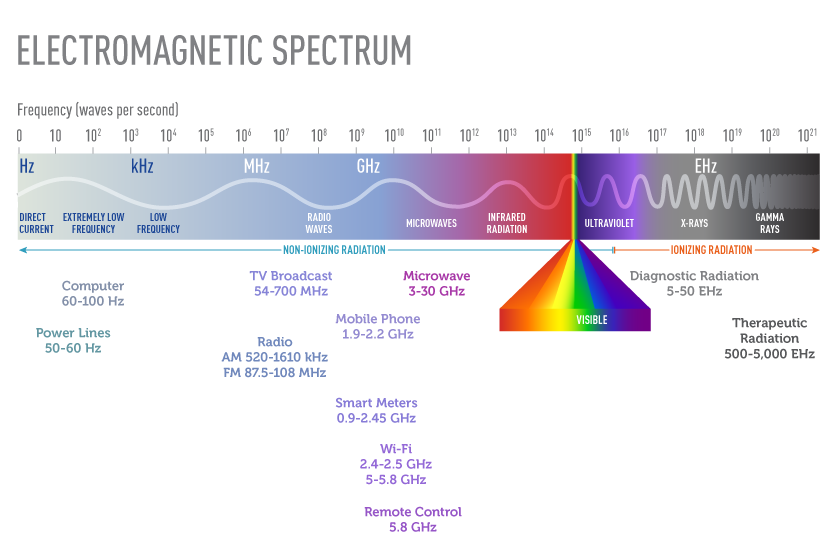
What is extremely low frequency (ELF) radiation?
ELF radiation is at the low-energy end of the electromagnetic spectrum and is a type of non-ionizing radiation. Non-ionizing radiation doesn’t have enough energy to directly damage DNA. ELF radiation has even lower energy than other types of non-ionizing radiation, such as radiofrequency radiation and infrared and visible light.
ELF radiation doesn’t damage the DNA in cells the way ionizing radiation does. It is largely thought to be safe. However, experts are studying ELF to see if it could somehow affect cancer risk in other ways.
Electric and magnetic fields
Electromagnetic radiation is made of 2 parts:
- Electric fields are the forces acting on charged particles (parts of atoms), such as electrons or protons, which cause them to move. Electric current is the flow of electrons produced by an electric field.
- A magnetic field is created when charged particles are in motion.
With most types of radiation, the electric and magnetic fields are paired. Because they act as one, they are looked at together as an electromagnetic field (EMF). But with ELF radiation, the magnetic field can exist and act alone, as can the electric field, and the two are often studied separately.
The possible link between EMFs and cancer has been a subject of debate for several decades. It's not clear exactly how non-ionizing EMFs could increase cancer risk. Plus, people are all exposed to different amounts of these fields at different times, so the issue has been hard to study.
Do power lines and other sources of ELF radiation cause cancer?
Concerns that ELF radiation from power lines and other sources might cause health problems, including cancer, have been around for many years.
What expert agencies say
Several national and international agencies study different exposures in the environment to determine if they are carcinogenic. In general, the American Cancer Society (ACS) does not determine whether something should be considered a carcinogen (something that can cause cancer). Instead, ACS looks to other respected organizations for help with this.
Based on animal and human evidence, some expert agencies have evaluated the potential cancer-causing nature of ELF radiation.
- The International Agency for Research on Cancer (IARC) is part of the World Health Organization (WHO). One of its major goals is to identify causes of cancer. It considers the evidence for ELF magnetic and electric fields separately. IARC has classified ELF magnetic fields as “possibly carcinogenic to humans.” It has classified ELF electric fields as “not classifiable as to their carcinogenicity to humans.”
- The US National Institute of Environmental Health Sciences (NIEHS) describes the scientific evidence suggesting that ELF exposure poses a health risk as “weak”. But the agency notes that ELF can’t be recognized as entirely safe and considers it to be a “possible” human carcinogen.
- The European research group Advanced Research on Interaction Mechanisms of electroMagnetic exposures with Organisms for Risk Assessment (ARIMMORA) has concluded that their studies were consistent with the previously established IARC classification of ELF magnetic fields as “possibly carcinogenic.”
What studies show
Researchers use 2 main types of studies to try to figure out if something causes cancer.
- Lab studies are done using lab animals or cells in lab dishes.
- Studies in people look for patterns over time.
Often, neither type of study provides enough evidence on its own. Experts usually look at both types of studies when trying to figure out if something can cause cancer.
Studies in the lab
Studies have looked at the possible effects of ELF magnetic fields (ELF-MF) on cancer in rats and mice. These studies exposed the animals to magnetic fields much stronger than what people are normally exposed to. Most of these studies have found no increase in the risk of any type of cancer.
One study did show an increased risk of tumors that start in thyroid cells, called C-cells, in male rats at some exposures. This increased risk was not seen in female rats or in mice and was not seen at the highest field strength. These inconsistencies, and the fact that these findings were not seen in the other studies, make it hard for scientists to conclude that the observed increased risk of tumors is from ELF radiation.
Other studies in mice and rats have looked specifically for increases in leukemia and lymphoma as a result of exposure to ELF radiation. Mixed results have been seen. One study noted a small increase in mice getting leukemia, but not rats.
Although there is no clear link between ELF-MF and cancer in animal studies, some evidence from animal and cell-based research shows that ELF-MF may affect living organisms in some ways. For example:
- Some studies suggest that at certain levels of exposure, ELF-MF may affect how information from genes is used for cellular processes.
- Some studies have noted that ELF-MF might stress cells, which could lead to the creation of reactive oxygen species inside the cells.
Results from different studies looking at these ideas have been inconsistent. And many studies have not found that ELF has any biological impact.
Studies in people
Studying the effects of ELF radiation in people can be hard, for many reasons.
Exposure to ELF radiation is very common, so it’s not possible to compare people who have been exposed and those who have not. Instead, studies try to compare people exposed to higher levels versus lower levels.
It is hard to determine how much ELF radiation a person has been exposed to, especially over a long period. The effects of ELF radiation aren’t thought to add up over time. And there is no test that can measure how much exposure a person has had.
Researchers can get a snapshot of ELF exposures in different ways, but none of these are perfect. They can:
- Have a person wear a device that records their exposure levels over hours or days
- Measure the magnetic or electrical field strength in a person’s home or workplace settings
- Estimate exposure based on the wiring configuration of someone’s workplace or home
- Estimate exposure based on how far someone’s home or workplace is from power lines
All these methods, however, result in exposure estimates with a lot of uncertainty. They usually don't account for a person’s ELF exposures while in other places. They also don’t measure ELF exposures in every location where a person has ever lived or worked over their lifetime.
There’s no good way to accurately estimate someone’s long-term exposure, which is most important when looking for possible effects on cancer risk.
Some studies have looked at possible links between ELF exposures in adults and cancer. Most have not found a link, although a small number have suggested a possible link.
Studies in children
- Some studies have looked at a possible link between ELF radiation from magnetic fields in the home and the risk of childhood leukemia. Past studies have had mixed results. A more recent study found no increased risk of leukemia and that the link between leukemia and magnetic fields has declined over time.
- Studies looking at the effect of ELF electric fields on childhood leukemia risk have not found a link.
- Studies evaluating the risk of childhood brain tumors and ELF magnetic fields have mixed results.
- Studies have generally not found any strong links between ELF electric or magnetic fields and other types of childhood cancers.
How are people exposed to ELF radiation?
Generating, transmitting, distributing, and using electricity all expose people to ELF radiation, which can come from power lines, household wiring, or any electrical device. This can include anything from refrigerators and vacuum cleaners to televisions and computer monitors (when they are on). Even electric blankets expose people to ELF radiation.
How much electromagnetic radiation you are exposed to depends on:
- The strength of the EMF
- Your distance from the source of the field
- The length of time you are exposed
The highest exposure occurs when a person is very close to a source putting out a strong field and stays there for a long time.
Can I avoid or limit my exposure to ELF radiation?
It’s not clear that exposure to ELF radiation is harmful. And it’s not possible to avoid all exposure to EMFs. But there are things you can do to lower your exposure if you are concerned.
The NIEHS recommends that people who are concerned about their exposure to EMF and ELF radiation:
- Find out where their major EMF sources are
- Move away from them or limit the time spent near them.
For example, moving even an arm’s length away from a source can dramatically lower exposure to its field.
Power lines
People who are concerned about ELF radiation exposure from high-power electrical lines should keep in mind that the intensity of any exposure goes down notably as you get farther away from the source. On the ground, the strength of the electromagnetic field is highest directly under the power line. As you get farther away, you are exposed to less and less, with the level eventually matching normal home background levels. The electromagnetic field directly under a power line is typically in the range of what you could be exposed to when using certain household appliances.
If you are concerned about your exposure to electromagnetic sources around you (including power lines), you can measure the field strength with a device called a gaussmeter.
To learn more
The following organizations may offer helpful information.
Environmental Protection Agency (EPA)
Website: www.epa.gov
National Cancer Institute (NCI)
Toll-free number: 1-800-422-6237 (1-800-4-CANCER)
Website: www.cancer.gov
Electromagnetic Fields and Cancer: www.cancer.gov/about-cancer/causes-prevention/risk/radiation/electromagnetic-fields-fact-sheet
- Written by
- References

The American Cancer Society medical and editorial content team
Our team is made up of doctors and oncology certified nurses with deep knowledge of cancer care as well as editors and translators with extensive experience in medical writing.
Amoon AT, Swanson J, Magnani C, et al. Pooled analysis of recent studies of magnetic fields and childhood leukemia. Environ Res. 2022; 204, Part A:111993.
Amoon AT, Crespi CM, Ahlbom A, et al. Proximity to overhead power lines and childhood leukaemia: An international pooled analysis. Br J Cancer. 2018;119(3):364-373.
Brabant C, Honvo G, Demonceau C, et al. Effects of extremely low frequency magnetic fields on animal cancer and DNA damage: A systematic review and meta-analysis. Progress in biophysics and molecular biology. 2025. 195:137–156. https://doi.org/10.1016/j.pbiomolbio.2024.12.005
Carlberg M, Koppel T, Ahonen M, Hardell L. Case-control study on occupational exposure to extremely low-frequency electromagnetic fields and the association with acoustic neuroma. Environ Res. 2020;187:109621.
Carlberg M, Koppel T, Ahonen M, Hardell L. Case-control study on occupational exposure to extremely low-frequency electromagnetic fields and glioma risk. Am J Ind Med. 2017;60(5):494-503.
Carles C, Esquirol Y, Turuban M, et al. Residential proximity to power lines and risk of brain tumor in the general population. Environ Res. 2020;185:109473.
Cecchetto C, Maschietto M, Boccaccio P, Vassanelli S. Electromagnetic field affects the voltage-dependent potassium channel Kv1.3. Electromagn Biol Med. 2020;39(4):316-322.
Correa-Correa V, Núñez-Enríquez JC, Mezei G. et al. Extremely low-frequency magnetic fields (ELF-MF) and radiofrequency: Risk of childhood CNS tumors in a city with elevated ELF-MF exposure. Environ Res. 2025;286(Pt 2),122858. https://doi.org/10.1016/j.envres.2025.122858Bottom of Form
Environmental Protection Agency. Radiation basics. Updated February 19, 2026. Accessed at https://www.epa.gov/radiation/radiation-basics on March 3, 2026.
Erdal N, Gürgül S, Celik A. Cytogenetic effects of extremely low frequency magnetic field on Wistar rat bone marrow. Mutat Res. 2007;630(1-2):69-77.
European Commission; CORDIS. Final Report Summary- ARIMMORA (Advanced Research on Interaction Mechanisms of electroMagnetic exposures with Organisms for Risk Assessment). 2015. Accessed at https://cordis.europa.eu/project/id/282891/reporting on May 28, 2026.
Giorgi G, Del Re B. Epigenetic dysregulation in various types of cells exposed to extremely low-frequency magnetic fields. Cell Tissue Res. 2021;386:1–15.
Habash M, Gogna P, Krewski D, Habash RWY. Scoping review of the potential health effects of exposure to extremely low-frequency electric and magnetic fields. Crit Rev Biomed Eng. 2019;47(4):323-347.
Huss A, Spoerri A, Egger M, Kromhout H, Vermeulen R; Swiss National Cohort. Occupational extremely low frequency magnetic fields (ELF-MF) exposure and hematolymphopoietic cancers - Swiss National Cohort analysis and updated meta-analysis. Environ Res. 2018;164:467-474.
International Agency for Research on Cancer. IARC Monographs on the Evaluation of Carcinogenic Risks to Humans. Volume 80: Non-Ionizing Radiation, Part 1: Static and Extremely Low-Frequency (ELF) Electric and Magnetic Fields. 2002. Accessed at http://monographs.iarc.fr/ENG/Monographs/vol80/index.php on March 4, 2026.
Karimi A, Ghadiri Moghaddam F, Valipour M. Insights in the biology of extremely low-frequency magnetic fields exposure on human health. Mol Biol Rep. 2020;47(7):5621-5633.
Khan MW, Juutilainen J, Auvinen A, et al. A cohort study on adult hematological malignancies and brain tumors in relation to magnetic fields from indoor transformer stations. Int J Hyg Environ Health. 2021;233:113712.
Khan MW, Juutilainen J, Naarala J, Roivainen P. Residential extremely low frequency magnetic fields and skin cancer. Occup Environ Med. 2021:oemed-2021-107776.
Kheifets L, Ahlbom A, Crespi CM, et al. Pooled analysis of recent studies on magnetic fields and childhood leukaemia. Br J Cancer. 2010;103:1128-1135. Erratum in: Br J Cancer. 2011;104(1):228.
Kheifets L, Crespi CM, Hooper C, et al. Residential magnetic fields exposure and childhood leukemia: A population-based case-control study in California. Cancer Causes Control. 2017;28(10):1117-1123.
Koeman T, van den Brandt PA, Slottje P, et al. Occupational extremely low-frequency magnetic field exposure and selected cancer outcomes in a prospective Dutch cohort. Cancer Causes Control. 2014;25(2):203-214.
Lai H. Genetic effects of non-ionizing electromagnetic fields. Electromagn Biol Med. 2021;40(2):264-273.
National Cancer Institute. Electromagnetic fields and cancer. Updated May 30, 2022. Accessed at https://www.cancer.gov/about-cancer/causes-prevention/risk/radiation/electromagnetic-fields-fact-sheet on March 4, 2026.
National Institute of Environmental Health Sciences. Electric and magnetic fields. Updated December 22, 2025. Accessed at https://www.niehs.nih.gov/health/topics/agents/emf on March 4, 2026.
National Institute of Environmental Health Sciences. Electric and Magnetic Fields Associated with the Use of Electric Power. 2002. Accessed at www.niehs.nih.gov/health/materials/electric_and_magnetic_fields_associated_with_the_use_of_electric_power_questions_and_answers_english_508.pdf on March 6, 2026.
National Institute of Environmental Health Sciences. Health Effects from Exposure to Power-Line Frequency Electric and Magnetic Fields.1999. Accessed at https://www.niehs.nih.gov/health/assets/docs_p_z/report_powerline_electric_mg_predates_508.pdf on March 6, 2026.
Panagopoulos DJ, Karabarbounis A, Yakymenko I, Chrousos GP. Human‑made electromagnetic fields: Ion forced‑oscillation and voltage‑gated ion channel dysfunction, oxidative stress and DNA damage (Review). Int J Oncol. 2021;59(5):92.
Pedersen C, Johansen C, Schüz J, Olsen JH, Raaschou-Nielsen O. Residential exposure to extremely low-frequency magnetic fields and risk of childhood leukaemia, CNS tumour and lymphoma in Denmark. Br J Cancer. 2015;113:1370-1374.
Saliev T, Begimbetova D, Masoud AR, Matkarimov B. Biological effects of non-ionizing electromagnetic fields: Two sides of a coin. Prog Biophys Mol Biol. 2019 ;141:25-36.
Salvan A, Ranucci A, Lagorio S, Magnani C; SETIL Research Group. Childhood leukemia and 50 Hz magnetic fields: Findings from the Italian SETIL case-control study. Int J Environ Res Public Health. 2015 ;12(2):2184-2204.
Schuermann D, Mevissen M. Manmade electromagnetic fields and oxidative stress - Biological effects and consequences for health. Int J Mol Sci. 2021;22(7):3772.
Schüz J. Exposure to extremely low-frequency magnetic fields and the risk of childhood cancer: Update of the epidemiological evidence. Prog Biophys Mol Biol. 2011;107:339-342.
Seomun G, Lee J, Park J. Exposure to extremely low-frequency magnetic fields and childhood cancer: A systematic review and meta-analysis. PLoS One. 2021;16(5):e0251628.
Talibov M, Guxens M, Pukkala E, et al. Occupational exposure to extremely low-frequency magnetic fields and electrical shocks and acute myeloid leukemia in four Nordic countries. Cancer Causes Control. 2015;26(8):1079-1085.
Toledano MB, Shaddick G, de Hoogh K, et al. Electric field and air ion exposures near high voltage overhead power lines and adult cancers: A case control study across England and Wales. Int J Epidemiol. 2020;49 Suppl 1(Suppl 1):i57-i66.
Turner MC, Benke G, Bowman JD, et al. Occupational exposure to extremely low-frequency magnetic fields and brain tumor risks in the INTEROCC study. Cancer Epidemiol Biomark Prev. 2014;23(9):1863–1872.
Zhang Y, Lai J, Ruan G, Chen C, Wang DW. Meta-analysis of extremely low frequency electromagnetic fields and cancer risk: A pooled analysis of epidemiologic studies. Environ Int. 2016;88:36-43.
Last Revised: June 22, 2026
American Cancer Society medical information is copyrighted material. For reprint requests, please see our Content Usage Policy.
American Cancer Society Emails
Sign up to stay up-to-date with news, valuable information, and ways to get involved with the American Cancer Society.